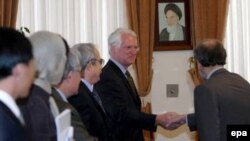
Envoys to Tehran at their August 22 meeting with Ali Larijani (epa)
August 23, 2006 (RFE/RL) -- The sponsors of an incentives package to limit Iran's nuclear program are studying Tehran's extensive response with the deadline for a UN-imposed halt to sensitive activities just over a week away.
Reuters quoted French Foreign Minister Philippe Douste-Blazy as saying today that those countries will need "a few days" to pore over Iran's response.
Iran's top nuclear negotiator, Ali Larijani, did not provide details of the document's contents to the public when he delivered it on August 22.
Larijani was quoted as saying that Tehran is prepared for "serious talks" concerning its nuclear program, but he made no comment on the crucial issue of uranium enrichment.
Iran's response followed weeks of insistence by Iranian officials that the country will not halt uranium enrichment, which the UN Security Council has demanded it do by the end of August or face possible sanctions.
The five permanent members of the Security Council -- China, France, Russia, the United Kingdom, and the United States -- plus Germany crafted the incentives package in an effort to discourage an Iranian nuclear program that some in the West believe is aimed at developing nuclear weapons.
'Long, Complex Document'
"It is a very long, complex document and we are studying it," Reuters quoted Douste-Blazy as saying, citing France 2 television. "In a few days, along with our European, American, Russian, and Chinese partners, we will say what we think and what we will do at the UN Security Council."
Russia and China -- whose countries have extensive economic ties to Iran -- have signaled reluctance to impose sanctions.
China has urged Iran to be constructive and to consider international concerns, Reuters reported, while Russia said it is ready to participate in further negotiations on the matter.
The United States, which has vowed not to allow Iran to obtain nuclear weapons, has not disguised its desire to seek sanctions if Tehran "thumbs its nose" at the UN Security Council.
"We will obviously study the Iranian response carefully," John Bolton, U.S. ambassador to the UN, said after the Iranian response was delivered. "[But] we are also prepared -- if it does not meet the terms set by the Perm-5 (five permanent veto-holding members of the UN Security Council) foreign ministers -- to proceed here in the Security Council."
Bolton said that if Iran fails to comply with Security Council demands, "It really is a test for the [Security] Council, and we'll see how it responds."
The United States and other governments have accused Iran of seeking to develop nuclear weapons. Iranian officials have dismissed those fears, saying they have a right to peaceful nuclear technology and want only to fuel nuclear power plants.
The UN nuclear watchdog, the International Atomic Energy Agency (IAEA), referred Iran's nuclear dossier to the UN Security Council after it concluded that Tehran had obfuscated and failed to provide convincing evidence that its nuclear program is intended strictly for civilian purposes.