



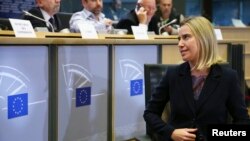
More quotes from Federica Mogherini, the EU's commissioner-designate for foreign policy, speaking on Monday during her confirmation hearing at the European Parliament in Brussels.
"I think that we have to work day by day by day with the Ukrainian authorities, with [Ukrainian] President [Petro] Poroshenko, to try and make his own efforts of dialogue and diplomacy work -- his own efforts. The efforts of the president of Ukraine, the efforts of the new parliament in Ukraine once they will have the elections in a couple of weeks. That is going to be our role, I think."
***
"We need to work maybe even on increasing the sanctions. As we can increase the sanctions if things get worse, we could lift the sanctions if things get better. That is the flexibility of the instrument. But we will need to increase more and more the support to the political efforts that the Ukraine leadership is trying to achieve. Difficult, almost impossible as it is, but if we do not stand at their side and help them in trying to achieve this with the difficult and complicated, tense political situation they have, dealing with an electoral campaign, with the winter that is going to probably a nightmare from the economic point of view from the energy point of view."
***
"With the elections coming up [in Ukraine], with the war on their territory -- if we do not stand at their side when they say we need to try and find a political solution, who else will?"
***
"I think the attempts that the Russians are trying to have [in the Eastern Neighborhood countries] is that of showing that the European choice is bad for the people in those countries. That is why I insist so much in supporting those countries' transition in delivering to their citizens. If we show and if we manage to show together that the European choice is good for the citizens in these countries -- I think of Moldova, with their elections coming up now, difficult ones. I think of Georgia. I think, obviously, of Ukraine."
***
"If the European choice is delivering concrete, good results for the people -- that would be an attractive, a pull factor, also for areas or parts of their societies that are probably thinking in a different way today."
On Russia's annexing Ukraine's Crimea:
"No doubt among us, I think we should be very clear, being whatever our political family, or our member states, our personal views, no doubt that occupying or annexing part of a country, changing the borders by force and having troops in a different country, is by all means a violation of international principles that we all agreed on and that are the basis of our common work."
On EU sanctions against Russia:
"We have adopted sanctions. Have the sanctions been effective on the Russian economy? Yes, yes. I think that the Russian economy is starting to suffer quite a lot in that. So if the question is: Have the choices we have made so far been effective on the Russian economy? Yes. Are they effective on Russian political decisions? I think we still have a question mark there and the Ukrainians themselves have a question mark there."
Speaking about Russia:
"I don't have that much experience when it comes to bears. Maybe someone from the Nordic area here might be more experienced than me. But I would say that we need a mix of assertiveness and diplomacy. The balance would also depend on the reaction of the bear."
***
"If Russia attempts to take the corridor [between Russia and Crimea] I think that first of all we would need to stay united. It is true that [EU] member states have had different sensibilities -- let's say -- on how to manage the crisis, but we managed to stay together. Among member states and with the other partners in the rest of the world. This is the most valuable added value that we have -- staying united. I think we will need to prevent this from happening rather than thinking how would we react if that happens."
Good morning. We are now resuming our live-blogging of the Ukraine crisis for Tuesday, October 7, 2014.
We are now closing the live blog for today. Don't forget that you can keep abreast of all our live coverage here. We'll leave you with this tweet from Ukrainian President Petro Poroshenko, thanking EU foreign policy chief-designate Federica Mogherini for pledging support for Ukraine:
Федеріка Могеріні підтримує реформування України та мій мирний план. Вдячний за підтримку. http://t.co/pU3q1wJAbw
— Петро Порошенко (@poroshenko) October 6, 2014
Wall Street Journal: Dollars hard to come by in #Ukraine, even for central banker http://t.co/y5q4DIoEt4
— Kyiv Post (@KyivPost) October 6, 2014
#Poroshenko sacks Chief of Border Service Mykola #Lytvyn. A dream come true for thousands of soldiers, volunteers http://t.co/4XJXx7utjm
— Myroslava Petsa (@myroslavapetsa) October 6, 2014
RFE/RL's Rikard Jozwiak has filed this short item on Federica Mogherini's comments today at the European Parliament:
Federica Mogherini, the European Union Commissioner-designate for foreign policy said during her confirmation hearing at the European Parliament that the EU needs to pay greater attention to its eastern neighbors.
Mogherini said the EU should offer "full support to Ukraine in terms of security, institutional reform, political process" and economic and energy challenges.
She said the EU needed to support other Russian neighbors such as Moldova and Georgia and work more closely with Armenia, Azerbaijan, and Belarus.
Mogherini said that while relations with Russia are strained at the moment, Russia remains "a strategic country in the world" and the EU needs to consider its ties with Russia "in the next five years."
Mogherini said "it is going to be crucial that we are going to engage with Russia for our own security."
Mark Adomanis has been taking issue in "The Moscow Times" with all those Russia analysts who believe Putin's stance on Ukraine will turn out to be a fatal miscalculation in the long run:
All things being equal, I think that Putin probably has miscalculated, and that many of the policies implemented over the past few months are unlikely to achieve their stated goals. But there isn't absolute certainty that this is the case. It is possible that, whether we like it or not, the Russian government will accomplish its goals in Ukraine at a cost that is considered acceptable by the majority of Russian society.
The crisis in Ukraine has been going on for about six months. This is, in today's media environment, something approximating an eternity. Despite what seems like clear evidence of the involvement, and death, of Russian troops, and despite a sharp slowdown in already-low economic growth in Russia, the political damage that I and many others expected Putin to suffer is not appearing.
According to the Levada Center pollster, Putin's approval rating in September was a stratospheric 86 percent, within two points of the all-time high it reached in the fall of 2008. This might not be the most deep-rooted popularity in the entire world, but Putin is as popular now as he has ever been.
Is it possible that this will continue or, as Shevtsova and others have argued, is this guaranteed to end in tears? I want to lay out a theory that, while not the most likely outcome, seems plausible, or at least plausible enough to warrant serious consideration. It involves my favorite subject — demography — and its impact on the Russian labor market.
One of the main reasons that the sharp decrease in Russian economic growth has not caused much pain for the average Russian is because unemployment has continued to fall. Unemployment is currently below 5 percent, the lowest it has been in Russia's entire post-Soviet history. Things are as close to full employment as they are likely to get.
But how on earth could unemployment fall with such a paltry level of overall economic growth? It is mostly because Russia's active labor force is now shrinking: The older generation is starting to retire, and the younger one that is taking its place is much smaller.
What all this means is that, over the next several years, Russia will face a serious labor crunch and there is likely to be sustained upward pressure on wages even with little or no growth in total output. In such an environment, the Kremlin is unlikely to be "punished" for the worsening economic situation because, for the average Russian, it simply won't feel like the economy is performing all that badly.
Read the entire article here
Donetsk morgue. 35 new bodies today, including a five year old girl. I'll spare you the photos, but grim stuff. pic.twitter.com/dB4HnHFGRP
— Oliver Carroll (@olliecarroll) October 6, 2014
Ukrainian military doctor claims Russian airborne troops officer saved 90 Ukrainian POWs from execution at Ilovaysk http://t.co/YTx7zufCPQ
— Leonid Ragozin (@leonidragozin) October 6, 2014