



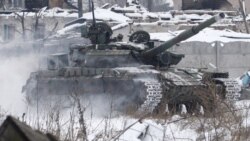
Ukraine's Hromadske TV says four mortar attacks have been launched on Donetsk airport:
Бойовики здійснили чотири мінометні удари по аеропорту Донецька – прес-центр АТОhttp://t.co/z16zxwxrKf pic.twitter.com/sD1COCgVBW
— Hromadske.TV (@HromadskeTV) October 9, 2014
Kiev taxi: shoot all our political leaders, bring in new ones, shoot them all, then new ones, shoot them, then MAYBE something will change
— Gulliver Cragg (@gullivercragg) October 9, 2014
Good morning. We'll start the live blog today with this update from RFE/RL's news desk:
Ukraine has urged the European Union not to accept pro-Russian rebels carving out a de facto state in the east of the country, warning it could destabilize Europe.
Foreign Minister Pavlo Klimkin also urged Moscow to dissuade separatists from holding their own elections in the eastern regions of Donetsk and Luhansk next month.
Speaking to Reuters on October 8, Klimkin said local people would do better to vote in local elections organized by Kyiv in December.
Klimkin said "fake elections" organized by the rebels in Donetsk and Luhansk would reinforce impressions that eastern Ukraine is becoming a long-term "frozen conflict" like the Moscow-backed breakaway regions of Transdniester in Moldova or Abkhazia and South Ossetia in Georgia.
Klimkin said he was not trying to "blackmail" Western European states into stepping up actions, such as economic sanctions, against Russia, or to get NATO to increase non-military assistance to Kyiv.
Klimkin was speaking in Brussels, where he and other senior Ukrainian officials met EU and NATO counterparts.
Among those with whom Klimkin held talks was NATO's new Secretary-General Jens Stoltenberg.
"The NATO secretary general has changed, but the priority importance of Ukraine remains the same," Klimkin tweeted after the meeting.
Klimkin said the country would seek European Commission funding to help eastern residents survive the winter with limited access to essential supplies.
In Washington, Ukrainian Central Bank chief Valeria Gontareva met with the boss of the International Monetary Fund (IMF) Christine Lagarde in hope of speeding up the delivery of a $17.1-billion loan and even expanding that amount.
Prime Minister Arseniy Yatsenyuk told his cabinet that Gontareva would ask the IMF "to modify its program taking current realities into account".
The two-year IMF arrangement is part of a global $27-billion package approved in April to help the new leaders avert bankruptcy and pull Ukraine out of its third recession in six years.
But the economic slide has only accelerated and the economy is now expected to shrink by up to nine percent this year.
Last month, the IMF itself warned Ukraine may need an additional $19 billion in short-term assistance should the conflict in the east stretch through the end of next year.
(Reuters, AFP)
That ends our live-blogging of the Ukraine crisis for Wednesday, October 8, 2014. Check back here in the morning for our continuing coverage or here for all the latest news.
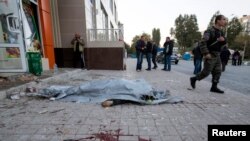
From Reuters:
At least one person was killed and three wounded when an artillery shell hit a shopping center in Donetsk, a city in east Ukraine controlled by pro-Russian separatists where fighting goes on despite a cease-fire.
A Reuters cameraman in Donetsk saw at least one body and counted three wounded people after the shell crashed through the roof of the shopping center, smashing food stalls.
The head of the separatist self-proclaimed Donetsk People's Republic, Alexander Zakharchenko, told a news conference nine people were wounded in the shelling.
"I don't know how this cease-fire is working here, or is it not working at all?" he said.
Kyiv denies shelling civilian areas and both sides say they are observing the September 5 cease-fire, which has generally brought a respite from fighting in eastern Ukraine.
But continued fighting in Donetsk, including at the city airport, between Ukrainian troops and rebel fighters is increasing pressure on the shaky truce.
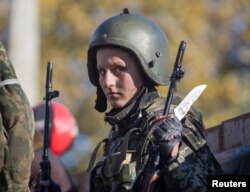
An excerpt from a Reuters report titled "Women Take Up Arms On Both Sides Of Conflict In East Ukraine" by Gabriela Baczynska:
DONETSK/DNIPROPETROVSK, Ukraine, Oct 8 (Reuters) -- Before fighting broke out in eastern Ukraine, Irina was a croupier in a casino who never dreamt of taking up arms. Now she is gambling with her life.
Using the nom de guerre "Gaika", a cartoon character that translates as Gadget, she has joined an artillery unit in a pro-Russian separatist group fighting government forces.
"When your home is being destroyed, everything that is dear to you, friends, work ... It's about character. Girls who go into combat are real Russian women," she said in an interview, explaining why she joined up.
It has proved a tough experience but she has no regrets.
"Howitzers, large vehicles, the noise is what I will remember most," she said. "Painful memories go away. We try to focus on the positive, joyful, meeting friends. There are so many friends around now, the war is bringing people closer."
Her unit, based outside her hometown of Donetsk, the main rebel stronghold in eastern Ukraine, is part of a rebel militia called Oplot and includes six women - herself, three medics, a fighter and a reconnaissance specialist.
"I had doubts before allowing women in," said their commander Yesaul, a Cossack from the nearby Luhansk region.
"But now I actually have more trust in them then in men. Women don't drink and I am sometimes seriously worried seeing my men's condition when they are relaxing after a mission."
Read the full report here.
Here's what the Estonian president had to say about that essay by Lawrence Freedman, excerpted below:
An excerpt from "Ukraine And The Art Of Limited War," an essay by Lawrence Freedman:
Ukrainian elections scheduled for 26 October are likely to see Russian sympathisers in the Kiev parliament marginalised. Ukraine finds itself severely weakened, with its economy in freefall and key territories out of its control. Poroshenko has accepted the need for compromise, in terms of more autonomy for the troubled regions and respect for Russian concerns. But he will not satisfy demands for complete separation or abandon closer relations with the EU. For its part, Russia therefore must decide on its own priorities: To protect Crimea, to prevent the integration of a truncated “Novorossiya” into Ukraine or to keep Ukraine away from the EU.
This uncertainty about the future confirms President Obama’s proposition that there cannot be a “military solution.” This became something of a mantra among NATO leaders up to and around the alliance’s Cardiff summit of early September 2014, taking place at the same time as the cease-fire negotiations in Minsk. Its effect at the time was to signal to both domestic audiences and Ukraine that NATO members were not going to get militarily involved. Combined with heavy combat losses, this may well have convinced Poroshenko not to continue to push back militarily against Russia and the separatists, and accept a cease-fire. At most, NATO countries have been prepared to supply forms of military assistance to help the Ukrainians resist further Russian advances.
This mantra was at one level self-evident but at another missed the point. Wars are political struggles and therefore any solution will be marked by a political settlement. The military situation on the ground, however, will hardly be irrelevant. In this case, September’s tentative settlement was far more advantageous for the Russian position as a result of its direct intervention than it would have been without it.
The full essay can be read here.