



And here's a little taster of Bildt's article:
Most of the attention given to European security issues today is focused on the Balkans. But the stability concerns that the West must address in the Baltic Sea area are no less important. For half a century, the Soviet empire stretched its geopolitical power deep into Central Europe and the Balkans, posing a potential threat to the West at many points. Russia now borders Western Europe only in the Nordic and Baltic regions. More than any other part of the former Soviet empire, Russia’s policies toward the Baltic countries will be the litmus test of its new direction. Central to these concerns is the future relationship between Russia and the three once-again independent countries of Estonia, Latvia, and Lithuania.
The way these problems are handled will test the emerging frameworks of Western security cooperation and provide crucial test cases for three important and interrelated international issues. Foremost, Russian conduct toward these states will show the true nature of Russia’s commitment to international norms and principles. If Moscow fully accepts the independence of the Baltic states and fully respects their rights, one can be sure that Russia has entered the family of nations. But if Moscow questions their sovereignty or undermines their independence, that would signal that Russia might once again become a threat to the international system.
Second, the European Union’s attitude toward the Baltic states will be a gauge of its ability to pursue the integration process while also establishing a working relationship with Russia.
Third, the security concerns of Estonia, Latvia, and Lithuania will test the readiness and ability of the United States to influence Russian policy and contribute to the new security order in Central and Eastern Europe. The stakes are high, for the credibility of the West has been severely tested in the Balkans. It could face even more daunting challenges in the Baltic region if we do not secure stability in the relationship between Russia and the three Baltic states.
It seems Google has updated its satellite images of Donbass since fighting broke out in the region. Some of the pictures are quite telling.
Here's an update from RFE/RL's news desk:
Officials from Russia, Ukraine, and the European Union are meeting in Brussels today to try to resolve a gas dispute between their two countries.
The meeting between Russian Energy Minister Aleksandr Novak and his Ukrainian counterpart, Yuri Prodan, is being brokered by European Energy Commissioner Guenther Oettinger.
Russia raised the price it charges Kyiv for natural gas after Ukraine's pro-Russia President Viktor Yanukovych was ousted in February, then halted gas supplies to Ukraine in June when Kyiv failed to pay the higher price.
Talks in Milan last week between the Russian and Ukrainian presidents -- Vladimir Putin and Petro Poroshenko respectively -- apparently made some progress.
Poroshenko said a preliminary agreement had been reached on a price of $385 per 1,000 cubic meters until the end of March -- $100 less than Russia had originally demanded.
(AFP, Reuters)
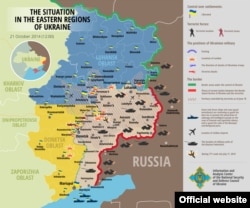
Here is today's situation map of eastern Ukraine by the National Security and Defense Council:
This video, uploaded to YouTube on October 20, is believed to show mortar shelling of residential districts of Donetsk. The video says it was by the Ukrainian Army, but of course that is impossible to verify.