

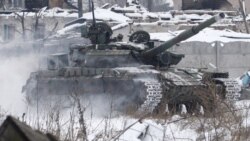
A wonderful video from RFE/RL's Ukrainian Service:


It’s been a tumultuous year for Halyna Trofanyuk. At the beginning of the year she traveled from her small village in western Ukraine to brave freezing conditions and brutal security forces at the protests in Kyiv. It was a decision that brought her to the very center of Ukraine’s political drama, but which also had far-reaching consequences for her personal life: a relationship won and lost, a grandson conceived on the Maidan. But what future will the baby have? Halyna is not optimistic -- and now says she’s sometimes ashamed to have joined the protests.
From RFE/RL's News Desk:
Foreign Minister Sergei Lavrov says Moscow will not pressure its "allies" to recognize Crimea as a part of Russia or to join it in recognizing Georgia's breakaway regions of South Ossetia and Abkhazia regions as independent states.
In a question-and-answer session following an address to Russia's lower parliament house on November 19, Lavrov said the security and economic groupings that Russia is currently building with other former Soviet republics are aimed to "protect the legitimate interests of our countries' security."
He said that "on some issues, including the status of Abkhazia, South Ossetia, or Crimean history, we are not making our partners share our assessments 100 percent, as we do not want to put them into an awkward position if for some reason it is uncomfortable for them."
The remarks appeared aimed to assuage concerns among ex-Soviet republics that Russia, which annexed Crimea in March in a move that Kyiv and the West say was illegal, wants to diminish their sovereignty or control their foreign policy.
BREAKING: Russian Foreign Minister Sergei Lavrov says that the conflict in eastern Ukraine is an internal issue and "all attempts to turn Russia into a party to the conflict are counterproductive and have no chance of success."
More from RFE/RL's News Desk on Lavrov's address to the State Duma today:
Russia has lashed out at the West over Ukraine, saying the political turmoil and armed conflict there is the result of what Foreign Minister Sergei Lavrov called 25 years of efforts by Western countries to strengthen their own security at the expense of others.
Addressing Russia's lower parliament house on November 19, Lavrov said the West "must support the process of mutually acceptable agreements instead of supporting the party of war in Kyiv, closing its eyes on outrageous human rights violations, lawlessness, and war crimes."
Lavrov tempered the message by saying that there is no alternative to cooperation between Russia and the European Union.
But he blamed the EU for the strains and said Russia's relations with the West must be based on the assumption of equality, echoing a demand President Vladimir Putin set out on the first day of his third term in 2012.
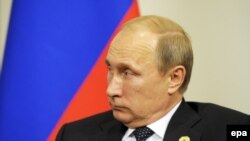
From Bloomberg's "Putin Said to Back Crackdown on Corruption as Sanctions Bite," by Evgenia Pismennaya and Irina Reznik:
Vladimir Putin sat motionless as the minister, seizing on the Russian leader’s first major meeting with his economic team in months, itemized the challenges.
Recession is imminent, inflation is getting out of hand and the ruble and oil are in free fall, Economy Minister Alexei Ulyukayev told Putin, according to people who attended the meeting at the presidential mansion near Moscow in mid-October. Clearly, Ulyukayev concluded, sanctions need to be lifted.
At that, Putin recoiled. Do you, Alexei Valentinovich, he asked, using a patronymic, know how to do that? No, Vladimir Vladimirovich, Ulyukayev was said to reply, we were hoping you did. Putin said he didn’t know either and demanded options for surviving a decade of even more onerous sanctions, leaving the group deflated, the people said.
Days later, they presented Putin with two variants. To their surprise, he chose an initiative dubbed “economic liberalization,” aimed at easing the financial burden of corruption on all enterprises in the country, the people said. It was something they had championed for several years without gaining traction.
The policy, which Putin plans to announce during his annual address to parliament next month, calls for a crackdown on inspections and other forms of bureaucratic bullying that cost businesses tens of billions of dollars a year in bribes and kickbacks, the people said. It entails an order from the president to end predatory behavior, with prosecution being the incentive for compliance, they said.
“Wastefulness, an inability to manage state funds and even outright bribery, theft, won’t go unnoticed,” Putin said at a meeting with supporters in Moscow yesterday.
Read the full story here.
BREAKING: Russian Foreign Minister Sergei Lavrov says the Ukraine crisis is the result of what he calls 25 years of efforts by Western countries to strengthen their own security at the expense of others.
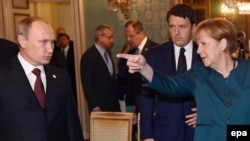
From "Germany's Merkel Toughens Tone With Russia's Putin," by the BBC's Jenny Hill:
The two leaders are said to have spoken over the telephone nearly 40 times since the Ukraine crisis began. During the G20 summit in Brisbane, Australia, Mrs Merkel spent hours in a private meeting with Mr Putin.
Then, on Monday, she addressed a think tank in Sydney.
Russia was "violating the territorial integrity and sovereignty of Ukraine", she said, and Europe would continue to apply pressure.
While she had long respected Russia's concerns about Ukraine moving closer to Nato, she argued it was "simply not acceptable to forbid a country" to sign a trade agreement with the EU.
Judy Dempsey from the Carnegie Europe think tank believes the German leader simply does not trust the Russian president.
"Merkel is not willing to give Putin the chance to save face, which some European diplomats and leaders might like, to get the Ukraine dossier off their desks," she says.
The German news magazine Spiegel agrees: "The chancellor believes that what Putin says and what Putin does have long since diverged."
The chancellor's speech in Australia has been judged within Germany as her most overtly critical of Mr Putin so far.
"Merkel throws down the gauntlet," exclaimed popular tabloid Bild. It described her speech as "hard hitting", which, for a leader renowned for her cautious public rhetoric, it was.
Read the full story here.
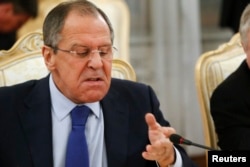
From RFE/RL's News Desk, to kick our live-blogging off for November 19:
Russian Foreign Minister Sergei Lavrov is expected to focus on the crisis in eastern Ukraine when he addresses the State Duma on November 19.
Ahead of his speech before Russia's lower house of parliament, Lavrov met with visiting German Foreign Minister Frank-Walter Steinmeier.
Both reportedly agreed on the need to return to the so-called Minsk protocol, a dialogue that involves the warring factions in Ukraine, as well as Russia and the OSCE.
But Steinmeier said he was not optimistic the Minsk protocol could change the situation on the ground in eastern Ukraine, where government forces are battling pro-Russian separatists.
Steinmeier traveled to Moscow from Kyiv where President Petro Poroshenko told him Russia had failed to uphold a September 5 cease-fire agreement.
NATO Secretary-General Jens Stoltenberg on November 18 accused Russia of a "serious military buildup" both inside eastern Ukraine and on the Russian side of the border.