



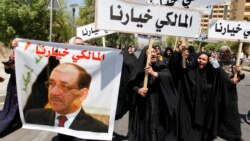
Iran 'most powerful external player' in Iraq
Hayder al-Khoei, an Iraq analyst at Chatham House, told Al Jazeera that the struggle for power in Iraq is far from over:
"Don't rule out Maliki yet. Politically he is finished, but he still controls elite security forces and a vast network inside the security and intelligence apparatus. If he wants to cause trouble, he can.”
Khoei also mentioned Iran’s significant role:
"Furthermore, even though the Americans, the [European Union] and the [United Nations] have come out with statements supporting Ibadi, Iran is the key actor because it is the most powerful external player in Iraq. They’ve been very quiet. They made crystal clear that the unity of the Shia bloc was a red line for them. Today it was crossed, and it remains to be seen how they will respond."
You can read the full story here.
British help
British Prime Minister David Cameron speaking about Britain's role in supporting the Kurdish forces against the Islamic State:
"I think the first thing is to deal with this desperate humanitarian situation with people who are exposed, starving, dying of thirst on this mountainside, getting them to a place of safety. Yes, of course we do support the Kurds and we should continue to support the Kurds, and in terms of the ammunition that they are getting Britain is going to be playing a role in helping to get that to them."
That concludes our live-blogging for today, Wednesday August 13. We will be back at 9:00 a.m. (Prague time) tomorrow. In the meantime, you can follow all our Iraq coverage here.
Welcome back to our live coverage of all the day's developments in Iraq.
U.S. Rescue Mission Unlikely
The U.S. has said a rescue mission of displaced people from Mount Sinjar in northern Iraq is unlikely after determining there are fewer people stranded there than previously thought.
The Pentagon said in a statement that U.S. officials who visited the mountain on August 13 said the several thousand people living there are in relatively good condition.
It was previously thought that there were tens of thousands of minority Yezidis and Christians on the mountain.
U.S. Defense Secretary Chuck Hagel credited airdrops of water and food of sustaining those on Mount Sinjar and said U.S. air strikes had pushed back Islamic State militants, allowing thousands to escape the mountain.
The United States had been considering a rescue mission on the mountain in the belief that their situation was dire.
Hagel said U.S. military and relief efforts will continue.
UN says humanitarian crisis at its highest level
The UN, however, sees a different picture to the one presented by U.S. officials.
UN special representative Nickolay Mladenov said yesterday that declaring Iraq a "Level 3 Emergency" will release additional goods and funds to help tens of thousands of people displaced by the IS.
Mladenov said Iraq was given the most serious level "given the scale and complexity of the current humanitarian catastrophe."
Mladenov said tens of thousands of people are reportedly still trapped on Sinjar Mountain "with health conditions quickly deteriorating." He said the situation in Dahuk, where more than 200,000 displaced Iraqis have fled, is also of "grave concern."
Iraq is the UN's fourth Level 3 humanitarian emergency, joining Syria, South Sudan and Central African Republic.
Meanwhile, IS militants remain just outside of Irbil, the capital of autonomous Kurdistan region.
Camps set up for displaced
Thousands of people have poured into camps in the autonomous Kurdistan region. The UN as well as a number of countries are trying to set up a number of camps to meet rising demand.