





ZAPORIZHZHYA, Ukraine – The welcoming smell of coffee and pastries wafts through Mother’s Farm cafe and shop in Ukraine's eastern city of Zaporizhzhya, a sign of business as usual. But with the front line of the war with Russia just 25 kilometers away, business is far from usual.
Mother's has kept its doors open despite several close calls, most recently on January 2 -- as outlined in a social media video by owner Yulia Matviyenko -- of plaster falling from the ceiling during a Russian strike nearby.
“Every business that remains in Zaporizhzhya and recovers after what is thrown at us deserves respect,” she told RFE/RL’s Ukrainian Service.
“We have already been taught over all these years to stand tall. And when the situation worsens, we become one big team. Strangers support each other,” she added.
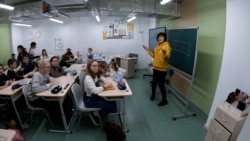

Matviyenko’s business is an example of economic resilience in a country battered by a relentless war that will see the fourth anniversary of Russia's full-scale invasion next month.
Its spirit of defiance is embodied by something every customer can handle -- a set of coffee cups inherited from a cafe in Kharkiv, another frontline city 255 kilometers to the northeast that Russian forces have also ruthlessly bombarded.
“The girls [at the cafe] passed them on. Unfortunately, their establishment is no longer there, but the cups remain,” Matviyenko said. “I believe that this symbolizes life, the continuation of the life of the business that was hit, that was destroyed."
Matviyenko started out in business before the full-scale invasion in February 2022. Her family had a farm, raising birds for meat. But she decided to take her children to safety and then to volunteer in Ukraine’s territorial defense forces.
Later, she went back into business, making dried meat rations for soldiers when her brothers were preparing to head to Ukraine’s military operations in Russia’s Belgorod region.

Eventually, with the aid of a grant from regional authorities, she launched Mother’s Farm. “My children are always with me…in two days we made a cozy place,” Matviyenko said.
Matviyenko is now planning to expand her business by supplying supermarket chains in Zaporizhzhya, this time helped by a grant from a veteran’s fund.
Other businesses haven't fared as well.
Oleksiy Puchkov found that the conditions of war, particularly frequent power cuts, made it impossible for his bakery to survive.
“People had to sit in the dark and wait for the generators to turn on and provide electricity,” he said. “This became impossible to do at night. It was difficult to get there because of the curfew. Even with passes, an employee cannot always do it.”
He told RFE/RL that he was optimistic that work would resume, but that for now it was suspended. “Our production volumes have been falling lately. For the last two years, we have been unprofitable,” he said.
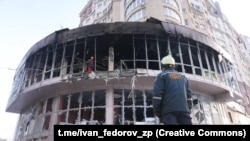
This has become something of a pattern, Olena Yeremenko, head of a local business alliance, told RFE/RL.
"I don't see any mass relocation of businesses right now, apparently the main businesses have already left. But there are closures, mostly production, due to the loss of orders, suspension of activities with the hope of returning. And this is over the past six months, and this is a very bad signal. It can only get worse," she said.
Puchkov said an additional problem in frontline zones like Zaporizhzhya was people leaving the area for safety reasons.
“In Lviv or Cherkasy it is more or less calm,” he said, referring to cities n westrn and central Ukraine. “Our people go there…they buy a bun, milk in the supermarket, lunch in a canteen or cafe. And we don’t have these people. There are much fewer of them and their purchasing power is melting away.”