


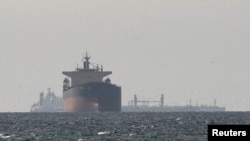
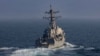
WASHINGTON -- A US naval blockade on ships entering Iranian ports and coastal areas took effect on April 13 as Washington increasingly turns to "economic statecraft" to force Tehran to agree on a peace deal after weeks of air strikes.
RFE/RL spoke with Max Meizlish, a research fellow at the Foundation for Defense of Democracies (FDD) and a former official at the US Treasury's Office of Foreign Assets Control (OFAC) on the intersection of naval blockades and financial warfare.
Meizlish argues that while kinetic air strikes grab headlines, the real battle is being fought against the Chinese financial lifelines and clandestine trade networks that keep the Iranian regime afloat.
RFE/RL: With the latest developments around Iran and the Strait of Hormuz, how should we understand the strategic objective of the US Navy's presence in the region at this moment?
Max Meizlish: It seems to me that the US is moving to more aggressively target the nexus of economic interests held by the Iranian regime -- all the vectors of economic interests that are central to the regime's operations and the economic viability of the country.
We previously saw targets through missile strikes looking at petrochemical facilities, and now this is an extension of that strategy. Any ships moving in and out of Iranian ports are going to be the subject of US blockades and potential interdiction efforts.
This is an escalation of what has been in motion for the last couple of weeks.
RFE/RL: Regarding Iran's maritime calculus, how do these developments shape Tehran's decision-making when it comes to managing shipping flows through the strait?
Meizlish: It is going to make it much more difficult. The reality is that the IRGC (Islamic Revolutionary Guards Corps) has been operating what people are calling the "Tehran Toll Booth," with facilities on Larak Island. It is becoming increasingly impractical for ships to make their way through the strait, even if they pay that toll.
It is notable that after President [Donald] Trump's posts stating the US would interdict any ships that made payments to Iran through this toll system, there were reports of at least two Chinese state-owned ships associated with the COSCO shipping line passing through the Iranian-controlled corridor.
There are now questions as to whether those ships made payments and whether the US is actually prepared to follow through on the promise to interdict ships that pay Iran. The Iranians still have leverage as long as they operate this toll booth, so it is now a question of whether US authorities will interdict those facilitating the payments.
RFE/RL: How does the US balance long-term deterrence with day-to-day enforcement in a high-stakes maritime environment?
Meizlish: The US has to be credible in its deterrence. In January, when the US imposed a quasi-blockade on ships departing Venezuela, the government went to great lengths to pursue the ships that broke the blockade. However, that is only part of the problem. There are structural barriers from a legal and timeline perspective that make seizing ships, taking ownership of the oil, and selling it onto the market a very slow process.
While the US can move to capture a ship that breaks a blockade, the legal process to forfeit the cargo in US courts takes weeks or months. We will see how robust the enforcement effort is, but actual interdiction is just the beginning of what the US must do to make this credible.
RFE/RL: Do we have a timetable for when we might start seeing the actual impact of this current enforcement?
Meizlish: The blockade went into effect earlier today. I would expect to hear reports of attempted interdictions as soon as efforts are made by ships trying to move forward.
Right now, I would be looking to see if there is any movement by US naval assets to interject those two Chinese ships I mentioned earlier, provided they actually made payments. Aside from that, we will have to see if anyone else tries to bust through the blockade.
RFE/RL: Looking at the bigger picture, to what extent are China, Russia, and other actors -- some call them the "axis of evasion" -- contributing to the resilience of Iran's logistics and supply chains?
Meizlish: China is the central actor. This part of the story does not get nearly enough attention. Without China, Iran would not have been able to wage this war. For years, China has bankrolled the regime by buying up to 90 percent of Iran's exported oil, albeit at a steep discount. This has provided billions of dollars to the regime.
China also provides technology, diplomatic support, and chemical precursors for ballistic missile fuel. From a financial perspective, they provide the logistical channels for payments, such as "oil-for-metals" barter systems.
There is the Bank of Kunlun and connections to cross-border interbank messaging systems. There really is no bigger or more important enabler of Iranian sanctions evasion than China. The US needs to make this clear and rally partners in Europe and the Gulf to highlight that Iran's malign actions would not be possible without years of Chinese support.
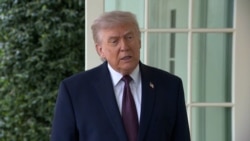

RFE/RL: Given Trump's upcoming visit to China, are there specific pressure points Washington can exploit to shift Beijing's incentives quickly?
Meizlish: We could ramp up economic sanctions in a targeted way aimed at a small or midsize Chinese bank connected to major state entities. I recently published research with my colleague, Elaine Dezenski, highlighting a "teapot" refinery in China -- Wanda Holdings Group -- which takes in sanctioned Iranian oil through a closed-loop system in Shandong.
China likes to position itself as isolated from sanctions evasion, but when you look below the surface, it is just not true. If the US wants to put pressure on China for a coercive purpose, or to restore order in the strait, we can target these specific entities. China would benefit from the strait being open, but its timeline for doing so might not align with that of the US.
RFE/RL: To clarify, you're saying China needs the strait reopened but it may also benefit from prolonged disruption?
Meizlish: Precisely. The US and China have aligned interests, but they have divergent timelines.
RFE/RL: How do you expect Beijing to react to the US-enforced blockade in the near term?
Meizlish: I think we will see China remain outwardly vague. They will likely say that maritime access needs to be unhindered and that there should be a free flow of trade. I don't expect them to be critical of anyone to an extreme unless the US puts more direct pressure on Beijing to rein in Iran.
RFE/RL: Are we now in a phase of full-spectrum economic warfare with Iran, and is the US enforcing sanctions aggressively enough to "win?"
Meizlish: There is more the US could be doing regarding the enablers. While we are hitting targets kinetically, we should be going after the Chinese entities that facilitate payments. Additionally, the US should be working with other countries to freeze the assets of Iranian regime insiders and oligarchs.
Just as we did with Russia through the REPO (The Russian Elites, Proxies, and Oligarchs) Task Force, we should be doing the same for Iranian insiders. There are reports of regime members holding hundreds of millions of dollars in European capitals.
For example, Ali Ansari -- an intermediary for the leadership -- is sanctioned by the UK but not the US, despite having a vast portfolio of luxury properties held through shell companies. We should be imposing economic pain and diverting those assets into escrow to support the people of Iran someday. The blockade could be very well complemented by these other forms of economic statecraft.
RFE/RL: As you look at the coming weeks, what indicators will suggest that this economic statecraft is achieving its intended effect?
Meizlish: The intended effect is bringing Iran back to the table. If the US can achieve that in a verifiable and enforceable way, that is what success looks like. However, the political goals seem to shift from day to day, making it difficult to assess what a "win" looks like in a binary way. Ultimately, success is depriving the regime of the assets it steals from its people, preventing it from rearming through China and Russia, and further degrading its capacity to withstand pressure.

