



News
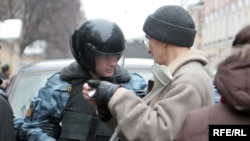
Riot Police Complain Of Corruption As Demonstrations Rock Russia
The letter was published by the independent "Novoye vremya" magazine.
The officers complain that battalion commander Sergei Yevtikov has demanded that each officer arrest no less than three demonstrators at opposition rallies or face loss of bonuses and awards. They say that there is a standing order to detain Eduard Limonov, head of the banned National Bolshevik Party, as soon as he is spotted.
In an exclusive interview with RFE/RL's Russian Service, Sergei Taran, a former OMON officer and a coauthor of the letter to Medvedev, explained how commanders ordered OMON troops to disrupt demonstrations.
"There is usually an order, and I don't know where it comes from, to take certain people away [during opposition rallies]," Taran said. "So [OMON members] detain them, throw them into buses, and bring them to police stations. There are prewritten reports -- for instance, charging them with crossing the street illegally -- so [policemen] just fill in their names and make up these absurd reports."
Interior Ministry spokesman Mikhail Sukhodolsky was quoted by Interfax today as saying the information published in "Novoye vremya" will be checked. "And if in some form or another the facts are confirmed, which I strongly doubt they will be, then the harshest possible measures will be taken against those who allowed violations," Sukhodolsky was quoted as saying.
A spokeswoman for the Moscow police told the agency that the OMON letter "bears a clearly libelous character" and said several of the signatories were dismissed from OMON late last year.
The OMON complaints come as Russia faces a wave of protests by opposition activists seeking to defend the right to assemble peaceably, which is guaranteed by Article 31 of the Russian Constitution. They have vowed to hold nationwide demonstrations on the 31st of every applicable month to highlight their complaints. A wave of unsanctioned protests on January 31 led to dozens of activists in numerous cities being detained by police.
WATCH: Moscow police crack down on protesters asserting their right to assemble peacefully.
In Moscow, OMON troops detained about two dozen demonstrators, including former Deputy Prime Minister Boris Nemtsov, who described the arrests for RFE/RL's Russian Service.
"Those who were standing around us, a colonel called Viktor Aleksandrovich, acted completely pleasantly and agreed that the authorities are doing everything so that in the end there will be a revolution," Nemtsov said. "They are acting stupidly. The remaining police acted like animals -- they grabbed us, spun us around, shouted, screamed, pushed, and pressed up tight against Lyudmila Mikhailovna [Alekseyeva, the 82-year-old head of the Moscow Helsinki Group]."
Asked how many people were at the demonstration, Nemtsov said that "if you count OMON and the police, several thousand. If you don't count OMON and the police, a few hundred."
The letter by the Moscow OMON battalion complains of widespread corruption and abuse of office. Officers have quotas for the number of people they are to detain per shift and are docked pay if they fail to fulfill the plan, the letter states.
The officers also complain that they are forced to protect elite cottages outside of Moscow and the businesses of alleged criminals who are protected by senior Interior Ministry officials. Officers also complain that the police protect the prostitution business in exchange for money and sexual favors.
The letter also states that OMON troops are regularly assembled and told by officers that protest actions such as the Marches of Dissent, neo-Nazi demonstrations, and gay-pride parades are sponsored by foreign intelligence agencies.
Late last year, Novorossiisk police Major Aleksei Dymovsky made headlines by posting a video appeal about police corruption on YouTube. He was jailed earlier this month on fraud and abuse-of-office charges. The handling of the Dymovsky matter has raised doubts about President Medvedev's announced intention to reform the Interior Ministry and combat police abuses.
All Of The Latest News
- By RFE/RL
Latvian Russian-Speakers Protest Against Kremlin's War In Ukraine
Hundreds of people from Latvia's Russian-speaking community participated in a protest in the streets of the capital, Riga, against Russia's unprovoked war against Ukraine.
Protesters on April 23 waved Ukrainian flags and posters with slogans such as "Stop the genocide in Ukraine" and "Complete Russian gas and oil embargo," according to Latvian public broadcaster LSM.
Organizers of The Russian Voice Against War rally said the event was designed to demonstrate that Russian-speaking people in Latvia do not identify with Russian President Vladimir Putin's government and that they respect the sovereignty and culture of other countries.
Organizers posted photos and videos of the protest on the event’s Facebook page.
Ethnic Russians make up around 25 percent of Latvia's population of 1.9 million.
On April 21, the Saeima, Latvia's parliament, "unanimously adopted a statement on the aggression and war crimes of the Russian Federation in Ukraine, expressing solidarity with Ukraine and the Ukrainian people."
"The Saeima acknowledges that the Russian Federation is currently committing genocide against the people of Ukraine," the statement said.
Prime Minister Krisjanis Karins on April 22 said it was necessary to weaken Russia's ability to finance its war in Ukraine and pressed for further European Union sanctions on all Russian banks and all energy resources.
After meeting with his Baltic counterparts, Karins tweeted that "Latvia, Lithuania, and Estonia are united in stepping up support to Ukraine and determined to stop using of Russian gas."
Fellow Baltic states Estonia and Lithuania -- all former Soviet republics and European Union and NATO members -- have taken hard lines against Russia's invasion of Ukraine, which began on February 24.
With reporting by AP and LSM
- By RFE/RL
Zelenskiy Says U.S. Secretaries Of State, Defense To Visit Kyiv
Ukrainian President Volodymyr Zelenskiy has told a news conference that U.S. Secretary of State Antony Blinken and defense chief Lloyd Austin will visit Kyiv on April 24.
"Tomorrow, the American officials are coming to visit us; I will meet the defense secretary [Austin] and Antony Blinken," he told reporters on April 23.
If it takes place, the visit would mark the highest-profile arrival by U.S. officials following a series of visits by European leaders to war-ravaged Ukraine's capital.
Following the other visits, the Biden administration had been under pressure to send a high-level representative to Ukraine as a show of support amid Russia's brutal invasion of the country.
Zelenskiy told the news conference that he would discuss with the U.S. officials the types of weapons needed by Ukraine in its fight against Russia's unprovoked attack.
There was no immediate comment from the U.S. side, which has said it was considering a visit but that Biden himself would not travel to Ukraine.
Zelenskiy also issued a fresh call for a meeting with Russian President Vladimir Putin in a bid to "put an end to the war."
"I think that whoever started this war will be able to end it," he told the televised news conference, held at a metro station in central Ukraine.
"From the beginning, I have insisted on talks with the Russian president," he said.
"It's not that I want [to meet him]; it's that I have to meet him so as to settle this conflict by diplomatic means."
"We have confidence in our partners, but we have no confidence in Russia," he added.
The Ukrainian leader repeated his warning that Kyiv would break off talks if Russia killed the remaining Ukrainian soldiers holding out in a steel plant in the besieged port of Mariupol.
Talks have been held with little or no progress between Ukrainian and Russian officials.
Zelenskiy also spoke with British Prime Minister Boris Johnson by phone on April 23 to discuss Kyiv's military needs.
Johnson's office said the British leader told Zelenskiy that Britain would reopen its embassy in Kyiv next week.
Most countries closed their embassies in Kyiv following Russia's February 24 invasion, but many have reopened their diplomatic posts after Ukrainian resistance forced Russian troops to retreat from around the capital.
Johnson told Zelenskiy that the British government was continuing its efforts to help collect evidence of Russian war crimes.
He also told the Ukrainian leader that more defensive weapons -- including vehicles, drones, and anti-tank missiles -- would be sent to help Kyiv in its battle against Russian forces.
"The prime minister ended by reiterating the U.K.'s unwavering support for the people of Ukraine and committed to continue working with international partners to provide the assistance necessary to help Ukraine defend itself," Downing Street said.
Andriy Sybiha, the Ukrainian president's deputy chief of staff, said Zelenskiy spoke with Johnson about a "new phase" of military aid, including the provision of heavy weapons.
With reporting by RFE/RL's Ukrainian Service, AP, Reuters, and AFP
- By RFE/RL
Russian Space Official Says New Nuclear-Capable ICBM To Be Deployed By Fall
The head of Russia's space agency has said the country plans to deploy its first military unit armed with the nuclear-capable Sarmat, a new intercontinental ballistic missile, within months.
Roskosmos Director-General Dmitry Rogozin was quoted by Russian news agency TASS as making the statement in an interview with state television station Rossia-24.
It comes with the Russian armed forces publicly derided by Western military analysts as underperforming, poorly trained, and badly equipped in the Ukraine campaign.
Ukrainian officials, a former Russian foreign minister, and other international observers have accused Moscow of "nuclear blackmail" since the outbreak of war -- a serious charge against the leadership of a country with the world's biggest nuclear arsenal by number or warheads.
Rogozin said the Sarmat unit will be based in the Siberian town of Uzhur, in the Krasnoyarsk region, about 3,000 kilometers east of Moscow.
The deployment will happen no later than this autumn, he said.
Russian President Vladimir Putin and other senior officials have repeatedly made veiled references to the country's nuclear arsenal since Putin launched an all-out military invasion of Ukraine on February 24.
Putin ordered Russia's nuclear arsenal on high alert days after the unprovoked invasion began, with the Kremlin citing "Western countries...taking unfriendly actions" through economic sanctions and "aggressive statements against our country."
Russia calls Sarmat "the most powerful missile with the longest range of destruction of targets in the world," and Putin has claimed it can overcome "all modern means of anti-missile defense."
Russia tested its Sarmat missile on April 20 in what was regarded as an effort to project strength even as its conventional forces were widely seen to be faltering against Ukrainian professional and volunteer fighters.
Russia properly notified Washington of the launch beforehand, the Pentagon said.
Afterward, Rogozin, who routinely trolls the West on social media and other statements, warned British Prime Minister Boris Johnson in conjunction with purported comments that "if Sarmat is used, none of you will 'consult with each other.'"
Nuclear fears around the Russian invasion have stemmed from more than just atomic weapons.
Russian forces stormed the decommissioned nuclear plant at Chernobyl, kicking up contaminated soil and raising radiation levels there.
And on March 4, Russian troops overran the functioning Zaporizhzhya nuclear power plant, sparking a fire at a plant training facility.
With reporting by Reuters
Bosnian Quake Victim Died After Hillside Collapsed On Home
Bosnian officials have identified the lone death so far from a major earthquake and aftershocks that shook the Balkans overnight as a 27-year-old woman whose house was partially buried by a crumbling hillside in the southern city of Stolac.
The magnitude-6 earthquake shook Bosnia-Herzegovina shortly after 11 p.m. on April 22, Europe's seismological center said.
Its epicenter was about 9 kilometers north of Ljubinje at a depth of about 5 kilometers.
The director of a cantonal hospital in nearby Mostar told RFE/RL that the young woman was dead on arrival, and said three others with head injuries from the seismic rumblings were in stable condition.
The director of the Stolac Health Center, Kazimir Raguz, said most injuries there were lacerations or sprains from fleeing, as well as minor injuries from falling household items.
All of the patients there had been released for home treatment, the director said.
The earthquake was felt in other Bosnian cities and neighboring countries but did not cause widespread major damage.
A power outage was reported in some parts of Mostar, including Berkovici, where electricity was quickly restored, according to Mayor Nenad Abramovic.
There was some damage to cars, roofs, and chimneys in the city of Ljubinje, said Ranko Radic, head of the local civil-protection administration there.
The Bosnian Serb member of the Bosnian tripartite presidency, Milorad Dodik, told the Srna news agency that 500,000 convertible marks, or around $280,000, in emergency funds would be sent to Ljubinje to help repair the quake damage.
With reporting by Reuters
- By RFE/RL
Kyiv Awaits NATO Summit Invite As Wider Security Concerns Mount
Defense Minister Oleksiy Reznikov has said that Ukraine is expecting an invitation to a NATO summit next week in Germany initiated by the United States.
The Pentagon has invited 40 allies to meet in Germany on April 26 to discuss Ukraine and its longer-term security needs.
Pentagon spokesman John Kirby said defense ministers and senior generals from 20 countries, NATO and non-NATO members, have already accepted the invitation from U.S. Defense Secretary Lloyd Austin.
It will reportedly take place at the Ramstein Air Base in western Germany.
Ukrainians continue to battle Russian forces trying to take eastern and southern territory in a nearly two-month-old, all-out war following eight years of Russian assistance to armed separatists in eastern Ukraine.
Meanwhile, UN Secretary-General Antonio Guterres is due to hold talks with Russian President Vladimir Putin in Moscow next week in an attempt to discuss bringing peace to Ukraine.
Ukraine has made its intention to join NATO part of its constitution, although President Volodymyr Zelenskiy has also acknowledged that such a goal is unlikely in the near term.
But in addition to weapons and other support, he has appealed to NATO and other countries to enforce a no-fly zone over Ukraine to help its forces repel Russia, sparking intense debate within NATO.
Live Briefing: Russia's Invasion Of Ukraine
RFE/RL's Live Briefing gives you all of the major developments on Russia's invasion, how Kyiv is fighting back, the plight of civilians, and Western reaction. For all of RFE/RL's coverage of the war, click here.
U.S. President Joe Biden and others have orchestrated major weapons shipments and other support for Ukraine, and have warned Russian President Vladimir Putin against his forces crossing "one inch" into NATO members' territory.
Underscoring Kyiv's recent plea for increased military assistance to beat back the Russian invasion, Russia's Defense Ministry said on April 23 that it had shot down a Ukrainian Su-25 fighter jet and destroyed three MI-8 military helicopters at an airfield in the Kharkiv region, in northeastern Ukraine.
There was no immediate way to confirm the Russian assertion, and Ukrainian officials did not initially respond to the claim.
Russia said a day earlier that it captured a large arms depot in Kharkiv, a report that was also difficult to confirm.
An adviser to the head of Zelenskiy's office, Mykhaylo Podolyak, said on April 23 that negotiations on possible security guarantees for Ukraine from foreign partners were under way and could be completed within as little as a week.
Speaking on a telethon to raise support for Ukraine, Podolyak said that "Of course, there will be different package guarantees," but he added that "It is important for us to supply weapons, close the skies, military consultations, and the means to quickly purchase additional weapons."
Advisers to leaders of the United States, Britain, Turkey, Poland, Germany, France, and Israel have reportedly expressed readiness to discuss a list of security guarantees for Ukraine.
The acting commander of Russia's Central Military District, Rustam Minnekayev, said on April 22 that full control of southern Ukraine was a strategic goal to allow access to Moldova's pro-Russian breakaway region of Transdniester.
Kyiv has repeatedly warned that Transdniester could be used as a staging area for Russian operations against Ukraine or against Moldova, a non-NATO member that shares a border and a common history with NATO member Romania.
With reporting by AFP, AP, and Reuters
- By Current Time
Russia Adds Ekho Moskvy Editor, Navalny Ally, Others To 'Foreign Agents' List
Russian authorities have designated the former head of an independent radio station, a longtime ally of a jailed opposition leader, and seven others as "foreign agents" in a crackdown that has intensified since Russia launched all-out war in Ukraine eight weeks ago.
The Justice Ministry added former Ekho Moskvy editor in chief Aleksei Venediktov and exiled Kremlin critic Leonid Volkov to a list that now targets around 150 entities and citizens for ostracization and burdensome labeling requirements.
News of their listings follows confirmation that the ministry also placed prominent opposition activist Vladimir Kara-Murza, who is in detention over alleged statements concerning the Ukraine war, on the "foreign agents" list.
The other additions are: TV journalist and former lawmaker Aleksandr Nevzorov, independent media award RedKollegia co-founder Sergei Parkhomenko, sociologist Viktor Vakhshtain, Yaroslavl LGBT rights activist Yaroslav Sirotkin, journalist Vladimir Voronov, and RFE/RL journalists Artur Asafiev and Yekaterina Lushnikova.
Russia's original 2012 legislation on "foreign agents" targeted NGOs and rights groups and has since been expanded to punish media organizations, individual journalists, YouTube vloggers, and many other perceived opponents alleged to have even indirect ties to outside funding.
Venediktov's Ekho Moskvy was a leading media outlet that, along with numerous other remaining independent news providers, has been shut down since late February over their coverage of the war.
Volkov is a longtime associate of jailed opposition leader Aleksei Navalny who was among several Navalny allies to flee Russia last year before being placed on the government's list of extremists and terrorists.
Russian authorities have tried to cast Navalny and his supporters as Western-backed subversive operatives trying to destabilize Russia.
Many of Navalny’s allies have fled Russia rather than face restrictions on their freedoms or prison time at home, contributing to a long-running demographic dilemma that has been exacerbated by a wave of emigration since the Ukraine invasion.
Venediktov, who is Jewish and a frequent target of pro-Kremlin abuse, reported finding the severed head of a pig at the door of his Moscow apartment late last month and a note reading "Judensau," or "Jewish pig."
Kara-Murza was listed by the ministry as an agent of Ukraine.
A Russian court on April 22 ordered pretrial detention for Kara-Murza for allegedly spreading false information about the Russian army, his lawyer said.
Nine other people were added to the "foreign agents" list on April 15, including YouTuber Yury Dud, political scientist and publicist Yekaterina Shulman, cartoonist Sergei Elkin, The Insider founder and editor-in-chief Roman Dobrokhotov, and journalist and LGBT activist Karen Shainyan.
Iranian General 'Unhurt' In Attack On Vehicle In Southeast
Iranian state media say a general of the powerful Islamic Revolutionary Guards Corps (IRGC) was unhurt but a bodyguard killed when gunmen fired on their vehicle in southeastern Iran early on April 23.
The apparent target, Brigadier General Hossein Almassi, is an IRGC commander in the restive Sistan-Baluchistan Province, a particularly poor and mostly Sunni region that borders Pakistan and Afghanistan.
The reports said suspects were apprehended after the attack near a checkpoint in the provincial capital, Zahedan, but they did not provide details.
IRNA said Almassi was not injured and identified the dead bodyguard as Mahmud Absalan, the son of a senior IRGC commander in the region.
Sistan-Baluchistan has been the scene of numerous clashes between Iranian security forces and Baluch militants, as well as drug traffickers exploiting it as a major smuggling route for Afghan opium and heroin.
Some of its large Sunni population complain of discrimination by the majority Shi'ite Iranian authorities.
On January 1, the IRGC said it had killed six "armed bandits" in the province in an incident in which three local volunteers for the regime's Basij militia were also killed.
Days earlier, Iranian authorities said three men suspected in an attack in late December that left two IRGC members dead had been killed.
Based on reporting by AP and Reuters
- By RFE/RL
Ukrainians Say Russia Attacking Mariupol Holdouts; Odesa Hit In Missile Attack
A new attempt to evacuate civilians from Mariupol appears to have failed, with local officials laying the blame on Russian forces who reportedly attacked a metals plant where desperate Ukrainian defenders are holding out in the devastated southeastern port city.
The report of a fresh effort to storm the Azovstal plant comes two days after President Vladimir Putin claimed in a televised meeting that Russian troops would merely seal off the facility in an effort to save Russian lives fighting for the "catacombs" underneath.
Live Briefing: Russia's Invasion Of Ukraine
RFE/RL's Live Briefing gives you all of the major developments on Russia's invasion, how Kyiv is fighting back, the plight of civilians, and Western reaction. For all of RFE/RL's coverage of the war, click here.
Azovstal is thought to be sheltering about 2,000 Ukrainian fighters, with much of the rest of the city already under Russian control.
Oleksiy Arestovych, an adviser to Ukraine's president, told a briefing on April 23 that Russian forces had resumed bombardment from the air of Azovstal and were trying to storm it.
An aide to the city mayor said some 200 residents had arrived early on April 23 for a planned evacuation but were told by Russian troops to leave and warned of possible shelling.
Both sides have blamed the other for previous failures of attempts to evacuate civilians from the besieged city, which has been encircled since early in the conflict
Elsewhere, Russian forces intensified their assault on eastern and southern Ukraine with "around-the-clock" shelling, dashing hopes for a cease-fire as Easter Sunday approached on the Orthodox calendar.
In the strategic Black Sea port of Odesa, government officials said a Russian missile strike hit a military facility and two residential buildings, killing at least five people and injuring 18, although the reports could not immediately be confirmed.
The Ukrainian presidential office said a 3-month-old child was among those killed.
And Ukrainian governors in the eastern part of the country reported deadly fighting and shelling overnight and throughout April 23, although some reports indicated Russian advances had stalled in the face of strong Ukrainian resistance.
The head of the Kharkiv regional administration, Oleh Sinehubov, said on his Telegram channel that Ukrainian forces had retaken at least three villages near the Russian border after "fierce battles."
British military intelligence said early on April 23 that Russian invasion forces appeared to have made no major gains in the past 24 hours.
U.K. intelligence also said Russian air and naval forces still had not established control of Ukraine's skies or seas in the face of fierce Ukrainian resistance.
In a video address late on April 22, Ukrainian President Volodymyr Zelenskiy thanked countries that have delivered weapons to help Ukraine's defense and said its armed forces continued to deter attacks in eastern and southern Ukraine.
Ukraine's General Staff has said Russian forces increased attacks along the entirety of the front line in the east.
"The Izyum direction, Donbas, Azov, Mariupol, Kherson region are the places where the fate of this war and the future of our state is being decided now," Zelenskiy said.
He also intensified warnings of Putin's alleged territorial aims elsewhere in the region in addition to its freshly stated goals of wresting away and occupying eastern and southern Ukraine.
The acting commander of Russia's Central Military District, Rustam Minnekayev, was quoted by official state media on April 22 as saying that full control of southern Ukraine was a strategic goal to allow access to Moldova's pro-Russian breakaway region of Transdniester.
Minnekayev's comments were the most detailed public description yet of Russia's goals in the second phase of its invasion of Ukraine and were highlighted by Kyiv as a sign that the Kremlin has been lying with its previous statements that Moscow has no territorial ambitions.
Kyiv has also repeatedly warned that Transdniester could be used as a staging area for Russian operations against Ukraine or Moldova, which shares a border and a common history with NATO member Romania.
Transdniester is a sliver of territory that borders Ukraine where hundreds of Russian troops remain deployed over Chisinau's objections.
Minnekayev said Russian speakers were oppressed in Transdniester. Moldova and Western leaders say that is untrue.
Moldova's Foreign Ministry rejected the Russian statements as "unfounded" and summoned Moscow's ambassador to express Chisinau's "deep concern."
"Moldova...is a neutral state and this principle must be respected by all international actors, including the Russian Federation," the ministry said in a statement.
In the eastern Luhansk region, Governor Serhiy Hayday said on television on April 23 that all of that region's cities were being shelled around the clock, and that the bombardment was only intensifying.
Hayday also said via Telegram that an evacuation effort was planned from the Pokrovsk railway station to help residents fleeing the Luhansk and Donetsk regions.
He also said two people were killed when the city of Popasna "got the most" of the Russian shelling of residential buildings in the region, in addition to street fighting that has continued for weeks.
He said Ukrainian defense forces were leaving some settlements in order to regroup. But Hayday insisted the movements were not a critical setback.
Earlier, Deputy Prime Minister Iryna Vereshchuk had called via Telegram for people in Mariupol to gather on a highway near a local shopping center in hopes of escorting them safely out of the city.
Many thousands of residents have fled the city of a prewar population of around 500,000 people, but bombardment blamed on encircling Russian forces has frequently derailed civilian evacuations.
The Ukrainian National Guard's Azov Battalion, whose forces are trapped in Azovstal, released video on April 23 of dozens of women and children who they said had been living in the tunnels beneath the plant for months. One woman talks about yearning for fresh air and sunshine.
The regiment's commander, Svyatoslav Palamar, told AP the video was filmed on April 21. Its contents could not initially be verified.
On April 22, new satellite images showed a second possible mass grave site in a nearby town, compounding the worst fears about the humanitarian catastrophe unfolding there since Putin's offensive began on February 24.
Putin issued an order this week for Russian forces to seal off Mariupol so that "not even a fly" could penetrate into the badly damaged city of around 500,000 people before the conflict.
With reporting by RFE/RL's Ukrainian and Russian services, Reuters, AFP, and AP
One Death Reported After Strong Earthquake Felt Across Balkans
One person died and at least three were injured in a strong earthquake that struck Bosnia-Herzegovina on April 22, sending people fleeing their homes.
The earthquake, which struck shortly after 11 p.m., was felt throughout the country and in neighboring Croatia, Serbia, and Montenegro.
The director of the Safet Mujic Cantonal Hospital in Mostar confirmed to RFE/RL that the woman who died was injured in the city of Stolac.
She was found among the rubble after a part of a hill collapsed on her family house, the hospital told RFE/RL. Her exact age was not given, but her birth year was 1992.
She had already passed away when she was brought to the hospital, the director said, adding that there were three other people with head injuries.
"They came with scratches or sprained wrists [sustained] while fleeing houses," hospital director Kazimir Raguz said. "There were also minor head injuries due to objects falling into houses, but nothing was more significant and serious. They were all released for home treatment."
Ranko Radic, the head of civil protection in Ljubinje, which is located about 30 kilometers from Stolac, told RFE/ RL that there were damaged cars, roofs, and chimneys in that city.
The earthquake had a magnitude of 5.7 and its epicenter was about 42 kilometers southeast of the city of Mostar at a depth of about 5 kilometers, according to the Euro-Mediterranean Seismological Center (EMSC)
The EMSC warned that aftershocks were likely in the coming hours and days. Radic said two had been felt in Ljubinje, and most people remained outside because of the danger.
The fire department in Trebinje, located about 80 kilometers from the epicenter, told RFE/RL it had no reported damage.
A power outage was reported in some parts of Mostar, and a chimney fell from a building into a city street.
With reporting by Reuters, AP, and AFP
Russia Confirms One Death Among Crew Of Sunken Moskva, 27 Missing
The Russian Ministry of Defense has admitted that one crew member died and 27 are missing as a result of a fire on the Moskva missile cruiser last week.
The remaining 396 crew members were evacuated to other ships of the Black Sea Fleet, Interfax said, quoting a statement from the ministry.
Since the ship sank there have been reports quoting relatives of sailors who served on the cruiser about the dead and missing.
The ministry said that it has been providing assistance to the relatives of the deceased and the missing.
Russia acknowledged on April 14 that the Moskva had sunk, attributing the disaster to a fire that caused ammunition on the ship to detonate.
The ministry claimed that the entire crew of 500 was evacuated from the ship, which Ukraine and the United States said sank after Ukrainian forces hit the vessel on April 13 with at least one Neptune missile.
A senior Pentagon official said on April 15 that the loss of the ship was a "big blow" for Moscow. The official said then that the strike was believed to have caused casualties, but it was difficult to assess how many.
Bashkir Activist Ruslan Gabbasov Gets Political Asylum In Lithuania
Activist Ruslan Gabbasov from Russia's Republic of Bashkortostan, who fled Russia in December fearing for his safety, has obtained political asylum in Lithuania.
Gabbasov wrote on Facebook on April 22 that the asylum was handed to him after just 4 1/2 months, while usually it takes up to one year to get political asylum in the Baltic state.
Gabbasov told RFE/RL earlier that he left Russia after Russian authorities imposed pressure on him, trying to connect him with criminal cases in Bashkortostan.
According to Gabbasov, the authorities have been trying to incriminate him for his participation in the activities of the banned Bashqort group, which for years promoted the Bashkir language and culture as well as equal rights for ethnic Bashkirs.
Before the organization was recognized as extremist and banned, Gabbasov was in the leadership of the civil body.
He also said that his decision to leave Russia was influenced by two events in November, namely the arrest of Lilia Chanysheva, the former head of jailed Russian opposition politician Aleksei Navalny's headquarters in Bashkortostan, and the conviction of activist Ramila Saitova, who was sentenced to three years in a colony settlement after a court in Bashkortostan found her guilty of calling for extremist activities.
- By RFE/RL
Dutch Subsidiary Of Russia's Alfa Bank Declared Bankrupt
A Dutch court has declared the Russian-owned Amsterdam Trade Bank (ATB) bankrupt after it was caught up in sanctions related to Moscow's invasion of Ukraine.
Amsterdam's district court issued the ruling on the bank, which is a subsidiary of Russia's Alfa Bank, in a decision confirmed on April 22 by the Dutch central bank.
The bank, founded in 1994, had around 23,000 customers, most of whom are Dutch, but 6,000 are German, the Dutch central bank said in a statement on its website.
The statement said ATB depositors would be covered up to 100,000 euros ($108,000) each under the Netherlands' deposit guarantee system.
Live Briefing: Russia's Invasion Of Ukraine
RFE/RL's Live Briefing gives you all of the major developments on Russia's invasion, how Kyiv is fighting back, the plight of civilians, and Western reaction. For all of RFE/RL's coverage of the war, click here.
According to filings at the Dutch Chamber of Commerce, one of the bank’s largest owners is Mikhail Fridman, the Russian-Israeli billionaire who is contesting Western sanctions imposed on him following Russia's invasion of Ukraine.
Alfa Bank, Russia's top private lender, is subject to U.S. sanctions imposed on April 6, which froze all its assets linked to the U.S. financial system. It is also subject to British sanctions.
Alfa Bank has not been targeted by the European Union, and Amsterdam Trade Bank itself had not been sanctioned.
In a statement on its website, ATB confirmed that it had requested bankruptcy. The bank said that U.S. and British sanctions had "caused operational difficulties, as the majority of ATB's counterparties, including corresponding banks...find it difficult to continue supporting ATB."
The bankrupt bank recently condemned the Russian invasion of Ukraine, while stressing its focus was serving European small and medium-sized businesses.
In a statement at the time it said that, as a regulated Dutch bank, it acted independently of shareholders and complied with all sanctions against Russia.
With reporting by AFP and Reuters
- By RFE/RL
UN Chief To Meet With Putin Next Week For Talks On War In Ukraine
Russian President Vladimir Putin will meet with UN Secretary-General Antonio Guterres in Russia next week, the Kremlin and a UN spokesman said on April 22.
Kremlin spokesman Dmitry Peskov told the state news agency RIA Novosti that the meeting will take place on April 26, and that Guterres will meet first with Russian Foreign Minister Sergei Lavrov."
He will also be received by Russian President Vladimir Putin," Peskov added.
A UN spokesperson said Guterres hopes to talk about what can be done to bring peace to Ukraine.
The meeting was announced after Russia’s top diplomat said talks to end the fighting in Ukraine have “ground to a halt.”
Lavrov said during a press conference that talks were at a standstill because a proposal Russia passed on to Ukrainian negotiators about five days ago “remains without a response.”
The proposal was drawn up with Ukrainian comments taken into account, Lavrov said.
Vladimir Medinsky, Putin’s aide and Russia’s lead negotiator at the talks with Ukraine, confirmed reports that he held several lengthy conversations on April 22 with the head of the Ukrainian delegation.
He didn’t offer any details as to what was discussed or if any progress was made.
Based on reporting by AFP and Reuters
Video Blog Of A Russian Soldier In Ukraine
A 25-year-old Russian soldier has posted a video blog of his time in Ukraine, showing him and his comrades firing at Ukrainian positions and cavorting in occupied apartments. Later, he laments, "We've had many losses."
Kyrgyz Foreign Minister Resigns
BISHKEK -- Kyrgyz Foreign Minister Ruslan Kazakbaev has resigned.
Presidential spokesman Erbol Sultanbaev told RFE/RL on April 22 that Kazakbaev stepped down but did not give any details.
Kazakbaev, 55, had served as the Central Asian nation's foreign minister since October 14, 2020. It was his second time in the post after serving from 2010 to 2012.
He was elected as a lawmaker in 2015.
Prague Street In Front Of Russian Embassy, Nearby Bridge Renamed To Honor Ukrainian Heroes
PRAGUE -- The name of the Prague street in front of the Russian Embassy has been changed to Ukrainian Heroes Street and a bridge nearby has been renamed in honor of a Ukrainian soldier.
Prague city officials and Ukraine’s ambassador to the Czech Republic were on hand on April 22 as street signs bearing the new names were posted at the sites.
The decision to rename a segment of the street and the bridge, which was approved by Prague municipal lawmakers and the city's topographical commission last month, came into force on April 22. The street was previously named Korunovacni Street.
The renamed street will not affect locals as there are no residential buildings in the renamed segment.
The renamed bridge is a railway bridge next to the site that now bears the name of Vitaliy Skakun, a Ukrainian soldier who blew himself up to destroy a bridge in the Kherson region to block the progress of Russian troops on February 24, the day the Kremlin started its unprovoked invasion of Ukraine.
Ukrainian President Volodymyr Zelenskiy posthumously gave Skakun the title Hero of Ukraine.
It's not the first time Prague officials have made a political statement to Russia around its embassy.
In 2020, they renamed a square next to the embassy after Boris Nemtsov, a former deputy prime minister and outspoken critic of the Russian government who was fatally shot in February 2015 near the Kremlin.
The same year, Prague's mayor named a promenade in a park behind the embassy after Russian journalist Anna Politkovskaya, a critic of Russian President Vladimir Putin.
Politkovskaya's dogged reporting exposed high-level corruption in Russia and rights abuses in its North Caucasus region of Chechnya. New York-born Politkovskaya was shot dead near her Moscow apartment building on October 7, 2006.
Russian Man Fined For Wearing Shoes With Ukraine's Colors
Call it a fashion crime.
A court in Moscow has fined a man for wearing blue-and-yellow shoes because they were seen as a statement of support for Ukraine even though he was only out shopping.
Lawyer Ilya Utkin said on April 21 that the Butyrka district court convicted his client, whose identity has not been disclosed,
after he was picked up earlier in the month while wearing footwear that was in the national colors of Ukraine as an unsanctioned rally protesting Russia's war against its neighbor took place nearby.
According to Utkin, his client had nothing to do with the protest and was in the city center to buy gifts for his wife and daughter. But police detained him anyway, saying he was wearing "political tools" on his feet.
Since Russia launched its attack against Ukraine on February 24, there have been several unsanctioned rallies across the country protesting the invasion, with thousands arrested, including activists who held single-person protests, holding makeshift posters saying "Peace to the World," "No to War," "Fascism Will Not Pass," and others.
Some have been arrested while holding posters citing the bible, statements by President Vladimir Putin, or even with the inscription "two words" as a replacement for the banned "no war," or with a number of stars corresponding to the number of letters in the phrase "no war."
With reporting by The Insider and MSK1.ru
Turkmen Consumers Face Jail Time If Caught Buying Too Much Bread
ASHGABAT -- Consumers in Turkmenistan may pay a lot more than money for their daily bread after officials warned that anyone found buying more than their allotted share of the staple could be jailed.
RFE/RL correspondents from the energy-rich Central Asian nation's capital, Ashgabat, said that police have begun monitoring lines at state grocery stores, taking pictures and filming customers to prevent them from returning to buy extra bread.
As they studied the crowds, police warned that anyone found buying more than their allotment of bread will face a penalty of up to 15 days in jail, the journalists said.
The authoritarian government in Turkmenistan has been forced to tighten controls as poverty and economic hardship grow across the country despite its wealth of energy resources.
Lines are commonplace as people rush to state shops when they open at 5:30 a.m. in an attempt to get subsidized bread, which is about a tenth of the price of what is found at bazaars and private bakeries.
Earlier in February, police were detaining those who tried to buy more bread than their ration, including children, but released them shortly afterward. The amount of bread allotted to a person varies from region to region, and can be up to three pieces a day.
Despite being home to the world's fourth-largest proven natural-gas reserves, corruption and chronic mismanagement of resources have led Turkmenistan into an economic tailspin. The situation has been exacerbated by the coronavirus pandemic, which the Turkmen government officially denies.
The country has seen a dramatic increase in the number of individuals who rely on subsidized food as prices at state grocery stores rise.
Russia Court Orders Opposition Activist Held Over Charges He Distributed False Information
MOSCOW -- A Russian court has ordered pretrial detention for prominent Russian opposition activist Vladimir Kara-Murza for allegedly spreading false information about the Russian Army, his lawyer said.
Moscow's Basmanny district court ordered the 40-year-old Kremlin opponent be held in pretrial detention until June 12, lawyer Vadim Prokhorov said on Facebook on April 22. The prison he will be sent to is not known, Prokhorov said.
Russia's Investigative Committee is conducting a probe into accusations that Kara-Murza distributed false information about the Russian Army.
The court said Kara-Murza would stay in detention at the request of the investigator handling the case, Interfax reported. The defendant told the court that he considers the case politically motivated, the news agency said.
The decision to hold him in pretrial detention will be appealed, Prokhorov said, according to Interfax.
Prokhorov wrote earlier on Facebook on April 22 that his client was questioned at the Investigative Committee with regard to the case, but he did not give any further details.
Separately, the Russian Justice Ministry added Kara-Murza to a list of "foreign agents." The designation means he is subject to stringent financial reporting requirements and must label anything he publishes with a disclaimer. The ministry listed him as a Ukrainian agent.
Kara-Murza was arrested outside his home on April 11 and sentenced the next day to 15 days in jail on a charge of disobeying the police.
President Vladimir Putin signed a law on March 5, just days after Russia launched its ongoing unprovoked invasion of Ukraine, that calls for lengthy prison terms for distributing "deliberately false information" about Russian military operations.
The law envisages sentences of up to 10 years in prison for individuals convicted of an offense, while the penalty for the distribution of "deliberately false information" about the Russian Army that leads to "serious consequences" is 15 years in prison.
It also makes it illegal "to make calls against the use of Russian troops to protect the interests of Russia" or "for discrediting such use" with a possible penalty of up to three years in prison. The same provision applies to calls for sanctions against Russia.
A close associate of slain opposition leader Boris Nemtsov, Kara-Murza is best known for falling deathly ill on two separate occasions in Moscow -- in 2015 and 2017-- with symptoms consistent with poisoning.
Tissue samples smuggled out of Russia by his relatives were turned over to the FBI, which investigated his case as one of "intentional poisoning."
U.S. government laboratories also conducted extensive tests on the samples, but documents released by the Justice Department suggest they were unable to reach a conclusive finding.
The arrest of the outspoken Kremlin critic comes amid a mounting crackdown by Russian authorities on opposition figures and any dissent to the ongoing war in Ukraine, which started on February 24.
The investigative group Bellingcat found that Kara-Murza had been followed by Russian security agents who were also allegedly involved in the poisoning of another opposition figure, Aleksei Navalny.
With reporting by AFP, Reuters, and Interfax
Aliyev Says Won't Recognize Armenia's Territorial Integrity Unless Peace Deal Signed
Azerbaijani President Ilham Aliyev says his country will refuse to recognize Armenia's territorial integrity unless Yerevan signs a bilateral peace deal in line with proposals made by Baku.
Speaking on April 22 at the Fifth Congress of the World's Azeris in the city of Susa, located in the Nagorno-Karabakh region, where the two countries recently fought a war, Aliyev said the Baku-proposed peace deal was Armenia's "only and last chance."
"If they reject [the deal], we will also refuse to recognize the territorial integrity of Armenia," Aliyev said.
Susa is known as Shushi in Armenian.
Aliyev also called on Yerevan to avoid dragging out talks on a peace deal, stressing that Armenia had previously agreed with all five elements of the proposed agreement.
Earlier this month, Aliyev and Armenian Prime Minister Nikol Pashinian agreed to start drafting a bilateral peace treaty to resolve the Nagorno-Karabakh conflict and set up a joint commission on demarcating their common border during talks in Brussels hosted by European Council President Charles Michel.
Baku wants the peace deal to be based on five elements, including a mutual recognition of each other's territorial integrity.
Pashinian has publicly stated that they are acceptable to Yerevan in principle, fueling Armenian opposition claims that he is ready to recognize Azerbaijani sovereignty over the breakaway Nagorno-Karabakh.
In a 2020 six-week war, Baku regained control of parts of the breakaway region, including Susa, as well as seven adjacent districts that had been under the control of ethnic Armenian forces since the end of a separatist war in 1994.
Some 2,000 Russian troops have been deployed to monitor the current cease-fire.
Nagorno-Karabakh, which had been under ethnic Armenian control for nearly three decades, is internationally recognized as part of Azerbaijan.
With reporting by Vestnik Kavkaza, Interfax, and TASS
UN Says Growing Evidence Of Russian War Crimes In Ukraine
The United Nations says that Russian actions in Ukraine, which have included summary executions of civilians, may amount to war crimes.
"Russian armed forces have indiscriminately shelled and bombed populated areas, killing civilians and wrecking hospitals, schools, and other civilian infrastructure, actions that may amount to war crimes," Ravina Shamdasani, a spokeswoman for the Office of the High Commissioner for Human Rights, said on April 22.
In the town of Bucha, near Kyiv, a UN mission has documented that 50 civilians had been killed there, including by summary execution, Shamdasani said.
Mass graves and hundreds of dead civilians were discovered in Bucha and other towns around Kyiv after Russian troops retreated three weeks ago.
Russian officials denied that their soldiers killed any civilians there and accused Ukraine of staging the atrocities.
UN High Commissioner for Human Rights Michelle Bachelet said on April 22 that "over these eight weeks [since the start of war], international humanitarian law has not merely been ignored but seemingly tossed aside."
The UN mission "has also documented what appears to be the use of weapons with indiscriminate effects, causing civilian casualties and damage to civilian objects, by Ukrainian armed forces in the east of the country," she said.
From the start of the war on February 24 to midnight on April 20, the UN mission had documented and verified that 2,345 civilians have been killed and 2,919 wounded, it said.
"We know the actual numbers are going to be much higher, as the horrors inflicted in areas of intense fighting, such as Mariupol, come to light," Bachelet said.
Based on reporting by Reuters and AFP
Former Kazakh Security Chief's Nephew Added To Wanted List On Corruption Charge
NUR-SULTAN -- A nephew of the former head of Kazakhstan's Committee of National Security (KNB), who was arrested after deadly anti-government protests in January, has been added to the country's wanted list.
The Anti-Corruption Agency said on April 22 that Nurlan Masimov, 48, who before the January protests served as police chief of the northern Pavlodar region, was wanted on suspicion of bribe-taking.
Nurlan Masimov's uncle, Karim Masimov, known as a close ally of former President Nursultan Nazarbaev, was arrested after the January unrest along with three of his KNB deputy chiefs on charges of high treason.
Protests in the southwestern town of Zhanaozen in early January over a sudden fuel-price hike spread across Kazakhstan and led to violent clashes in Almaty and elsewhere.
The protesters' economic discontent was quickly followed by broader popular calls against corruption, political stagnation, and widespread injustice.
Much of their anger appeared directed at Nazarbaev, who ruled the Central Asia state from 1989 until March 2019, when he handed power to Qasym-Zhomart Toqaev. However, Nazarbaev was widely believed to remain in control behind the scenes.
Since the protests, Toqaev has swept out many seen as loyal to Nazarbaev, as well as those who were seen as failing to contain the violence.
Separately, the Almaty city prosecutor's office said on April 22 that municipal lawmaker Qairat Qudaibergen had been arrested and charged with the organization of mass disorder during the January protests.
Kazakh officials said at least 230 people, including 19 law enforcement officers, were killed during the unrest across the country.
Human rights groups insist that the number may be much higher, as scores of people remain missing, and presenting evidence that many peaceful demonstrators and persons who had nothing to do with the protests were killed by police and military personnel following Toqaev's "shoot-to-kill-without-warning" order.
Kyrgyzstan Bans 'Z' Symbol Victory Day Celebrations On May 9
BISHKEK -- Kyrgyzstan has banned the "Z" symbol from being used during Victory Day celebrations on May 9.
The State Committee for National Security (UKMK) said in a statement late on April 21 that the use of the symbol, which has been used by Russia's armed forces to mark their vehicles and equipment during the unprovoked invasion of Ukraine, will be considered to be "inciting ethnic hatred."
Russian military vehicles in Ukraine are marked with the Latin letters Z or V. Supporters of the war have seized upon the letter Z, which has started appearing on social media and clothing.
Kyrgyz authorities had earlier announced that a traditional military parade on May 9 would not be held.
Earlier this week, authorities in Moldova and Lithuania banned the ribbon of St. George, a black and orange military symbol of Russian patriotism and aggression against Ukraine, as well as the signs "Z" and "V."
In Estonia, authorities banned the use of the St. George ribbon, "Z" and "V "signs, and other symbols of support for Russia's war against Ukraine during Victory Day celebrations.
Last week, Ukrainian lawmakers also banned the Russian symbols in public places, commercials, clothes, and social media.
- By RFE/RL
Russian Olympic Swimming Champion Rylov Suspended For Moscow Rally Appearance
FINA, international swimming's governing body, says it has suspended Russian Olympic champion Yevgeny Rylov for appearing at a pro-war rally in Moscow last month.
Switzerland-based FINA said in a statement that the ban took effect on April 20, and will last for nine months.
Rylov participated in a pro-war rally at the Luzhniki Stadium in Moscow on March 18, sparking an investigation by the world swimming agency.
FINA, which has already had banned Russian and Belarusian athletes and officials from all events through to the end of 2022, said in the statement that Rylov was suspended for his "attendance and conduct" at the event.
Russian cultural and sports groups and individuals have been barred from many international competitions following Moscow's unprovoked invasion of Ukraine.
Belarus has also been hit after Russia used its territory to move troops into Ukraine.
The March 18 rally featured Russian President Vladimir Putin speaking before a large crowd, many of whom were holding national flags and patriotic posters to mark the eighth anniversary of the 2014 annexation of Ukraine's Crimea region.
The Kremlin, which used the occasion to justify Moscow's unprovoked invasion of Ukraine, slammed FINA's decision, describing it as another example of the "politicization of sport," coming the same week that Russian and Belarusian tennis players were banned from Wimbledon.
"Eventually, this inflicts damages on international federations, international tournaments, when the strongest are unable to take part in them," Kremlin spokesman Dmitry Peskov told journalists
- By RFE/RL
Kyiv Says Russia Has 'Stopped Hiding' True Goal Of War As Fighting In East Intensifies
A senior Russian military official's comments that Moscow plans to take full control of the eastern Donbas region and southern Ukraine during its new offensive has drawn a sharp reaction from Kyiv as Ukraine's General Staff said Russian forces had increased attacks along the whole front line in the east.
Rustam Minnekayev, acting commander of the Central Military District, was quoted by official Russian state media outlets on April 22 as saying that full control of southern Ukraine was a strategic goal to allow access to Moldova's pro-Russian breakaway region of Transdniester, which borders Ukraine.
Minnekayev said Russian speakers were oppressed in Transdniester. Moldova and Western leaders say that is untrue.
Live Briefing: Russia's Invasion Of Ukraine
RFE/RL's Live Briefing gives you all of the major developments on Russia's invasion, how Kyiv is fighting back, the plight of civilians, and Western reaction. For all of RFE/RL's coverage of the war, click here.
The comments by Minnekayev were the most detailed description yet of Russia's goals in the second phase of its invasion of Ukraine, and were highlighted by Kyiv as a sign that the Kremlin has been lying in previous statements that said it had no territorial ambitions.
"They are not going to stop. The command of the Russian central military district announced the next victim of the Russian aggression. After gaining control over the southern Ukraine, Russia plans to invade Moldova, where they say Russian speakers are being 'oppressed,'" Ukraine's Defense Ministry said on Twitter.
"They stopped hiding it," the Ukrainian Defense Ministry said in another tweet. Russia "acknowledged that the goal of the 'second phase' of the war is not victory over the mythical Nazis, but simply the occupation of eastern and southern Ukraine. Imperialism as it is."
To achieve the goals Minnekayev laid out, Russia would have to push hundreds of kilometers westward beyond current lines and past the major Ukrainian cities of Mykolayiv and Odesa. A Russian occupation of the territory would cut off Ukraine's entire Black Sea coastline.
Kyiv has warned several times that Transdniester could be used as a staging area for Russian operations against Ukraine or Moldova, which shares a border and a common history with NATO member Romania.
Ukrainian President Volodymyr Zelenskiy said in a video address late on April 22 that Minnekayev's comments showed Moscow wants to invade other countries.
He also said allies were finally delivering the weapons that Kyiv had asked for, adding the arms would help save the lives of thousands of people.
"We will defend ourselves as long as possible...but all the nations who, like us, believe in the victory of life over death must fight with us," he said.
Ukraine's General Staff said Russian forces increased attacks along the front line after shifting troops away from the southeastern port of Mariupol.
The Mariupol mayor's office said that Russian forces had been pummeling an estimated 2,000 Ukrainian fighters holed up inside the plant, the last known pocket of resistance in the city.
"Every day they drop several bombs on Azovstal," said Petro Andryushchenko, an adviser to Mariupol's mayor. "Fighting, shelling, bombing do not stop."
The Russian Defense Ministry said it was ready for a cease-fire to allow trapped civilians a chance to get out but only if Ukraine's soldiers surrendered.
Ukrainian Deputy Prime Minister Iryna Vereshchuk said that "there is a possibility" a humanitarian corridor out of the besieged port city of Mariupol could be opened up on April 23.
"Watch the official announcements tomorrow morning. If all goes well, I will confirm," she said in an online address to people waiting to be evacuated.
Zelenskiy said Russia had rejected a proposed truce in Mariupol over Orthodox Easter this weekend.
In the Kharkiv region, the Russian Defense Ministry said its forces had captured a large arms depot. It also reported hitting dozens of targets in the Donetsk and Kharkiv regions on April 22.
But a senior NATO official who briefed reporters on April 22 said Kharkiv had turned out to be "an incredibly difficult challenge" for Russian forces.
"Ukrainian citizens in Kharkiv have shown great ability to defend themselves in several counterattacks. The fighting there was extremely powerful," the official said, adding that the Ukrainians hold the city.
The official also said that Russia is expected to send more than a thousand mercenaries from the Vagner Group, a private military company, to fight in eastern Ukraine.
"We have already seen that the Russian private military company Vagner operates in eastern Ukraine, and we expect that they will send more mercenaries, including high-ranking members of the organization," the official said at the briefing.
Moscow is recruiting mercenaries, including foreign fighters, to make up for losses within its army, but it is unclear which of these groups will be integrated into Russian units in Ukraine and how this will affect their combat effectiveness, the official said.
Russia's current actions in the Donbas, where its troops are trying to advance towards Kramatorsk, point to even more aggressive operations in the future, the official added.
With fighting intensifying, the Russian government and the United Nations announced that UN Secretary-General Antonio Guterres will hold talks with Russian President Vladimir Putin in Moscow next week in an attempt to discuss bringing peace to Ukraine.
Before the announcement Russian Foreign Minister Sergei Lavrov said discussions had stalled, but Vladimir Medinsky, a Putin aide and Russia's lead negotiator at the talks with Ukraine, confirmed reports that he had held several lengthy conversations on April 22 with the head of the Ukrainian delegation, but he did not elaborate.
The Russia's Defense Ministry admitted late on April 22 that one crew member died and 27 are missing as a result of a fire on the Moskva missile cruiser last week.
The remaining 396 crew members were evacuated to other ships of the Black Sea Fleet, Interfax said, citing a statement from the ministry.
Russia acknowledged on April 14 that the Moskva had sunk, attributing the disaster to a fire that caused ammunition on the ship to detonate. Ukraine and the United States said the ship sank after Ukrainian forces hit the vessel on April 13 with at least one Neptune missile.
Russia initially claimed that the entire crew of 500 was evacuated from the ship.
Meanwhile, the United Nations human rights office in Geneva said there was growing evidence that Russia's actions in Ukraine may amount to war crimes.
In the town of Bucha, near Kyiv, a UN mission has documented that 50 civilians had been killed there, including by summary execution, it said.
Russian officials have denied that their soldiers killed any civilians there and accused Ukraine of staging the atrocities.
With reporting by Rikard Jozwiak Reuters, AFP, CNN, BBC, and AP
Editors' Picks
Top Trending
NFT Grab: Georgians Sell Off Russian Territory To Raise Money For Ukraine
2Leading Strategist Questions Russian Forces' Ability To 'Act Like A Western Army'
3Former Senior Manager At Russian Energy Giant, Family Members Found Dead In Spain
4Fire At Russian Defense Ministry's Research Institute In Tver Kills Six People
5Video Blog Of A Russian Soldier In Ukraine
6Interview: Can Western Weapons Help Ukraine Stop Russia's Donbas Offensive?
7Mothers Of The Moskva: For Relatives Of Missing Sailors, A Lack Of Information Fuels Grief
8Rublev Joins Djokovic In Criticizing Wimbledon Ban On Russian, Belarusian Players
9Ukrainians Say Russia Attacking Mariupol Holdouts; Odesa Hit In Missile Attack
10The Week In Russia: The Kursk And The Moskva
Subscribe