



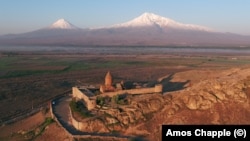

Something seems to be missing from Armenia’s new biometric passport. That’s according to many in the country, who have flagged an unusual image in the document.
Among pages showcasing Armenia’s heritage and culture is a picture of Khor Virap. The 17th century monastery is famous largely for its spectacular backdrop of Mount Ararat. In the passport, however, the monastery is depicted from an angle showing only nondescript mountains on the horizon. Critics have called the unusual image a “ploy” to avoid including Ararat in the official document.

Mount Ararat is situated inside Turkey and officially known by its Turkish name Mount Agri, but the landmark rises prominently above Yerevan on clear days.
The 5,100 meter mountain was a part of ancient kingdoms of Armenia, but ethnic Armenians were driven from settlements around Ararat amid the Ottoman state-led killings, which have been recognized as genocide by dozens of countries including the United States. When borders in the region were redrawn following World War I, Ararat's twin peaks were included within the eastern edge of modern Turkey.
Armenian Prime Minister Nikol Pashinian recently hinted at the controversy over the passport depiction of Khor Virap, saying during a live stream with Interior Minister Arpine Sargsian that, “we’ve chosen such a perspective to suit our policies and what we have discussed for a long time.”
“Given it is the passport of the Republic of Armenia," Pashinian added, the passport reflects “the territory of the Republic of Armenia.”

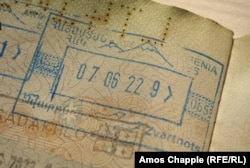
The absence of the mountain in the passports, which are set to be rolled out in the fall of 2026, follows a government decision late last year to remove snow-capped icons of Mount Ararat from passport stamps. That decision led to an uproar in the country, including a lawsuit filed against the government.
Opposition politician Hayk Mamijanian condemned the removal of the mountain from passport stamps at the time, telling reporters “it never ceases to amaze how zealously Pashinian is ready to please Turkey or Azerbaijan."
Since Azerbaijan’s military recapture of the Nagorno-Karabakh region in 2023, Armenia has sought to normalize relations with neighboring Azerbaijan and Turkey, both historic foes of Armenia.
Armenia and Azerbaijan initialled a peace agreement in 2025 that includes a clause indefinitely forbidding either country from making territorial claims on the other. Turkey, a close ally of Baku, has long objected to Armenia’s use of Ararat as a national symbol, including in the coat of arms of the Soviet Republic of Armenia.
Joshua Kucera, a senior analyst for International Crisis Group, says the Khor Virap image appears to be, “part of the larger ‘real Armenia’ narrative that [Pashinian] is promoting, trying to refocus Armenians' attentions to the issues within their own borders rather than ‘historical Armenia’ outside its borders.”
The Caucasus expert says that reframing effort also includes the recaptured Nagorno-Karabakh region of Azerbaijan.
Some fear a more consequential target for the Pashinian government could be the current Armenian coat of arms, which features Ararat as its centerpiece, topped with Noah’s Ark. The mythical vessel is believed by some Christians to have settled atop Mount Ararat following the biblical flood. In 2023, Pashinian criticized the emblem for representing "a dichotomy between historical Armenia and real Armenia.”
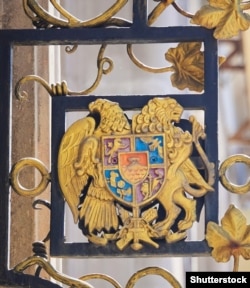
Edmon Marukian, a politician and former ally of the Armenian prime minister, called the 2025 erasure of Mount Ararat from passport stamps a potential precursor to Armenia’s coat of arms being remade. “Removing [Ararat] would require changing the constitution and the law,” the politician noted, adding, “are we, as citizens, ready to tolerate this?”
In April, RFE/RL's Armenian Service asked Pashinian about the potential for Ararat to be removed from the coat of arms. The prime minister responded only that "I am not raising such a question."


,_Emblem_of_Armenia_(1990%E2%80%931992).svg)