Accessibility links

Breaking News

Belarusian Nobel Laureate Says HBO Series Has 'Completely Changed Perception' Of Chernobyl

Updated
"I told my agent: 'Galya, they're going to make another film…' I was far from convinced," said Svetlana Alexievich.

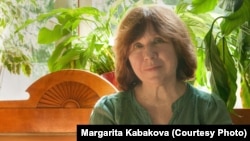
Belarus's Nobel laureate Svetlana Alexievich rolled her eyes when the creators of Chernobyl approached her for permission to use material from her book Voices From Chernobyl for the hit HBO miniseries.

"I told my agent, 'Galya, they're going to make another film...' I was far from convinced. The only thing that convinced me, maybe, was the fee," Alexievich explained in a recent interview with RFE/RL's Belarusian Service.

However, the five-part miniseries about the tragic accident at the Ukrainian nuclear power plant has raked in rave reviews from critics and viewers alike, and Alexievich is no exception.

"It really impressed me. It is a very strong film. There is something there in the aesthetics that touches the modern consciousness. There is a dose of fear. There is reasoning. There is beauty. That is something that has always worried me about evil, when it's not out in the open, when so much is confusing."

And she said that her fellow Belarusians, hard hit by the nuclear fallout scattered into the air when Reactor No. 4 exploded on April 26, 1986, have now had their eyes pried open to the real scale of the tragedy, Alexievich said.


"We are now witnessing a new phenomenon that Belarusians, who suffered greatly and thought they knew a lot about the tragedy, have completely changed their perception about Chernobyl and are interpreting this tragedy in a whole new way. The authors accomplished this, even though they are from a completely different world -- not from Belarus, not from our region," she explained.

Alexievich said the film has especially struck a chord with young Belarusians.

"It's no accident that a lot of young people have watched this film. They say that they watch it together in clubs and discuss it. They are different. For them, questions about the environment, especially in the West, it is through that lens that they understand life."

Alexievich also praised the selection of Johan Renck as director.

"The director is a Swede by nationality. And in the Swedish consciousness there is a deep awareness of the environment," she said.

Meanwhile, Alexievich's book has, in turn, received high praise from Craig Mazin, the writer and producer of Chernobyl, who tweeted on June 13: "I drew historical fact and scientific information from many sources, but Ms. Alexievich's Voices From Chernobyl was where I always turned to find beauty and sorrow."

From the vintage Soviet furniture and trash bins to the period clothing, Chernobyl has been praised for staying incredibly accurate to detail, even using real dialogue, much of it recorded in Alexievich's oral history of the disaster, Voices From Chernobyl.

"There is a lot of my text in the reactions of the people. For example, when people stand on the bridge and admire the fire. Those are the first impressions following the accident. The world's, as well. The director even admitted that all of this was created from the book. I have a contract with them and author's rights of ownership," Alexievich explained.

Some have suggested that the character of Ulana Khomyuk, a Belarusian nuclear physicist bent on uncovering the truth behind the disaster, is based on Alexievich, although Chernobyl's creators have said the figure is inspired by a composite of scientists involved in the disaster. Alexievich isn't convinced the character is based on her either.

"I don't think they wrote Khomyuk with me in mind. [Eimuntas] Nekrosis (the late Lithuanian theater director) before his death put on a play based on [my] The Boys In Zinc. I was supposedly the main figure, but she was absolutely not like me."

Alexievich says having a female protagonist like Khomyuk simply made sense, juxtaposing her against Valery Legasov, who was instrumental in the cleanup after the disaster.

"In the film, there is a need for a leading figure, a woman -- maybe because they took from my view of life, this sense of femininity, the world of the woman. For me, this is very important. In all my books there are many women heroes, not only in the work The Unwomanly Face Of War. This relationship with the living. A woman is extremely capable of detecting the connection of things. Therefore, it was probably necessary to have a woman, not only Legasov. If there had been two men, there would be no story. They introduced a woman and with a man and a woman you get two perspectives. It is very interesting."

Under The Shield: Inside Chernobyl's New Safe Confinement
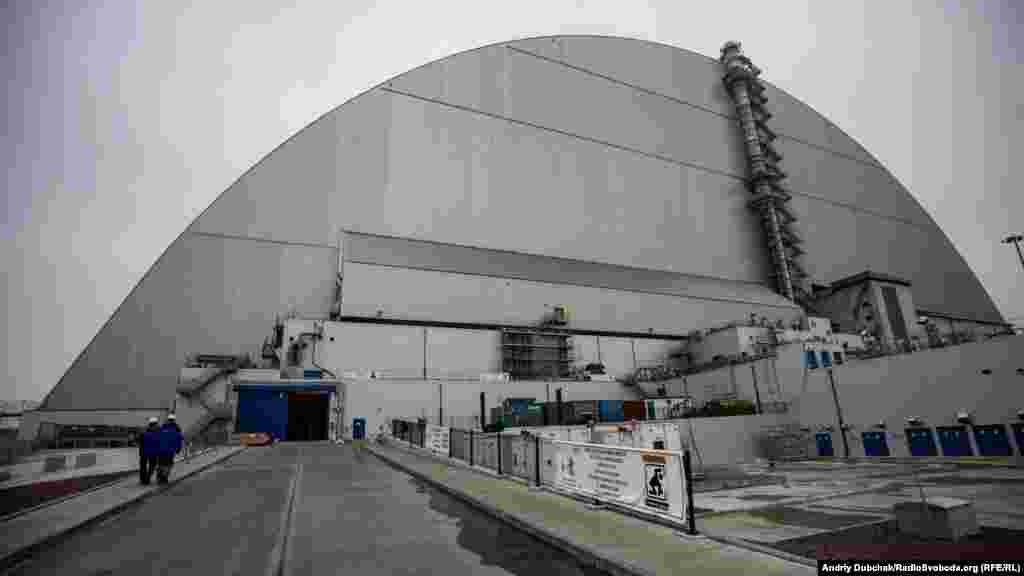
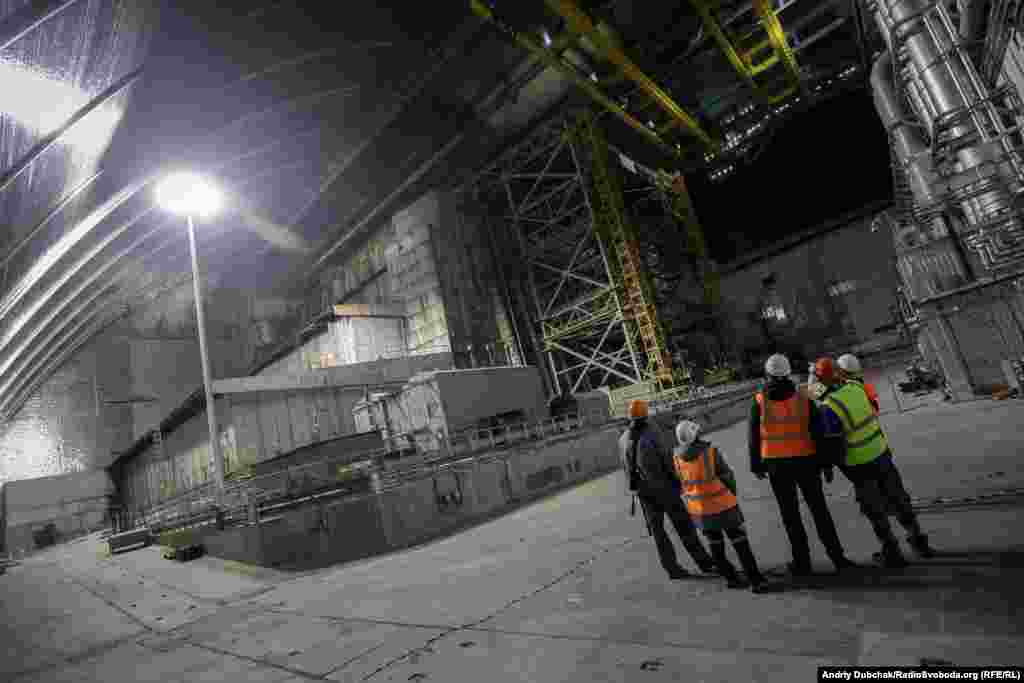
The New Safe Confinement (NSC) was designed to prevent further radiation leaks from Ukraine's stricken Chernobyl nuclear power plant. It took two weeks in November 2016 to slide the massive steel structure into position. At a height of 109 meters and a length of 257 meters, the shield is the world’s largest movable metal structure. It covers the crumbling concrete sarcophagus that encased Chernobyl's reactor number four where an explosion in April 1986 spewed tons of radiation across Europe.
1/14 The New Safe Confinement (NSC) was designed to prevent further radiation leaks from Ukraine's stricken Chernobyl nuclear power plant. It took two weeks in November 2016 to slide the massive steel structure into position. At a height of 109 meters and a length of 257 meters, the shield is the world’s largest movable metal structure. It covers the crumbling concrete sarcophagus that encased Chernobyl's reactor number four where an explosion in April 1986 spewed tons of radiation across Europe.
It has been two years since a giant steel shelter was slid into position over Chernobyl's crumbling radioactive ruins. RFE/RL's Ukrainian Service takes a rare look at operations inside of the containment.
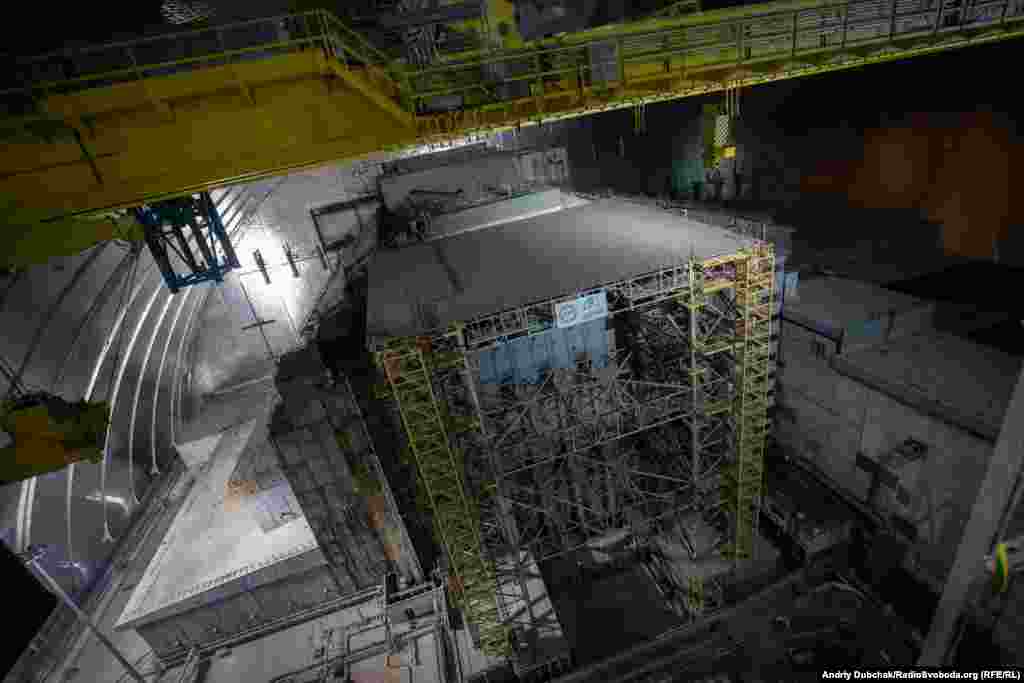
A new steel structure was built under the containment shield to support the decaying concrete sarcophagus in Chernobyl's reactor number four.  Eventually, officials plan to dismantle the sarcophagus and remove the remaining nuclear fuel from the plant. 
2/14 A new steel structure was built under the containment shield to support the decaying concrete sarcophagus in Chernobyl's reactor number four.  Eventually, officials plan to dismantle the sarcophagus and remove the remaining nuclear fuel from the plant. 
It has been two years since a giant steel shelter was slid into position over Chernobyl's crumbling radioactive ruins. RFE/RL's Ukrainian Service takes a rare look at operations inside of the containment.
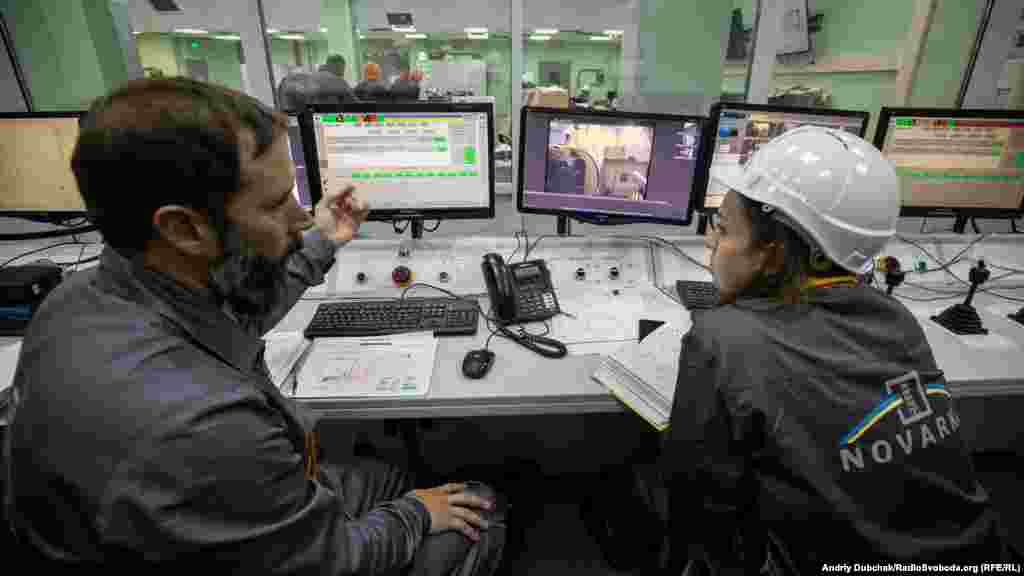
Two nuclear containment specialists inside the main control center at the New Safe Confinement (NSC). Some 3,000 people work at the site, including several foreign specialists. 
3/14 Two nuclear containment specialists inside the main control center at the New Safe Confinement (NSC). Some 3,000 people work at the site, including several foreign specialists. 
It has been two years since a giant steel shelter was slid into position over Chernobyl's crumbling radioactive ruins. RFE/RL's Ukrainian Service takes a rare look at operations inside of the containment.
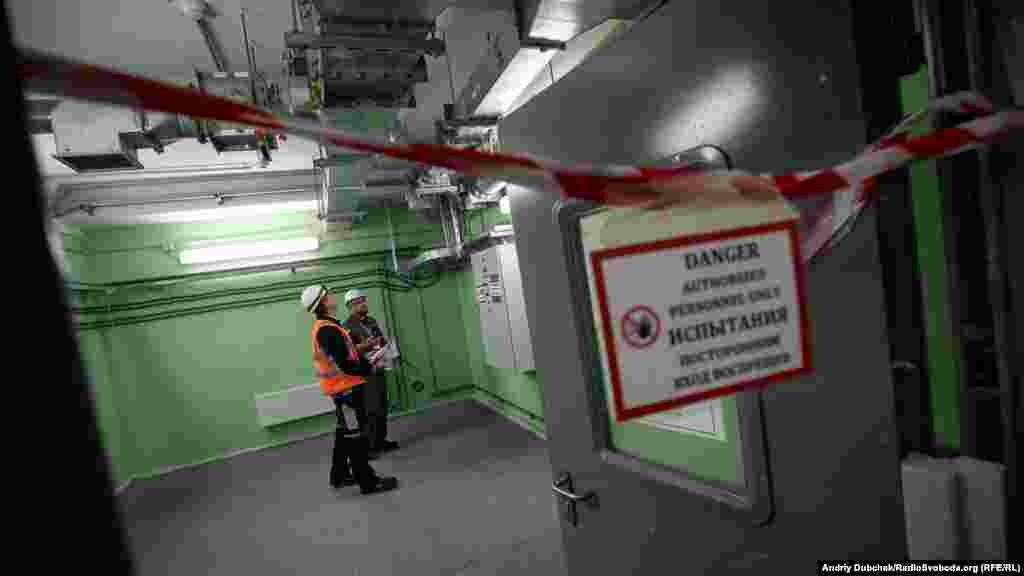
Workers at Chernobyl's New Safe Confinement (NSC) inspect new equipment. Two years after the structure was put into position, containment systems are still being installed and tested.  The cost of the shield was almost $1.6 billion, with funding coming from the European Bank for Reconstruction and Development. 
4/14 Workers at Chernobyl's New Safe Confinement (NSC) inspect new equipment. Two years after the structure was put into position, containment systems are still being installed and tested.  The cost of the shield was almost $1.6 billion, with funding coming from the European Bank for Reconstruction and Development. 
It has been two years since a giant steel shelter was slid into position over Chernobyl's crumbling radioactive ruins. RFE/RL's Ukrainian Service takes a rare look at operations inside of the containment.
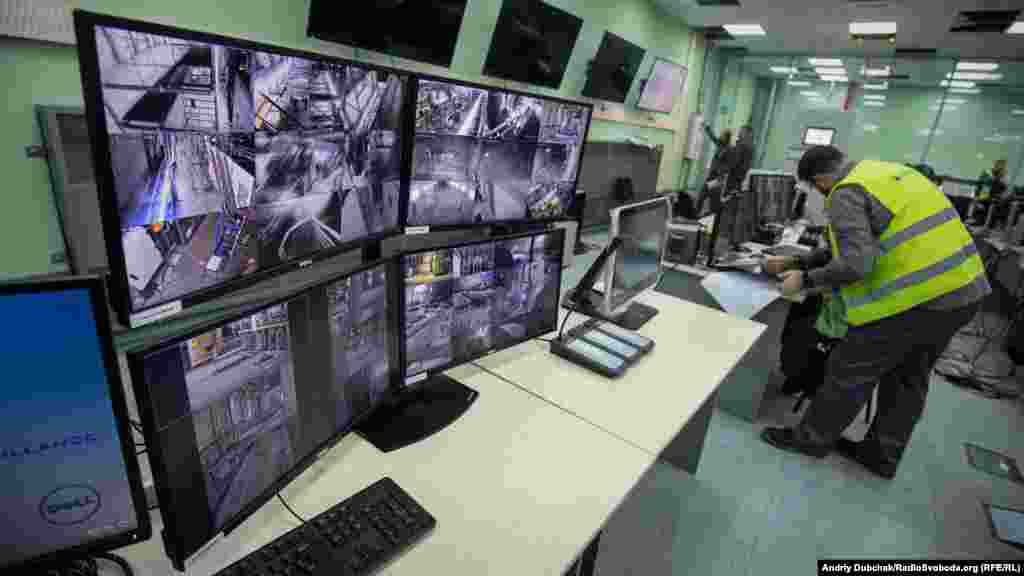
Dozens of robotic cameras are located throughout Chernobyl's New Safe Confinement (NSC). Streaming video is monitored from the structure's main control room known as the Confinement Management Center (CMC). The containment structure is also equipped with automated fire-suppression systems.
5/14 Dozens of robotic cameras are located throughout Chernobyl's New Safe Confinement (NSC). Streaming video is monitored from the structure's main control room known as the Confinement Management Center (CMC). The containment structure is also equipped with automated fire-suppression systems.
It has been two years since a giant steel shelter was slid into position over Chernobyl's crumbling radioactive ruins. RFE/RL's Ukrainian Service takes a rare look at operations inside of the containment.
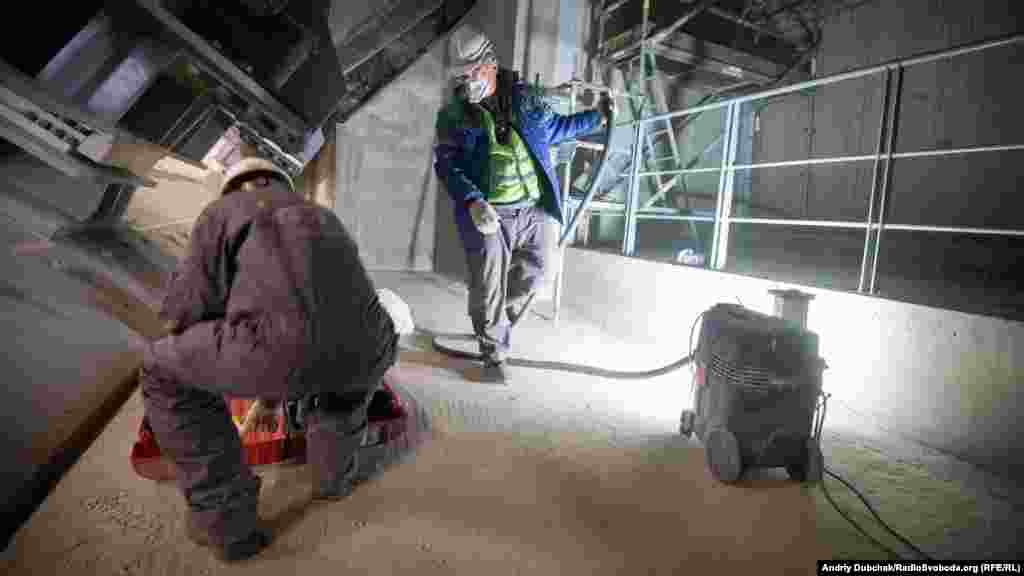
Workers inside the New Safe Confinement (NSC) grind joints of the concrete pillars. Although there can be a lot of dust inside the shield, the level of the radioactivity is relatively low. Officials say there is little risk to the health of the workers. 
6/14 Workers inside the New Safe Confinement (NSC) grind joints of the concrete pillars. Although there can be a lot of dust inside the shield, the level of the radioactivity is relatively low. Officials say there is little risk to the health of the workers. 
It has been two years since a giant steel shelter was slid into position over Chernobyl's crumbling radioactive ruins. RFE/RL's Ukrainian Service takes a rare look at operations inside of the containment.
The old concrete sarcophagus under the New Safe Confinement (NSC). There remains an estimated 200 tons of radioactive fuel inside the crippled reactor.
7/14 The old concrete sarcophagus under the New Safe Confinement (NSC). There remains an estimated 200 tons of radioactive fuel inside the crippled reactor.
It has been two years since a giant steel shelter was slid into position over Chernobyl's crumbling radioactive ruins. RFE/RL's Ukrainian Service takes a rare look at operations inside of the containment.
In order to move around Chernobyl's containment structure, workers must routinely check if they have been exposed to radiation. This worker tests radiation levels with monitoring equipment known as a dosimetric control system.
8/14 In order to move around Chernobyl's containment structure, workers must routinely check if they have been exposed to radiation. This worker tests radiation levels with monitoring equipment known as a dosimetric control system.
It has been two years since a giant steel shelter was slid into position over Chernobyl's crumbling radioactive ruins. RFE/RL's Ukrainian Service takes a rare look at operations inside of the containment.
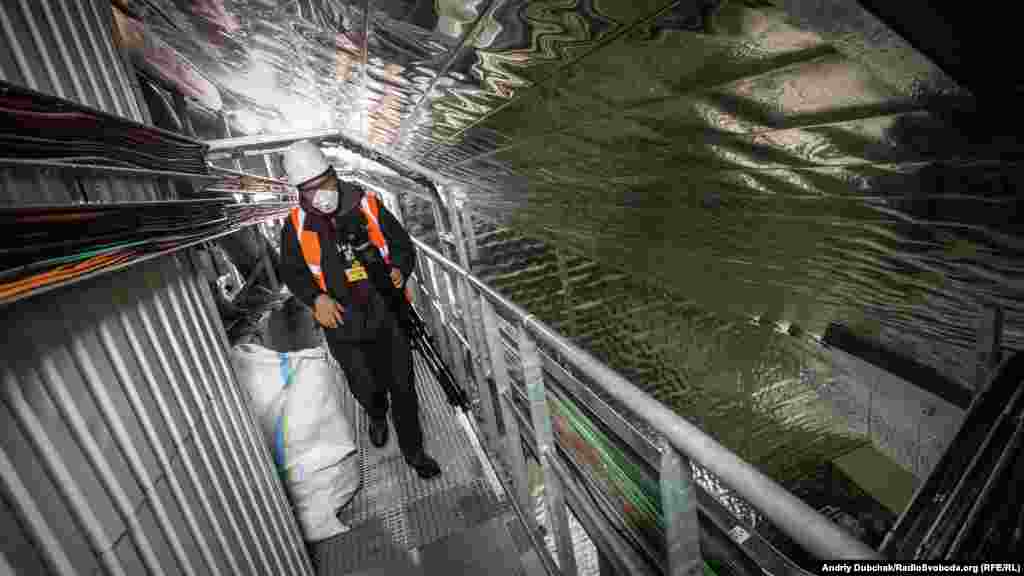
Chernobyl's New Safe Confinement (NSC) contains a labyrinth of passages, suspended walkways, and stairs. Elevators will be used in the future, but are still being installed and tested.
9/14 Chernobyl's New Safe Confinement (NSC) contains a labyrinth of passages, suspended walkways, and stairs. Elevators will be used in the future, but are still being installed and tested.
It has been two years since a giant steel shelter was slid into position over Chernobyl's crumbling radioactive ruins. RFE/RL's Ukrainian Service takes a rare look at operations inside of the containment.
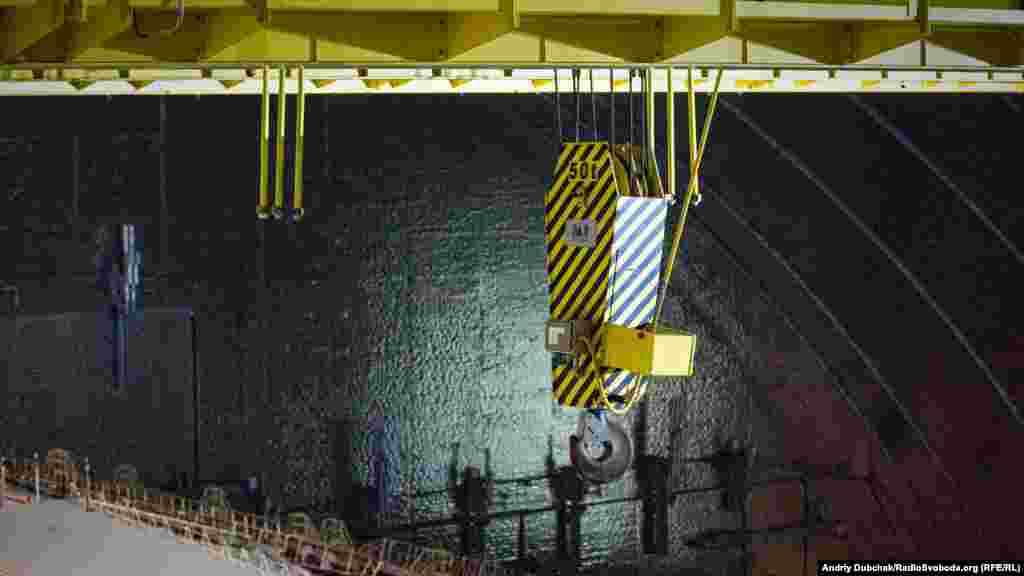
One of the two powerful cranes that have been installed inside the New Safe Confinement (NSC). They were designed to dismantle the old concrete sarcophagus that covers reactor number four. The cranes have so far removed the roof of the reactor's engine room.
10/14 One of the two powerful cranes that have been installed inside the New Safe Confinement (NSC). They were designed to dismantle the old concrete sarcophagus that covers reactor number four. The cranes have so far removed the roof of the reactor's engine room.
It has been two years since a giant steel shelter was slid into position over Chernobyl's crumbling radioactive ruins. RFE/RL's Ukrainian Service takes a rare look at operations inside of the containment.
Visitors are not permitted past this point due to high levels of radiation. In April 1986, the toxicity of the radioactive cloud produced by the Chernobyl accident was the equivalent to 400 Hiroshima atomic explosions.
11/14 Visitors are not permitted past this point due to high levels of radiation. In April 1986, the toxicity of the radioactive cloud produced by the Chernobyl accident was the equivalent to 400 Hiroshima atomic explosions.
It has been two years since a giant steel shelter was slid into position over Chernobyl's crumbling radioactive ruins. RFE/RL's Ukrainian Service takes a rare look at operations inside of the containment.
Workers and visitors must test their radiation levels before being allowed to leave Chernobyl's New Safe Confinement (NSC).
12/14 Workers and visitors must test their radiation levels before being allowed to leave Chernobyl's New Safe Confinement (NSC).
It has been two years since a giant steel shelter was slid into position over Chernobyl's crumbling radioactive ruins. RFE/RL's Ukrainian Service takes a rare look at operations inside of the containment.
Workers leaving the Chernobyl's confinement structure.
13/14 Workers leaving the Chernobyl's confinement structure.
It has been two years since a giant steel shelter was slid into position over Chernobyl's crumbling radioactive ruins. RFE/RL's Ukrainian Service takes a rare look at operations inside of the containment.
Chernobyl's New Safe Confinement (NSC) was designed to contain radiation for the next century.
14/14 Chernobyl's New Safe Confinement (NSC) was designed to contain radiation for the next century.
It has been two years since a giant steel shelter was slid into position over Chernobyl's crumbling radioactive ruins. RFE/RL's Ukrainian Service takes a rare look at operations inside of the containment.
Previous slide
Next slide

Asked about some of the inaccuracies in the series that critics have seized on, Alexievich is dismissive.

"First of all, it is a feature film, and the author is entitled to his interpretation and understanding of things. But they say, 'This minister was fat, old, and now he's young.' Or the opposite. Or the windows weren't like that. If you want to think like that, then if we look at the famous film Battleship Potemkin by Eisenstein, where the baby carriage flies down the steps, then some sailor named Zhalyaznyak would say that that type of revolution never happened. God forbid if the truth about Chernobyl or the gulag system had been in the hands of such people."

Alexievich noted even Russian media were full of praise for the series, at least at first.

"In the beginning, Russian media was very positive about the series and then probably there was some yelling in the Kremlin and they suddenly became very patriotic. Then there was news they are launching their own series about Chernobyl, about how 'our' agents pursue some American spy at the power plant. My God, when I read all this I thought that 30 years have passed and has really nothing changed in the consciousness?"

Despite those initial doubts, Alexievich is convinced that HBO has created a classic with a strong message that she feels needs to be heard.

"Most importantly, I would like that people watch it and think about the type of world we've entered with such dangers. And there are more and more. Artificial intelligence, robots. It's a whole new world."
  • 16x9 Image

    Anna Sous

    Anna Sous is a correspondent for RFE/RL's Belarus Service.​ She is a graduate of the Faculty of Journalism at the Belarusian State University. She worked for the independent newspaper Narodnaya Volya from 1997–2000 and has been with RFE/RL since then. She is a recipient of the Ales Adamovich Prize from the Belarusian PEN Center and was recognized as Journalist of the Year by the Belarusian human rights community in 2019. She is also the creator of Russia And Me -- a series of interviews with 12 former presidents of post-Soviet countries.

  • 16x9 Image

    Tony Wesolowsky

    Tony Wesolowsky is a senior correspondent for RFE/RL in Prague, covering Belarus, Ukraine, Russia, and Central Europe, as well as energy issues. His work has also appeared in The Philadelphia Inquirer, the Christian Science Monitor, and the Bulletin Of The Atomic Scientists.

This item is part of
XS
SM
MD
LG