




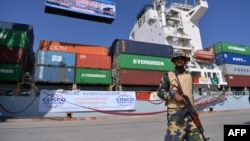
After years of Chinese calls for added measures in Pakistan to safeguard its citizens, Pakistani authorities have announced the creation of a new special police unit to protect Chinese nationals.
“The protection of Chinese citizens and projects of mutual interest remains our top priority,” Pakistani Interior Minister Mohsin Naqvi said on January 7 in Beijing during a meeting with Wang Xiaohong, China's minister of public security.
During their meeting, both officials announced the creation of the new security unit in Islamabad, as well as new joint police training programs and a rapid response system to exchange information about terrorist threats in Pakistan.
“We appreciate Pakistan’s sacrifices in the fight against terrorism,” Wang said, according to a Chinese readout of the meeting.
But despite the warm reception and praise heaped in Beijing, analysts and former officials told RFE/RL that the creation of the new security unit in the Pakistani capital comes amid a low point in China and Pakistan’s relationship, triggered by attacks in recent years that have killed dozens of Chinese nationals in the South Asian country.
Shakil Ahmad Ramay, an Islamabad-based analyst who has written multiple books on China-Pakistan relations, told RFE/RL that Pakistani police are currently poorly equipped to calm Beijing’s anxieties over the safety of its citizens.
"To help ensure the security of the Chinese nationals, Pakistani police need training and equipment,” he said.
Chinese Infrastructure Plans Slowing Down In Pakistan
Thousands of Chinese nationals work in Pakistan, mostly in jobs tied to the $60 billion China-Pakistan Economic Corridor (CPEC), a massive collection of Chinese-backed infrastructure projects.
But the deteriorating security situation -- which has led to 20 Chinese nationals being killed and 34 injured in terror attacks since 2021 -- has added to funding disagreements and corruption scandals to derail the expansive CPEC, which was once a flagship within Beijing’s globe-spanning Belt and Road Initiative (BRI) infrastructure project.

The new specialized police unit in Islamabad is one of multiple security initiatives brought in by Pakistani authorities to assuage Chinese anxieties over the safety of its citizens.
There is already an army brigade in Pakistan’s Balochistan Province assigned to protect Chinese nationals working on CPEC projects and hundreds of new checkpoints have been built along with protective barriers close to the infrastructure projects.
A former Pakistani official who worked on CPEC and spoke to RFE/RL on condition of anonymity in order to discuss sensitive issues, says that the poor security situation, the Pakistani government’s financial struggles, and problems implementing projects on time are all long-standing irritants that have largely derailed CPEC.



“CPEC has not just slowed down, it is almost dead,” the former official said.
While the venture is estimated to be worth $60 billion in total allocated projects, Pakistan has only received roughly $25 billion of that investment in CPEC on the ground since it was launched in 2015.
Asked about the newly announced special unit in Islamabad, the former CPEC official said that it was largely about optics and that “this is meant to keep the project alive in the media.”
Regional Security Issues On The Rise
No Chinese nationals were reported to have been killed in Pakistan in 2025, but the broader security situation brought new obstacles to China’s economic footprint in the region.
A pair of attacks killed five Chinese nationals working at a gold mine near Tajikistan's remote border with Afghanistan in November.
In October, Afghanistan and Pakistan exchanged military attacks, killing dozens of people and leading to Pakistan closing its border with Afghanistan. It was the worst outbreak of hostilities in years and raised fears of an all-out war. In late November, the Taliban accused Pakistan of carrying out air strikes inside Afghanistan that killed at least 10 people, nine of whom were children.
Domestic security issues inside Pakistan also persist.
Balochistan, which is home to many CPEC projects, including Gwadar Port, is Pakistan’s most undeveloped area and is home to a long-running violent insurgency against Islamabad led by the the Balochistan Liberation Army (BLA), an ethno-nationalist militant group seeking independence from Islamabad.
The BLA has targeted Chinese citizens and interests over the years to increase pressure on the Pakistani government, carrying out several high-profile attacks, including a 2019 attack on the Pearl-Continental Hotel in Gwadar and an attack on the Chinese Consulate in Karachi.
Other attacks in Pakistan against Chinese nationals have gone unclaimed, while others, including a 2021 bombing on a bus of Chinese workers on their way to the the Dasu Dam project that killed 13 people, nine of whom were Chinese, were attributed to Tehrik-e Taliban Pakistan (TTP) by Pakistani authorities.

