




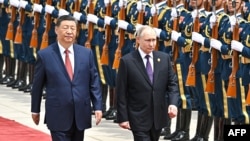
BRUSSELS -- The European Union will meet for high-level talks to discuss Beijing's increasing support for Moscow and to parse evidence that China may be sending weapons to Russia to be used on the battlefield in Ukraine, three EU diplomats told RFE/RL.
Foreign ministers from the bloc's 27 members will meet on December 15 for talks to discuss China's deepening ties with Russia, with an EU diplomat saying that Brussels sees "Chinese support increasing."
"What we are seeing is that without China's support for Russia in this war, Russia probably would not be able to do what it's doing," an EU diplomat told RFE/RL, speaking on condition of anonymity in order to discuss sensitive issues.
A separate EU diplomat added the meeting will focus on recent information of potential Chinese weapons deliveries to Russia that are being used in Ukraine, which, if confirmed, would mark a new level of support from Beijing beyond the steady supply of dual-use goods with civilian and military applications that has boosted the Kremlin's war effort since its full-scale invasion of Ukraine in 2022.
The official did not comment on what types of Chinese weaponry or equipment could be deployed in Ukraine. Chinese parts have been a key component of Russia's drone industry, which forms a vital part of the broader war effort in Ukraine -- from surveillance to kamikaze attacks -- and Ukrainian intelligence said in October that China was passing on satellite intelligence to Russia on targets in Ukraine.
Beijing claims it is neutral in the nearly four-year war and repeatedly said it has not provided weapons to Russia, but China has also continued to deepen political and economic ties with Moscow, including maintaining its status as a top customer for Russian oil and a growing trade partner.
But China's deepening ties to Russia have put Beijing in Europe's crosshairs, with the EU saying in July that China, including Hong Kong, is responsible for "approximately" 80 percent of the circumventions of sanctions against Russia.
In addition to its signs of increasing support for Moscow, EU ministers will also focus on the bloc's economic ties with China, including Chinese export controls placed on strategic rare earth minerals, security issues in the Taiwan Strait and South China Sea, and ongoing geo-economic tensions over the Dutch-based but Chinese-owned chipmaker Nexperia.
The French and German foreign ministers will also debrief other EU ministers on the recent visits to Beijing this month, where both delegations raised the issue of China's close ties to Russia.
In July, Chinese Foreign Minister Wang Yi told EU foreign policy chief Kaja Kallas that Beijing couldn't accept Russia's defeat in the war as it would free up Washington to focus on China. The comments were first reported by the South China Morning Post and later confirmed by RFE/RL.