




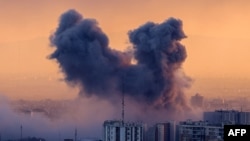
US and Israeli air strikes are delivering military blows against Iran, but Washington still lacks a defined political strategy for what comes after the fighting, Dana Stroul, former deputy assistant secretary of defense for the Middle East, said in an interview with Radio Free Europe/Radio Liberty.

Stroul, now director of research at The Washington Institute for Near East Policy, said Tehran’s conventional capabilities are being degraded but cautioned that Iran still has other options — including cyber operations and activating networks beyond the Middle East — and that pressures from casualties, munitions and interceptor stocks, and global economic fallout could grow the longer the war continues.
RFE/RL: From a US defense policy perspective, what is realistically achievable at this stage of the war with Iran?
Dana Stroul: From a defense policy perspective, I thought what General Kaine, the chairman of our Joint Chiefs of Staff, yesterday said was really important. He said the military objective was to eliminate Iran's ability to project power across the Middle East. And what he means by that are the three major concerns that US defense policymakers have had for a really long time: Iran's nuclear weapons program, Iran's missile program, and Iran's support for terrorism across the Middle East.
And we've seen over the past several days since this war started that, that they are making efforts to degrade and set back each of those different programs.
RFE/RL: What will be the clearest sign that the campaign is moving in that direction at this point?
Stroul: The signs are already there that the military objectives are on track. For example, within the first 48 hours of this campaign, Israel and the United States together achieved air supremacy over Iran. And so US forces moved from using weapons at sea, we call it standoff weapons, to what they say are stand in weapons. We now have fighter aircraft over Iran taking out missiles and drones and things like this.
And from the friends I have in the Middle East, I'm talking to people in the Gulf and Jordan and Israel, they all report that the pace and the intensity of the missile attacks and the drone attacks are going down, which means that we're having some operational effect inside Iran.
But I think it's really important to differentiate those military tools and assessments from the political end state.
And in terms of what the actual strategy is and what the overarching political objectives are, that is something that is for the president, President Trump, to decide and define. And he has not done that yet.
RFE/RL: The Pentagon said that Iran is firing far fewer missiles and drones than at the start of the conflict. What does this tell us actually about Iran's current, current military position?
Stroul: It tells us that conventionally, the United States and Israel working together are able to degrade and really set back Iran's capabilities. So, from a conventional military sense, there is progress in eliminating Iran's air threats and these sorts of actions.
But when it comes to what the political end state is, when the president will say, ‘Okay, we've achieved our objectives’. At this point, the messaging is all over the place.
RFE/RL: How long do you think that Iran can sustain this level of fighting?
Stroul: The question for whatever is left of the Iranian regime is what they define as winning for them, because this is a revolutionary regime who believes that it represents God's will on earth. What they need to do is survive. Even if their missile program is set back, even if the nuclear weapons program is set back. If this is just airstrikes, knowledge still remains, missile programs can be rebuilt as long as the regime survives.
RFE/RL: Do you see others joining this war?
Stroul: Well, I think first of all, Iran had a strategy in the Middle East as soon as the United States and Israel attacked it. And that strategy was to punish the partners and allies of the United States across the Middle East, particularly in the Gulf. And what's very clear is that strategy is not working.
What we've seen is that our Gulf partners, especially in the Gulf Cooperation Council, have really effective air defense and have really pointed the finger at the Iranian regime. They are mad at the indiscriminate attacks on civilian infrastructure across the Middle East, not at the United States and Israel for trying to eliminate Iran's infrastructure.
And I think there are active discussions about how to best eliminate the threats coming out of Iran. So we'll see how that evolves in the coming days.
RFE/RL: As US strike expands deeper into Iran, what should Washington be most focused on now?
Stroul: What Washington has right now is a war that is achieving military effectiveness. What Washington does not have is a strategy or policy for what comes after the fighting ends. And I think in this undefined space, there are several unknowns that could really increase pressure on President Trump.
The first is there could be more American casualties. There were six this week that could increase pressure on him, especially as he comes into a critical midterm election cycle. Number two is this question of US stocks of munitions and missile interceptors versus how long the Iranians can continue to threaten the region. And there are things like the global price of oil, the global economy, supplies. I think this only gets more complicated the longer this war goes on.
RFE/RL: If regional allies move from defensive support to a more active role, can that also change the course of the conflict?
Stroul: It's not going to change the course of the conflict because the United States and Israel can conventionally prevail over Iran on their own. But certainly widening the coalition that's participating in this, I think would have tremendous political value.
So, the question for a lot of countries that have now been pulled into this because of Iran's attacks have to decide is the best way to protect their interests and protect their populations, to continue to focus on defense and using these very expensive missile interceptors to defend their populations, or is the best defense a strong offense, in which case they might decide to join in trying to degrade, push back and destroy some of this missile and drone infrastructure inside Iran.
RFE/RL: How much capability does Iran still have to project threats beyond the Middle East?
Stroul: What's clear is that that conventional capability, the missiles and the drones, is going down with every passing hour. But Iran still has cards to play. What we have not seen yet is Iranian doing Iran taking on offensive cyber operations across the Middle East. We also know that Iran operates a global network of sleeper cells, terror cells all over the world. We have not seen those become activated.
Now, certainly a lot of countries, especially across Europe, the United States, Asia, are aware of this and probably are increasing their information sharing and intelligence and homeland defense. But these are additional options for Iran to make this painful beyond the Middle East, and we haven't seen that happen yet.
RFE/RL: And finally, do you see this war prolonging, or could it end within a few weeks, as it was said?
Stroul: From a military perspective, there are weeks left in terms of what the United States and Israel believe they need to do to eliminate these threats, whether it is sinking the rest of the Iranian navy, as we heard from the secretary of Defense Hegseth yesterday, whether it's continuing to take out the rest of the missile arsenal across Iran, the drone arsenal.
These things are going to take time. So, I would anticipate this going on for weeks. But again, the challenges, we have not heard from President Trump exactly what political end state he is seeking. And the risk is that this just creeps, mission creep and becomes a really protracted conflict.