

Accessibility links

Breaking News

For Displaced Azerbaijanis, Truce Reawakens 'Dream' Of Returning Home

Valida Orucova has spent much of the last three decades raising her family in a village near Baku. Now, she says she's looking forward to returning to her hometown in Nagorno-Karabakh.

BAKU -- In the dusty courtyard of a former sanatorium in Azerbaijan, dozens of school-age children danced and frolicked as grinning mothers, aunts, and grandmothers looked on.

It was a day after the leaders of Armenia and Azerbaijan -- with Russia's imprimatur – agreed to a truce deal meant to bring an end to the reignited war over the breakaway region of Nagorno-Karabakh.

Though the children were too young to have lived through their families' expulsions from the rugged slice of the Caucasus, they'd been swept up by the excitement of their elders.

Azerbaijan's military had retaken much of the territory around Nagorno-Karabakh that had been occupied since the early 1990s.

The truce calls for territory in the remaining occupied districts around Nagorno-Karabakh to be handed to Baku's control after fighting that erupted again on September 27, with thousands thought to have been killed on each side.

It is a day that 56-year-old Valida Orucova has waited half her life for.

She and her extended family fled in 1992 from violence in her hometown of Khojali, less than 20 kilometers north of Nagorno-Karabakh's main city -- known as Stepanakert to Armenians but Xankendi to Azerbaijanis.

"I long to return there," Orucova says. "I'm exhausted from thinking about it. Where should I go first? To [Khojali] to my father's [old] house? Or should I go to my mother-in-law's empty house?"

Orucova talks about drinking fresh spring water from either of two nearby fountains, one of which was labeled "Boys" and the other "Girls" back when she taught kindergarten there.

"I dream of walking down and drinking from those waters," she says. "I would feel like I was born again. I'd like to look at my village from the hill."

Since leaving Khojali, Orucova has spent much of the last three decades raising her family in less idyllic surroundings -- like the Gizilgum sanatorium in a village near Baku where her grandchildren were among those dancing in celebration.

The sanatorium was transformed long ago into a makeshift residence for dozens of families displaced by the war following the dissolution of the Soviet Union.

Orucova wants to teach Khojali pupils again. She also wants her own grandchildren to attend the old kindergarten.

But like many of the hundreds of thousands of Azerbaijani internally displaced persons (IDPs) who were forced from Nagorno-Karabakh and its surrounding districts, Orucova also wonders if she has grown too old to brave the return.

"We'll see," she says.

No Simple Cease-Fire

The original conflict, which peaked in 1992-94 after the collapse of the Soviet Union, forced more than a million people from all sides to flee their homes.

The conflict was frozen by a shaky cease-fire that failed to satisfy either side but left about one-eighth of Azerbaijan's territory under the control of ethnic Armenian separatists.

There were several surges of sporadic violence over the decades, with a full-scale war erupting again in late September.

The November 9 Russian-brokered truce came as a relief to an international community that increasingly feared fighting might draw in neighboring Russia and Turkey.

But the truce has sparked unrest in Armenia, which swallowed the brunt of the pain after its outmatched troops and separatist allies in Nagorno-Karabakh were routed by Azerbaijan's larger, better-equipped forces.

Many Armenians regard the settlement as a surrender and a national tragedy -- in some cases, a betrayal -- of historic proportions.

The ethnic Armenian separatists who'd occupied seven districts of Azerbaijan around Nagorno-Karabakh since the early 1990s had regarded the territory as a "security zone" around their breakaway region.

Azerbaijani forces recaptured most of four occupied districts in about six weeks of recent fighting.

The Russian-brokered truce calls for the remaining occupied territory to be handed over within days.

The truce also calls for ethnic Armenians to withdraw from those three remaining districts: Agdam; Kashatagh (which Azeris call Lachin) and Karvachar, which is known as Kalbacar in Azeri.

Baku on November 15 said it had granted an extension on the Armenian withdrawal from the mountainous district of Kalbacar, though it refused to budge on the timelines for the handover of Agdam and Lachin.

Most of the predominantly ethnic Armenian civilian population in and around Nagorno-Karabakh, which was itself home to around 150,000 people, fled during the latest fighting.

Mass Exodus As Armenians Flee Nagorno-Karabakh
please wait

No media source currently available

0:00 0:03:27 0:00

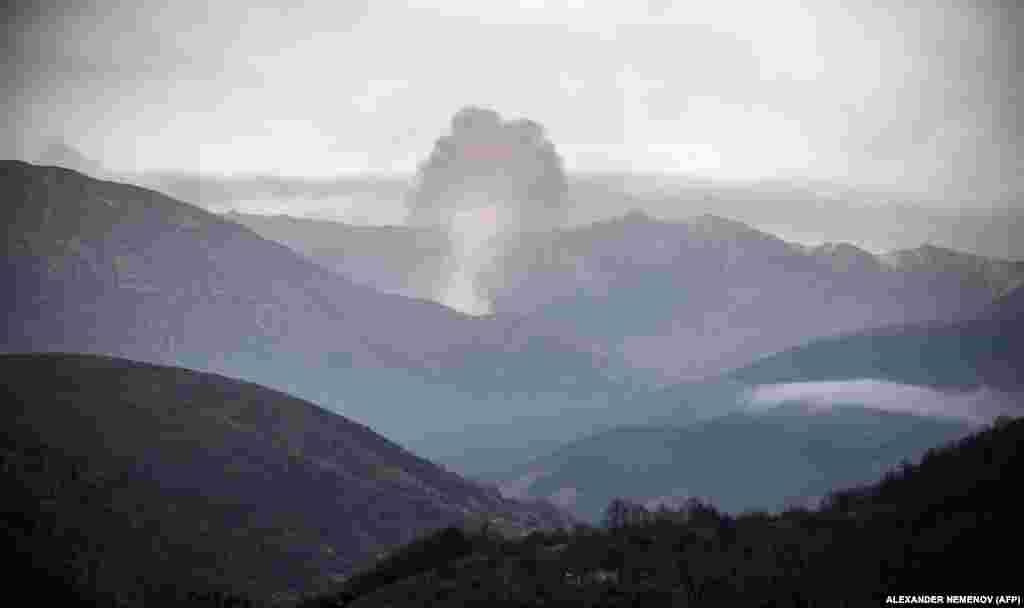
Last week, many who stayed behind in the districts to be handed over were busy heaping furniture, windows, toilets, and fixtures, into trucks or other vehicles to haul them off to an uncertain future.

There have been searing scenes of ethnic Armenians torching their homes -- particularly in Karvachar/Kalbacar -- before heading west toward Armenia.

Scorched Earth: Ethnic Armenians Destroy Homes, Infrastructure Before Fleeing Azerbaijani Regions

Residents watch houses smolder in Charektar village, known in Azeri as Caraktar, in the district of Karvachar (Kalbacar in Azeri). The mountainous district in Azerbaijan to the west of Nagorno-Karabakh is being vacated by Armenians and returned to Baku’s control under a Russian-brokered truce.
1/18 Residents watch houses smolder in Charektar village, known in Azeri as Caraktar, in the district of Karvachar (Kalbacar in Azeri). The mountainous district in Azerbaijan to the west of Nagorno-Karabakh is being vacated by Armenians and returned to Baku’s control under a Russian-brokered truce.
Many ethnic Armenians who are fleeing the regions around Azerbaijan’s breakaway region of Nagorno-Karabakh have opted to destroy their homes after removing as much as they can carry. The destruction comes ahead of a scheduled handover to Azerbaijan of territory seized by Armenians during a war in the early 1990s.
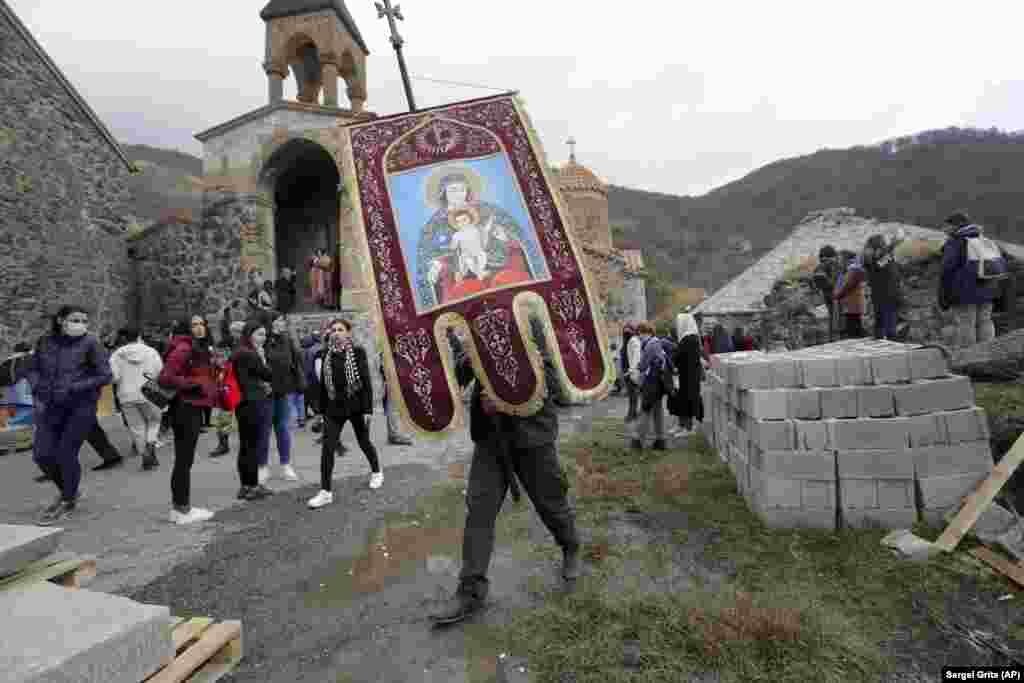
An Armenian church worker carries a religious pennant out of the Dadivank monastery in the district of Karvachar/Kalbacar.
2/18 An Armenian church worker carries a religious pennant out of the Dadivank monastery in the district of Karvachar/Kalbacar.
Many ethnic Armenians who are fleeing the regions around Azerbaijan’s breakaway region of Nagorno-Karabakh have opted to destroy their homes after removing as much as they can carry. The destruction comes ahead of a scheduled handover to Azerbaijan of territory seized by Armenians during a war in the early 1990s.
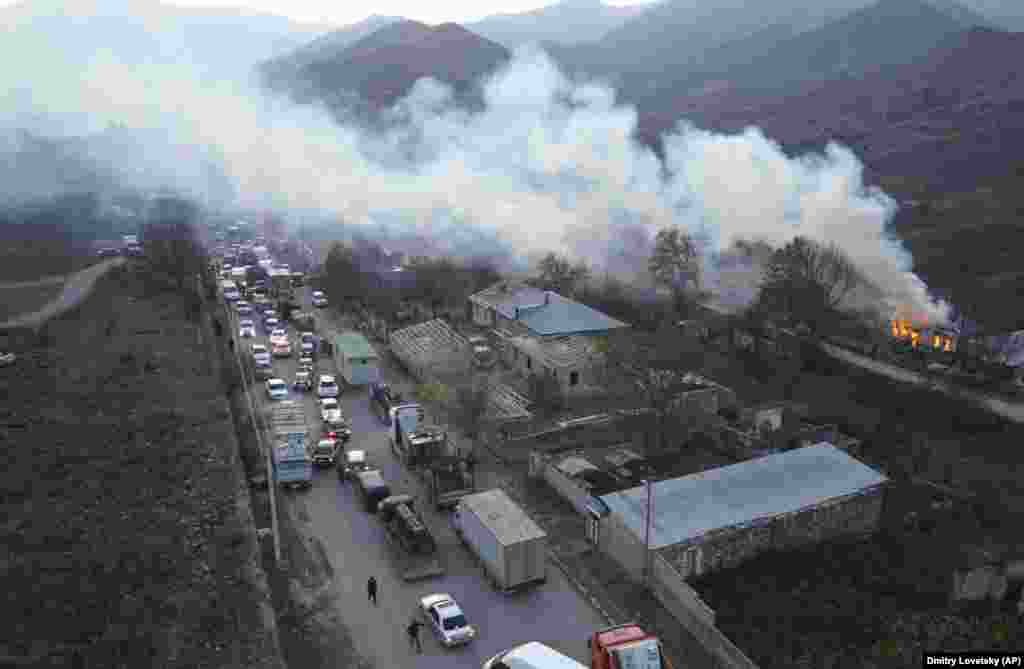
Smoke from a burning house drifts over a traffic jam as ethnic Armenians flee Karvachar/Kalbacar – which is internationally recognized as part of Azerbaijan. Ethnic Armenians point to ancient Christian monuments in the area that mark their historic ties to the land.
3/18 Smoke from a burning house drifts over a traffic jam as ethnic Armenians flee Karvachar/Kalbacar – which is internationally recognized as part of Azerbaijan. Ethnic Armenians point to ancient Christian monuments in the area that mark their historic ties to the land.
Many ethnic Armenians who are fleeing the regions around Azerbaijan’s breakaway region of Nagorno-Karabakh have opted to destroy their homes after removing as much as they can carry. The destruction comes ahead of a scheduled handover to Azerbaijan of territory seized by Armenians during a war in the early 1990s.
A burnt-out gas station near the Dadivank monastery in the district of Karvachar/Kalbacar. Hundreds of thousands of Azerbaijanis were forced to flee their homes in districts around Nagorno-Karabakh when Yerevan-backed Armenian separatists seized control of the territory during the early 1990s.
4/18 A burnt-out gas station near the Dadivank monastery in the district of Karvachar/Kalbacar. Hundreds of thousands of Azerbaijanis were forced to flee their homes in districts around Nagorno-Karabakh when Yerevan-backed Armenian separatists seized control of the territory during the early 1990s.
Many ethnic Armenians who are fleeing the regions around Azerbaijan’s breakaway region of Nagorno-Karabakh have opted to destroy their homes after removing as much as they can carry. The destruction comes ahead of a scheduled handover to Azerbaijan of territory seized by Armenians during a war in the early 1990s.
Ethnic Armenian soldiers topple a telephone pole in the village of Knaravan – a settlement recently built by ethnic Armenians in the Karvachar/Kalbacar district near Azerbaijan’s border with Armenia.
5/18 Ethnic Armenian soldiers topple a telephone pole in the village of Knaravan – a settlement recently built by ethnic Armenians in the Karvachar/Kalbacar district near Azerbaijan’s border with Armenia.
Many ethnic Armenians who are fleeing the regions around Azerbaijan’s breakaway region of Nagorno-Karabakh have opted to destroy their homes after removing as much as they can carry. The destruction comes ahead of a scheduled handover to Azerbaijan of territory seized by Armenians during a war in the early 1990s.
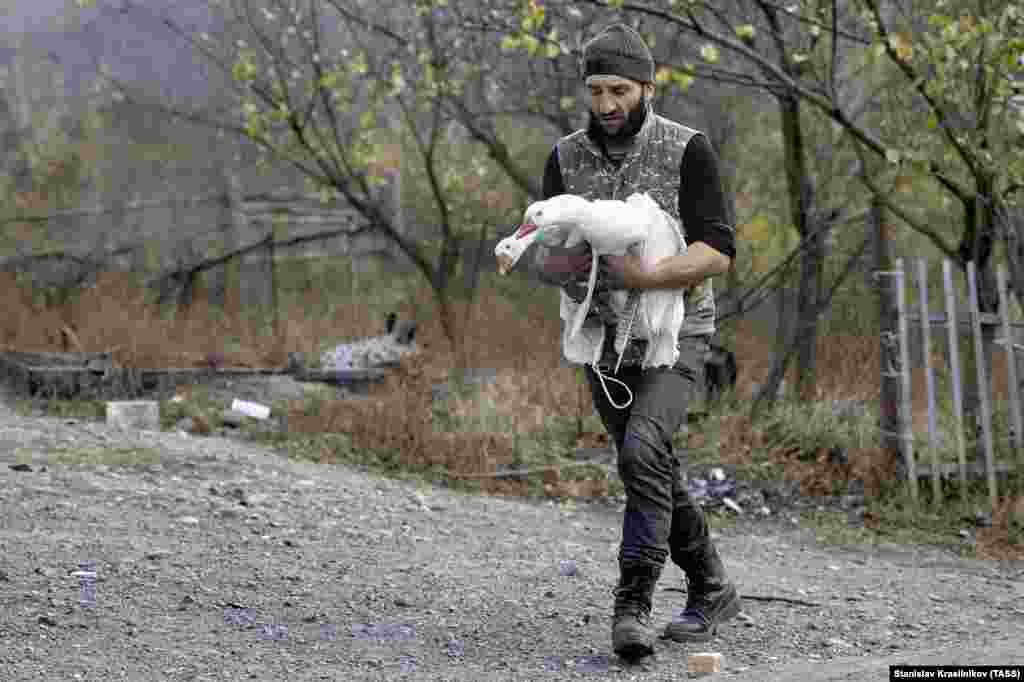
An ethnic Armenian man carries two geese as he packs up the contents of his home in the village of Charektar/Caraktar.
6/18 An ethnic Armenian man carries two geese as he packs up the contents of his home in the village of Charektar/Caraktar.
Many ethnic Armenians who are fleeing the regions around Azerbaijan’s breakaway region of Nagorno-Karabakh have opted to destroy their homes after removing as much as they can carry. The destruction comes ahead of a scheduled handover to Azerbaijan of territory seized by Armenians during a war in the early 1990s.
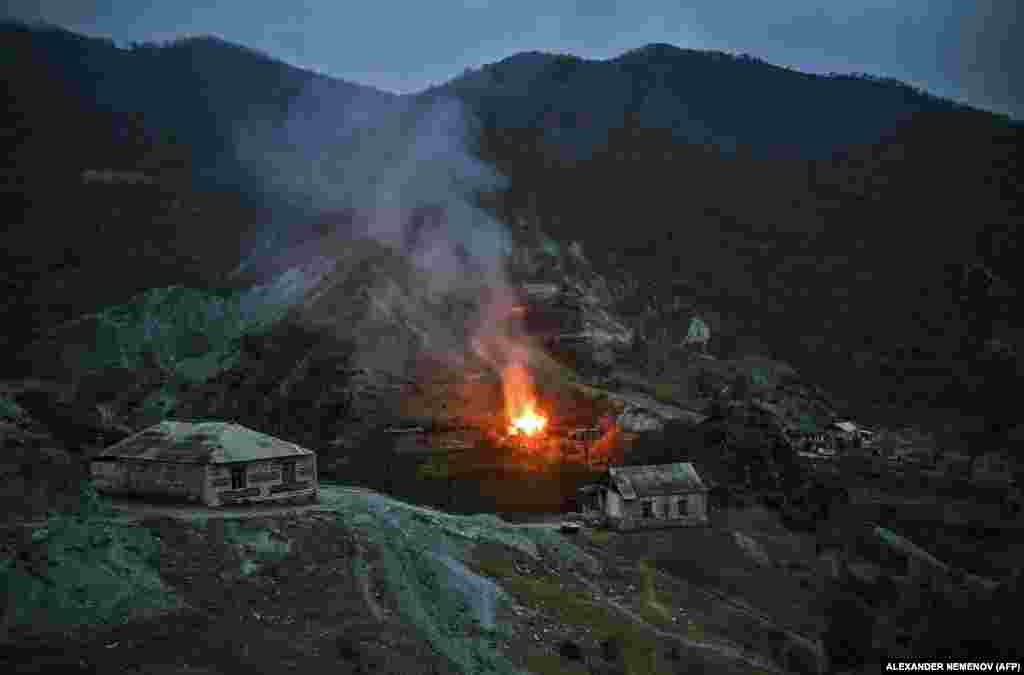
A house burns into the night in the district of Karvachar/Kalbacar.
7/18 A house burns into the night in the district of Karvachar/Kalbacar.
Many ethnic Armenians who are fleeing the regions around Azerbaijan’s breakaway region of Nagorno-Karabakh have opted to destroy their homes after removing as much as they can carry. The destruction comes ahead of a scheduled handover to Azerbaijan of territory seized by Armenians during a war in the early 1990s.
A home smolders in Charektar/Caraktar village.
8/18 A home smolders in Charektar/Caraktar village.
Many ethnic Armenians who are fleeing the regions around Azerbaijan’s breakaway region of Nagorno-Karabakh have opted to destroy their homes after removing as much as they can carry. The destruction comes ahead of a scheduled handover to Azerbaijan of territory seized by Armenians during a war in the early 1990s.
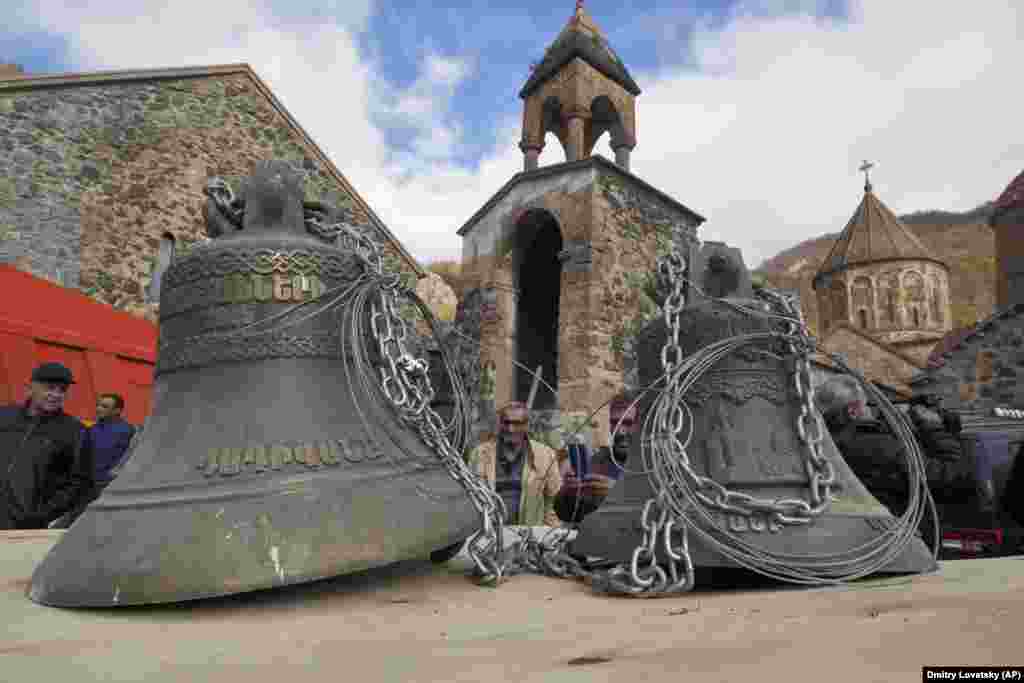
Bells removed from Dadivank monastery await transport to Armenia as preparations are made for ethnic Armenians to transfer control of the Karvachar/Kalbacar district back to Azerbaijan.
9/18 Bells removed from Dadivank monastery await transport to Armenia as preparations are made for ethnic Armenians to transfer control of the Karvachar/Kalbacar district back to Azerbaijan.
Many ethnic Armenians who are fleeing the regions around Azerbaijan’s breakaway region of Nagorno-Karabakh have opted to destroy their homes after removing as much as they can carry. The destruction comes ahead of a scheduled handover to Azerbaijan of territory seized by Armenians during a war in the early 1990s.
Smoke rises from buildings set ablaze in the Karvachar/Kalbacar district of Azerbaijan as ethnic Armenians leave the area.
10/18 Smoke rises from buildings set ablaze in the Karvachar/Kalbacar district of Azerbaijan as ethnic Armenians leave the area.
Many ethnic Armenians who are fleeing the regions around Azerbaijan’s breakaway region of Nagorno-Karabakh have opted to destroy their homes after removing as much as they can carry. The destruction comes ahead of a scheduled handover to Azerbaijan of territory seized by Armenians during a war in the early 1990s.
A man removes wiring from a telephone pole in the village of Yekhetnut in the district of Karvachar/Kalbacar.
11/18 A man removes wiring from a telephone pole in the village of Yekhetnut in the district of Karvachar/Kalbacar.
Many ethnic Armenians who are fleeing the regions around Azerbaijan’s breakaway region of Nagorno-Karabakh have opted to destroy their homes after removing as much as they can carry. The destruction comes ahead of a scheduled handover to Azerbaijan of territory seized by Armenians during a war in the early 1990s.
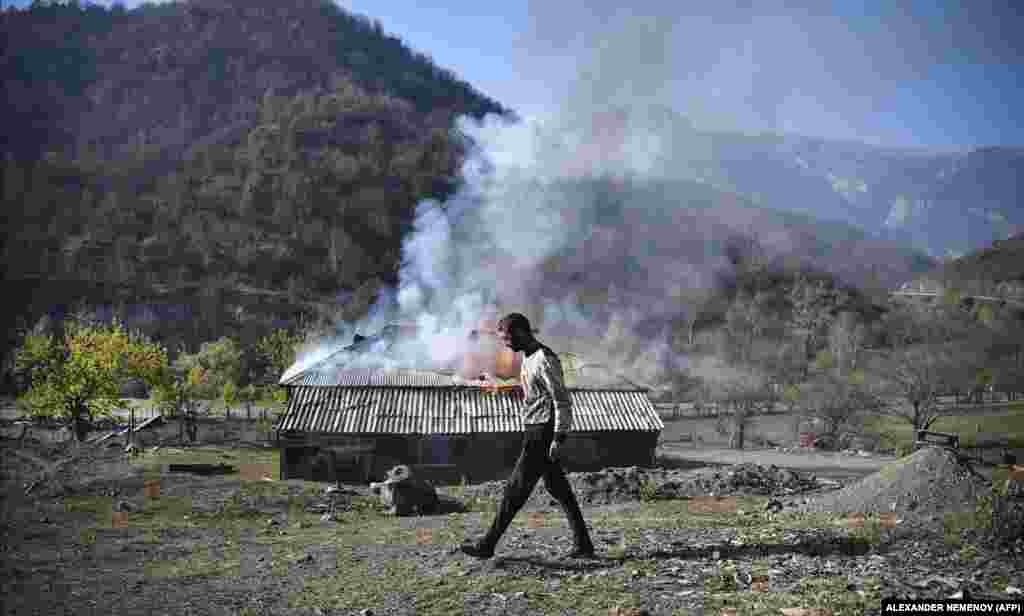
A man walks past a burning house in Charektar/Caraktar village.
12/18 A man walks past a burning house in Charektar/Caraktar village.
Many ethnic Armenians who are fleeing the regions around Azerbaijan’s breakaway region of Nagorno-Karabakh have opted to destroy their homes after removing as much as they can carry. The destruction comes ahead of a scheduled handover to Azerbaijan of territory seized by Armenians during a war in the early 1990s.
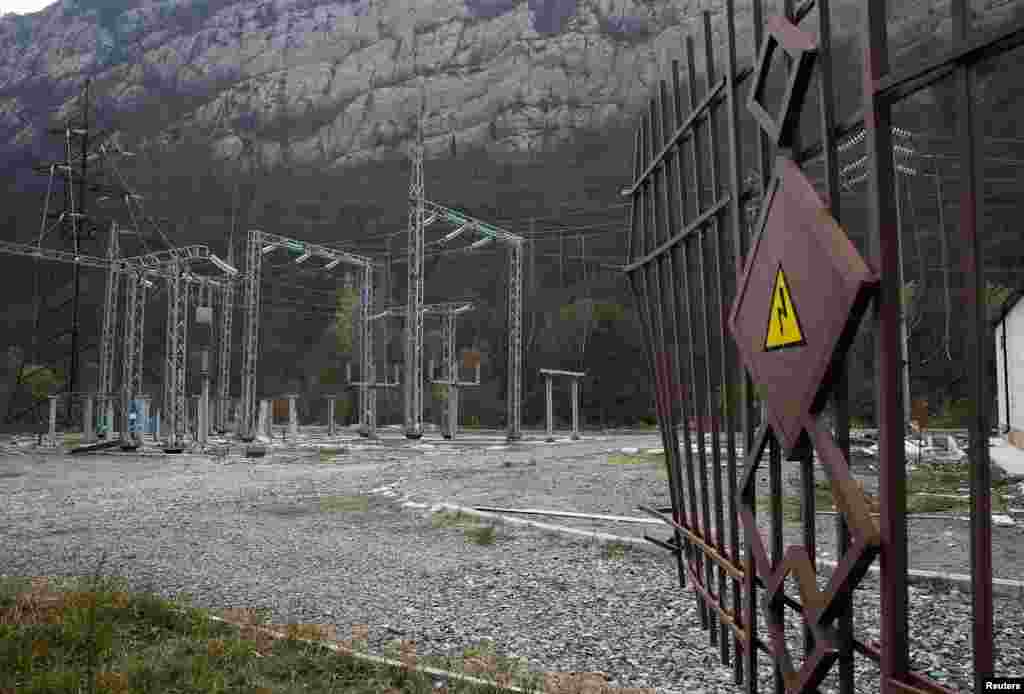
An electrical substation in Karvachar/Kalbacar after key components were removed.
13/18 An electrical substation in Karvachar/Kalbacar after key components were removed.
Many ethnic Armenians who are fleeing the regions around Azerbaijan’s breakaway region of Nagorno-Karabakh have opted to destroy their homes after removing as much as they can carry. The destruction comes ahead of a scheduled handover to Azerbaijan of territory seized by Armenians during a war in the early 1990s.
Garo Dadevusian (right) salvages the tin roof from his house in Karvachar/Kalbacar before setting the building ablaze.
14/18 Garo Dadevusian (right) salvages the tin roof from his house in Karvachar/Kalbacar before setting the building ablaze.
Many ethnic Armenians who are fleeing the regions around Azerbaijan’s breakaway region of Nagorno-Karabakh have opted to destroy their homes after removing as much as they can carry. The destruction comes ahead of a scheduled handover to Azerbaijan of territory seized by Armenians during a war in the early 1990s.
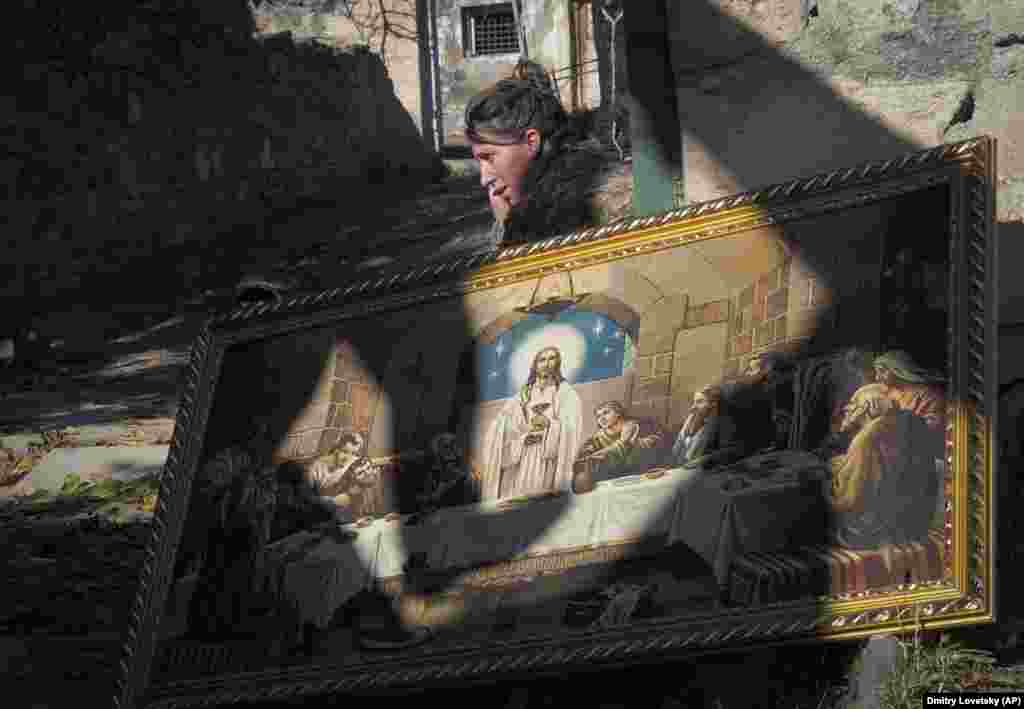
A woman carries a Christian painting out of her home before fleeing Karvachar/Kalbacar.
15/18 A woman carries a Christian painting out of her home before fleeing Karvachar/Kalbacar.
Many ethnic Armenians who are fleeing the regions around Azerbaijan’s breakaway region of Nagorno-Karabakh have opted to destroy their homes after removing as much as they can carry. The destruction comes ahead of a scheduled handover to Azerbaijan of territory seized by Armenians during a war in the early 1990s.
Ethnic Armenians in a truck pass houses destroyed in the recently built ethnic-Armenian settlement of Knaravan before control of the Karvachar/Kalbacar district is returned to Azerbaijan.
16/18 Ethnic Armenians in a truck pass houses destroyed in the recently built ethnic-Armenian settlement of Knaravan before control of the Karvachar/Kalbacar district is returned to Azerbaijan.
Many ethnic Armenians who are fleeing the regions around Azerbaijan’s breakaway region of Nagorno-Karabakh have opted to destroy their homes after removing as much as they can carry. The destruction comes ahead of a scheduled handover to Azerbaijan of territory seized by Armenians during a war in the early 1990s.
A dog in front of a burnt-out school building in Charektar/Caraktar.
17/18 A dog in front of a burnt-out school building in Charektar/Caraktar.
Many ethnic Armenians who are fleeing the regions around Azerbaijan’s breakaway region of Nagorno-Karabakh have opted to destroy their homes after removing as much as they can carry. The destruction comes ahead of a scheduled handover to Azerbaijan of territory seized by Armenians during a war in the early 1990s.
An ethnic Armenian couple embraces while watching their home burn in Charektar/Caraktar.
18/18 An ethnic Armenian couple embraces while watching their home burn in Charektar/Caraktar.
Many ethnic Armenians who are fleeing the regions around Azerbaijan’s breakaway region of Nagorno-Karabakh have opted to destroy their homes after removing as much as they can carry. The destruction comes ahead of a scheduled handover to Azerbaijan of territory seized by Armenians during a war in the early 1990s.
Previous slide
Next slide

The Stuff Of 'Dreams'

But to the east of the battlefield, in Azerbaijani-controlled territory, there is almost unbridled joy.

"We are very happy," says Gulzar Guliyeva, who is originally from a part of the Lachin district that still must be handed over to Baku's control.

Guliyeva and her family live in a converted dormitory in Sumqayit, an industrial city outside the capital that hosts the Peace Dove monument.

"We're waiting for the moment when we'll be able to go back to our land and our home," she says. "We can even sleep on the ground [for all I care]."

Another former Lachin resident in Sumqayit tells RFE/RL: "Every day, we would see our [former] city in our dreams. We've lived like this for 27 years."

In Zabrat, a village near Baku, dozens of IDP families originally from the Karvachar/Kalbacar district live among the tiled courtyards of an area now dubbed as the "Kalbacar neighborhood."

Nagorno-Karabakh: Azerbaijanis Plan Return As Armenians Destroy Homes Nagorno-Karabakh: Azerbaijanis Plan Return As Armenians Destroy Homes
please wait

No media source currently available

0:00 0:02:02 0:00

Resident Sevinj Mursalova says neither her family nor their neighbors slept the night that the truce was signed.

"It is impossible to describe it in words...," she tells RFE/RL's Azerbaijani Service. "We've never had such happiness in our lives and probably will not experience such happiness again.

Fifty-two-year-old Azerbaijani IDP Latif Misalovsa says he hopes to get back to Kalbacar via a road that he remembers being closed in 1992.

"We'll go that way," he says. "Inshallah, I'll return to my village. I'll live there -- I'll live my best days there."

What Will Returnees Find?

Few of Azerbaijan's IDPs who vow to return have any idea what they'll be returning to.

Many of the homes they left decades ago are now gutted ruins.

In some cases, these ruins are hauntingly visible from homes erected or occupied by ethnic Armenians who moved into the area with the encouragement of the Armenian government during the late 1980s and early 1990s.

The scars of the expulsions and displacement are deep.

Orucova's home, Khojali, was the scene of a notorious massacre of as many as 600 Azeris by ethnic Armenian forces in 1992.

Orucova recalls telling her children that, if she died, they would one day return to find their house near Khojali's airport -- the only airport in Nagorno-Karabakh.

"There was a hill there called Hacatapa -- the third house was ours," she remembers telling them, "I don't know if the house is OK now, because we see [images showing] that most of the houses in the occupied lands have been destroyed."

Amina Huseynova is a grandmother who lives near her son and his seven children in a neighborhood of Musfigabad, near Baku.

She tells RFE/RL that her entire family plans to return to their prewar home in a town that Azeris refer to as Xocavend but Armenians call Martuni.

While some neighboring homes were burned down during the war in the 1990s, her husband entrusted the keys of their home to his supervisor, who was an ethnic Armenian.

He, in turn, entrusted it to an acquaintance from Yerevan, the Armenian capital.

Huseynova says the man in Yerevan "told my husband that 'if your family returns, I'll give you the house back.' If not, he was going to live in that house himself."

Now, Huseynova says she has no idea whether the building is still standing and, if so, who lives there.

Questions About The Future

Even Azerbaijanis who weren't displaced by war acknowledge the challenges of overcoming divisions rooted in decades of conflict.

Some question whether the territory spelled out in the truce deal can ever again be home to both ethnic Armenians and Azeris.

"I don't think we can live together like we did during the Soviet Union," one Baku man tells RFE/RL. "But if the president says we should do that, of course we must do that."

Azerbaijan's president, Ilham Aliyev, has been challenged by the international community and rights groups to ensure the safety of all who live in the area.

But Aliyev is likely to encourage Azerbaijanis to resettle the territory as a wave of euphoria washes over the oil-rich country of about 10 million people.

Aliyev had been pumping the proceeds from oil and natural gas sales into building up Azerbaijan's military for much of the past decade.

He has also loudly criticized Armenian intransigence and international disinterest in a lasting solution to the Nagorno-Karabakh problem.

All the while, Aliyev also quietly courted greater cooperation with NATO-member Turkey and its increasingly autocratic president, Recep Tayyip Erdogan.

Turkish drones, military tactics, and diplomatic support proved essential to Azerbaijan's gains in the renewed war.

Aliyev's gambit appeared to pay off with quick military victories on the battlefield that tilted talk about a new cease-fire deal in Baku's direction.

Aliyev repeatedly insisted during Azerbaijan's military offensive that his ultimate aim was the return of all of the occupied territory, including Nagorno-Karabakh.

"We can live together with them, but only on one condition," another Baku resident says when asked about living side-by-side with ethnic Armenians. "They should give all our lands back."

Written by Andy Heil with reporting by RFE/RL Azerbaijani Service correspondents and contributions by Rovshan Gambarov
  • 16x9 Image

    Andy Heil

    Andy Heil is a Prague-based senior correspondent covering Central and Southeastern Europe and the North Caucasus, and occasionally science and the environment. Before joining RFE/RL in 2001, he was a longtime reporter and editor of business, economic, and political news in Central Europe, including for the Prague Business Journal, Reuters, Oxford Analytica, and Acquisitions Monthly, and a freelance contributor to the Christian Science Monitor, Respekt, and Tyden. 

  • 16x9 Image

    RFE/RL's Azerbaijani Service

    Despite near-total government control over the media, RFE/RL's Azerbaijani Service has built a high-impact social-media presence in Azerbaijan and a reputation as a leading source of independent news.

This item is part of
XS
SM
MD
LG