



Accessibility links

Breaking News

News

Draft Law On Foreign Agents Passes Republika Srpska's Legislature

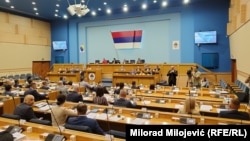
The National Assembly of Republika Srpska (file photo)

The National Assembly of Republika Srpska has adopted a controversial draft law that would require nonprofit organizations funded from abroad and active in Bosnia-Herzegovina's Serb entity to register and report on their work.

The so-called foreign agents law, formally known as the Special Register and Publicity of the Work of Nonprofit Organizations law, passed on September 28.

Whether the draft law will receive final approval and be implemented remains uncertain. It must still go through additional procedural steps before taking effect.

The law would require mandatory additional registration requirements and the submission of detailed financial reports. It also would prohibit NGOs receiving foreign funding to take part in political activities and would give the justice minister the authority to propose a ban on noncompliant organizations.

The draft law has been sharply criticized by U.S. and EU officials, who have called it repressive and anti-democratic.

In presenting the law to the National Assembly, Justice Minister Milos Bukejlovic said he would monitor the activities of organizations receiving foreign funding "across the territory of the whole of Bosnia and Herzegovina."

The draft law was approved by Republika Srpska's executive in March, and Bukejlovic said then the goal was "to prevent the misuse of nonprofit organizations."

The law was proposed last year by Milorad Dodik, the pro-Russian president of the Republic of Srpska and leader of the ruling Alliance of Independent Social Democrats (SNSD) party. At that time Dodik claimed that the law's framework “would be inspired by the American model,” a reference to the U.S. Foreign Agents Registration Act (FARA).

A similar foreign agents law in Russia has proved controversial and has been used to disrupt the work of media organizations, including RFE/RL. Russia also claimed its law was in response to the FARA.

U.S. officials have argued that Russia uses its foreign agents law to silence dissent and discourage the free exchange of ideas and have said there is there "no equivalence" between FARA and Russia’s foreign agents law.

Civil society organizations in Republika Srpska say the law has more in common with the Russian law than with FARA.

In addition to U.S. and EU criticism, the proposed legislation has drawn negative assessments from various organizations, including NGOs and domestic and international entities.

Transparency International of Bosnia said it contravenes the European Convention on Human Rights and Freedoms, the constitutions of both the state and Bosnia's entities, as well as existing laws within Republika Srpska.

More News

Updated

Mahsa Amini And Iran's 'Women, Life, Freedom' Movement Win EU's Sakharov Prize

A demonstrator holds a portrait of Mahsa Amini at a protest rally following her death.

Mahsa Amini and the "Women, Life, Freedom" movement in Iran that was triggered by the death of the 22-year-old were awarded this year's Sakharov Prize, the European Parliament's top rights award, just weeks after imprisoned Iranian women's rights activist Narges Mohammadi won the Nobel Peace Prize.

Amini, a Kurdish-Iranian woman who died in Tehran last year while in the custody of the notorious morality police for an alleged hijab infraction, and the movement were nominated by the parliament's three largest parties -- the European People's Party, the Socialists and Democrats and Renew Europe.

The "brutal murder" of Amini "marked a turning point,” said Roberta Metsola, president of the European Parliament, when announcing the winners on October 19.

"It has triggered a women-led movement that is making history. The world has heard the chants of 'women, rights, freedom' -- three words that have become a rallying cry for all those standing up for equality, for dignity, and freedom in Iran," she said.

Metsola added that the prize paid "tribute to the brave and defiant women, men and young people in Iran who, despite coming under increasing pressure, are leading the push for change."

Amini's death in September 2022 triggered anti-government protests in Iran in what is considered to be the biggest threat to the Islamic government since the 1979 revolution.

The authorities have responded to the unrest with a crackdown on demonstrations that has left hundreds dead and thousands injured.

More recently, 16-year-old high-school student Armita Garavand was reportedly assaulted by police on the Tehran subway on October 1 for not wearing a hijab, or Islamic head scarf. She has been in coma since the alleged assault on the Tehran subway.

The Sakharov Prize for Freedom of Thought is awarded each year by the European Parliament. Named in honor of Soviet physicist and political dissident Andrei Sakharov, it was set up in 1988 to honor individuals and organizations defending human rights and fundamental freedoms and comes with a sum of 50,000 euros ($53,000).

Last year, the European Parliament awarded the prize to the people of Ukraine, represented by their president, elected leaders, and civil society, amid Russia’s full-scale invasion.

Other previous winners include the jailed Russian opposition figure Aleksei Navalny, the democratic opposition in Belarus, and the jailed advocate for China's Uyghur minority, Ilham Tohti.

The other shortlisted nominees for this year’s Sakharov Prize were rights activists Vilma Nunez de Escorcia and Monsignor Rolando Jose Alvarez Lagos from Nicaragua and three women who have fought for abortion rights -- Justyna Wydrzynska from Poland, Morena Herrera from El Salvador, and Colleen McNicholas from the United States.

The movement for women's rights in Iran was also recognized earlier in October by the Nobel Committee, which awarded the 2023 Nobel Peace Prize to Mohammadi and recognized the hundreds of thousands of people who "have demonstrated against Iran's theocratic regime's policies of discrimination and oppression targeting women."

Bucharest Says Kyiv Recognizes Romanian As Official Language of Romanian Minority

Romanian Prime Minister Marcel Ciolacu (left) and Ukrainian Prime Minister Denys Shmyhal address a press conference in Kyiv on October 19.

Romanian Prime Minister Marcel Ciolacu said Kyiv has decided to officially recognize Romanian as the language of Ukraine's Romanian minority and welcomed President Volodymyr Zelenskiy's backing of the move. Ciolacu confirmed the move in a post on X, formerly Twitter. His message came after the first joint meeting of the Romanian and Ukrainian governments in Kyiv on October 18. President Klaus Iohannis also saluted Kyiv's decision. "I welcome the step taken today by Ukraine's government in implementing the understanding on the issue of so-called 'Moldovan' artificial language I reached with President Zelenskiy last week in Bucharest," Iohannis tweeted. To read the original story by RFE/RL's Romanian Service, click here.

Belarusian Activist Handed Another Year In 'Strict-Regime' Prison

Zmitser Dashkevich (file photo)

Zmitser Dashkevich, a well-known Belarusian activist who was not released from prison in July after finishing an 18-month term he was handed for taking part in the 2020 anti-government rallies, has been sentenced to another year in a strict-regime prison, this time on a charge of "blatantly disobeying penitentiary guards." Dashkevich's wife, Nasta, is currently serving a parole-like three-year sentence for taking part in the 2020 rallies against the official results of the presidential poll that declared the authoritarian ruler of Belarus, Alyaksandr Lukashenka, the winner. To read the original story by RFE/RL's Belarus Service, click here.

'Main Killer' Of Iranian Director Reportedly Arrested

Iranian film director Dariush Mehrjui (right) and his Vahida Mohammadifar attend a ceremony in Tehran in 2015.

Iranian police have arrested the "main killer" of director Dariush Mehrjui, who was stabbed to death along his wife over the weekend, Tasnim news agency reported. The 83-year-old, associated with the new wave of Iranian cinema, and his wife, Vahideh Mohammadifar, a 54-year-old screenwriter, were killed at their home in Karaj, west of Tehran, on October 14. The main killer, who was among those arrested by the police, was "identified and confirmed" during preliminary investigations, Tasnim said, citing the police. Police have arrested 10 people over the killings, the judiciary's Mizan Online website said, without providing further details.

Four Ukrainian Regions Targeted By Russian Strikes, Kyiv Says

An Orthodox priest collects religous objects as others clear up glass and debris inside the Holy Intercession Cathedral, which was damaged by missile strikes in Zaporizhzhya on October 18.

Russia has unleashed another wave of drone and missile strikes on four Ukrainian regions overnight, Ukraine's military said on October 19, but most of them were intercepted and destroyed by air defenses.

A total of 17 drones and missiles were launched against infrastructure, civilian, and military targets in Donetsk, Mykolayiv, Sumy, Dnipropetrovsk and Zaporizhzhya regions, the Ukrainian air defense said in its report.

Live Briefing: Russia's Invasion Of Ukraine

RFE/RL's Live Briefing gives you all of the latest developments on Russia's full-scale invasion, Kyiv's counteroffensive, Western military aid, global reaction, and the plight of civilians. For all of RFE/RL's coverage of the war in Ukraine, click here.

"Five Iskander M ballistic missiles; one S-300 antiaircraft guided missile; one guided air missile Kh-59; one cruise missile (type yet to be specified); nine Shahed-136/131 attack drones," were used in the attacks.

The Ukrainian air defense said it shot down the Kh-59 missile and three drones.

Earlier on October 19, regional Governor Vitaliy Kim reported that the southern region of Mykolayiv was again struck by a cruise missile.

The strike damaged a warehouse and several apartment buildings in the city of Mykolayiv, Kim said on his Telegram channel.

"There were no casualties," he said. Local residents reported on social media they had heard several explosions in the city.

On October 18, Russian missile strikes on residential buildings killed several civilians in Ukraine, including two people in Mykolayiv district and five people the southern city of Zaporizhzhya.

Several Killed In Strike On Ukraine's Zaporizhzhya
please wait

No media source currently available

0:00 0:01:58 0:00

President Volodymyr Zelenskiy condemned the attacks. "We will do everything to make the terrorist state bear fair responsibility. Russian terror must lose," he added.

Russia has been constantly shelling and launching air strikes at Ukrainian cities, killing and wounding civilians and causing extensive damage to civilian and energy infrastructure.

On the battlefield, Ukrainian forces fought about 80 close-quarter battles along the front line over the past 24 hours, the General Staff of Ukraine's military said on October 19.

Ukrainian forces continued to repel Russian assaults on Avdiyivka, just north of the eastern city of Donetsk, where Moscow has been attempting a breakthrough for the past several days, the military said.

Ukrainian troops continue their offensive operations in the south, in the Melitopol direction and in the Bakhmut area of Donetsk, it said.

On October 18, General Oleksandr Tarnavskiy, commander of the Ukrainian military's Tavria unit, said Ukrainian forces were proceeding with their planned advance toward the Sea of Azov. Troops with the Tavria "are continuing their offensive. They have had partial success to the south of Robotyne," Tarnavskiy said on Telegram.

Robotyne lies along an important road leading to the strategic southern city of Melitopol. Ukraine wants to secure the road as part of push to sever a land bridge linking Russian positions in the south and east.

With reporting by AFP and Reuters

Russian, North Korean Foreign Ministers Meet Amid Western Suspicions About Weapons Transfers

Russian Foreign Minister Sergei Lavrov (file photo)

The foreign ministers of Russia and North Korea met on October 19 in Pyongyang for talks expected to focus on how to boost their military ties, days after the United States accused the North of sending fresh shipments of munitions to Russia to support its war efforts in Ukraine. Russian Foreign Minister Sergei Lavrov flew to Pyongyang on October 18 for a two-day trip. During a reception speech later in the day, Lavrov said he thanked North Korea for its strong support for Russia's war on Ukraine.

World Food Program Appeals For $19 Million To Provide Emergency Food In Quake-Hit Afghanistan

People affected by the recent earthquakes sit on the debris of demolished houses in the Zendajan district of Afghanistan's western Herat Province on October 16.

The United Nations' World Food Program has appealed for $19 million to provide emergency assistance to tens of thousands of people affected by a series of devastating earthquakes and aftershocks that has rocked western Afghanistan. Ana Maria Salhuana, deputy country director of the World Food Program in Afghanistan, said it was helping survivors but it urgently needed more funding because "we are having to take this food from an already severely underfunded program." The group said it was working to provide emergency food assistance to 100,000 people in the region.

RFE/RL, CPJ Call For Immediate Release Of Journalist Detained In Russia

Alsu Kurmasheva is a dual U.S. and Russian citizen who lives in Prague with her husband and children.

Radio Free Europe/Radio Liberty (RFE/RL) and the Committee to Protect Journalists (CPJ) have called for the immediate release of RFE/RL journalist Alsu Kurmasheva, who was detained in Kazan, Russia, while awaiting the return of her passports.

Kurmasheva was detained on October 18 and charged with failure to register as a foreign agent, a charge that carries a maximum sentence of five years in prison.

Kurmasheva, a Prague-based journalist with RFE/RL's Tatar-Bashkir Service who holds dual U.S. and Russian citizenship, traveled to Russia for a family emergency in May.

She was temporarily detained while waiting for her return flight on June 2 at Kazan airport, where she had her U.S. and Russian passports confiscated and was not able to leave Russia since then.

She was initially fined for failing to register her U.S. passport with the Russian authorities. Kurmasheva was waiting for her passports to be returned when the new charge was announced on October 18.

"Alsu is a highly respected colleague, devoted wife, and dedicated mother to two children," RFE/RL acting President Jeffrey Gedmin said.

"She needs to be released so she can return to her family immediately."

Kurmasheva is a dual U.S. and Russian citizen who lives in Prague, Czech Republic, with her husband and children.

The CPJ called the charges against Kurmasheva "spurious" and urged the Russian authorities to release her immediately.

"CPJ is deeply concerned by the detention of U.S-Russian journalist Alsu Kurmasheva on spurious criminal charges and calls on Russian authorities to release her immediately and drop all charges against her," said Gulnoza Said, CPJ's Europe and Central Asia program coordinator.

Since 2012, Russia has used its so-called "foreign agent" laws to label and punish critics of government policies.

It also has been increasingly used to shut down civil society and media groups in Russia since the Kremlin launched its invasion of Ukraine.

The law allows authorities to label nonprofit organizations as "foreign agents" if they receive funding from abroad and are engaged in political activities.

Kurmasheva is the second U.S. journalist to be held by Russia, after Wall Street Journal reporter Evan Gershkovich was arrested on espionage charges in March this year.

Ukrainian Court Sentences Ex-Police Officers Over 2014 Maidan Shootings

Smoke rises above Independence Square during anti-government protests in central Kyiv in February 2014.

A Ukrainian court on October 18 handed a former police officer a life sentence and gave two others 15-year prison terms over the deaths of dozens of people killed in 2014 during the Maidan protests that toppled pro-Russian President Viktor Yanukovych. All three former officers were sentenced in absentia by Kyiv's Sviatoshyn district court because they were handed over to Russia in 2019 in a prisoner exchange. The Prosecutor-General's Office said on Telegram it would appeal the verdicts, but the message was deleted. To read the original story on RFE/RL’s Ukrainian Service, click here.

Number Of Russians Convicted Of Terrorism Has Increased Eightfold

According to the researchers, the increase is mainly due to arson attacks on military registration and enlistment offices since the start of Russia’s full-scale invasion of Ukraine and last year’s mobilization. (file photo)

The number of Russians convicted under the country’s terrorist act has increased eightfold this year, according to the Telegram channel We Can Explain, which cited researchers who studied statistics from the Supreme Court. The data showed that 39 people were convicted under the terrorist act from January to June. This compares with five people convicted during the same period last year. According to the researchers, the increase is mainly due to arson attacks on military registration and enlistment offices since the start of Russia’s full-scale invasion of Ukraine and last year’s mobilization. To read the original story on RFE/RL’s Russian Service, click here.

Iranians Flock To Funeral Of Famed Filmmaker Mehrjui And His Wife Despite Police Presence

Iranian director Masoud Kimiaei grieves over the coffin of Dariush Mehrjui at the October 18 funeral for the filmmaker and his wife, who were stabbed to death over the weekend.

Renowned Iranian filmmaker Dariush Mehrjui and his wife, screenwriter Vahideh Mohammadi-Far, were buried on October 18 after dying under mysterious circumstances in a funeral attended by many of the country's most well-known artists with riot police looking on.

The pair were stabbed to death over the weekend at their home about 30 kilometers west of Tehran, Iranian judicial officials said on October 15. Mehrjui, 83, was known as a co-founder of Iran's film new wave in the early 1970s.

Some activists and opposition figures in Iran have drawn parallels between the killings and similar crimes in the past that were ultimately deemed political murders.

As the ceremony progressed in central Tehran, attendees chanted slogans such as "Women, life, freedom" and "Murderers, murderers should be disgraced," highlighting the grief and defiance running through the crowd.

Other raised placards during the ceremony that read, "In exchange, we have security," a thinly veiled critique of the government's recent claims that despite more than a year of nationwide unrest, Iran enjoys a "state of security."

Videos shared with RFE/RL’s Radio Farda captured other slogans such as "Death to the murderer of this crime" and "Neither Gaza nor Lebanon, my life for Iran."

The ceremony also saw Marzieh Borumand, head of the House of Cinema, take the stage and make a controversial statement to the government to "be good to us, and we will fight alongside you against Israel."

The reference to the current war being fought between Israel and Iran-backed Hamas in the Gaza Strip elicited boos from some sections of the audience.

The deaths of Mehrjui and Mohammadi-Far have evoked memories of past political murders in Iran, especially the killing of activists Dariush Foruhar and Parvaneh Eskandari Foruhar in 1998. Both were ardent critics of Iran's religious leadership and faced consistent surveillance.

Written by Ardeshir Tayebi based on an original story in Persian by RFE/RL's Radio Farda

Bulgaria Defends Decision To Impose Tax On Russian Gas Transit As Hungary, Serbia Vow To Respond

Lukoil fuel storage tanks at Rosenets Port terminal near the city of Burgas on Bulgaria's Black Sea coast.

Bulgaria's government has defended its decision to impose a new tax on Russian gas transiting through the country as Hungary and Serbia -- which rely on supplies from Moscow -- vowed to respond to the move, which they called a “hostile” step.

Bulgaria imposed a tax on Russian gas transit in the amount of 20 leva ($10.80) per megawatt-hour last week, prompting reactions in Budapest and Belgrade, which receive Russian gas through Bulgaria.

Bulgarian Prime Minister Nikolay Denkov on October 18 defended the move, saying that “there is a good chance that this [tax] would create real competition” on the gas market “from which the whole of Europe would benefit.”

“We protect Bulgarian interests. These are revenues that can enter the state budget,” Denkov added.

Bulgarian Finance Minister Asen Vasilev said the goal of the tax was not to make gas more expensive for consumers in Hungary and Serbia but to make it less profitable for the Russian state energy company Gazprom to ship gas via Bulgaria.

“Because most Gazprom contracts are priced at the point of delivery in a given country, the tax will most likely have no impact on prices downstream.... It will only reduce Gazprom's profits,” he told the Financial Times in an interview published on October 17.

Russia stopped supplying gas to Bulgaria soon after the start of Moscow’s full-scale invasion of Ukraine in February 2022 after Sofia refused to pay in rubles -- a condition imposed on “unfriendly countries” as a way to sidestep Western financial sanctions against Russia's central bank.

But Sofia allowed Russian energy giant Gazprom to continue using its gas pipeline network to supply Serbia and Hungary, two of Europe’s most pro-Russian governments.

Belgrade and Budapest have said the new transit tax, which is equal to about one-fifth of current market prices, “threatens the security of the energy supply in Hungary and Serbia.”

“Bulgaria's decision to introduce a tax on Russian gas, which is delivered through its territory, is a step directed against Hungary and Serbia,” Serbian Deputy Prime Minister Sinisa Mali and Hungarian Foreign Minister Peter Szijjarto said in a joint statement on October 17.

“Hungary and Serbia will harmonize their positions and respond adequately to this controversial decision of Bulgaria.”

In separate comments, Szijjarto said that Bulgaria’s decision was “a hostile move because it has the potential to jeopardize the security of energy supplies for other countries.”

The Russian state news agency TASS quoted Szijjarto as saying that the new tax was discussed during a meeting between Hungarian Prime Minister Viktor Orban and Russian President Vladimir Putin on October 17 at a forum in China.

Szijjarto said that Putin, along with Gazprom CEO Aleksei Miller, had assured Hungary that Gazprom will fully fulfill its obligations to supply the required amount of natural gas to Hungary in accordance with the long-term contract between the two countries.

Hungary has been receiving 4.5 billion cubic meters (bcm) of gas per year from Russia under a deal signed in 2021, mainly via Bulgaria and Serbia.

Serbia also has expressed fears that the new tax imposed by Bulgaria would make gas more expensive. Serbian President Aleksandar Vucic said the tax would “drastically increase” the price of gas that Serbia pays.

Bulgaria's parliament adopted the introduction of the additional tax in late September.

The amendment was introduced by lawmakers from three parties between the first and second reading of a law on implementation of sanctions against Russia over its invasion of Ukraine.

The amendment was supported by the ruling parties GERB, We Continue The Change – Democratic Bulgaria, as well as the Movement For Rights And Freedoms, which is formally not part of the ruling coalition but supports it in key votes.

But President Rumen Radev, seen by some as pro-Russian, criticized the new tax, saying that by imposing it the government “interferes in the sovereign decisions of other countries.”

The measure entered into force on October 13, but there are no details yet on the mechanism for collecting the tax. The ministries of economy, energy, and finance did not respond to questions sent by RFE/RL’s Bulgarian Service on the issue.

According to preliminary estimates the new tax could bring as much as 2 billion leva ($1 billion) per year into Bulgaria's budget if the levels of Russian gas transited through the country are maintained.

Iranian Court Sentences Amini Lawyer To Prison For Foreign Media Interviews

Iranian attorney Mohammad Saleh Nikbakht represents the family of the late Mahsa Amini. (file photo)

Tehran's Islamic Revolutionary Court has sentenced prominent Iranian attorney Mohammad Saleh Nikbakht, who represents the family of the late Mahsa Amini, to one year in prison on a charge of "propaganda against the system" after he conducted interviews with several foreign media outlets, including RFERL’s Radio Farda.

Ali Rezaei, the attorney for Nikbakht, said on October 18 that the sentence is the maximum penalty typically meted out in such cases. He added that in past incidents where individuals were persecuted for interviews with overseas Persian-speaking media, the prison terms were considerably shorter.

Furthermore, the court's verdict does not stop at imprisonment for Nikbakht as he is additionally prohibited from activities on social media as part of his punishment.

The interviews that led to Rezaei's conviction included discussions on issues such as the plight of protesters in Iran, criticism of the airing of political confessions on state media, and the reasons behind prohibiting motorcycle licenses for Iranian women.

Another significant point of contention has been Nikbakht's public disagreement with the forensic medical conclusion surrounding the death of his client, 22-year-old Mahsa Amini. Authorities had attributed her death while in police custody for an alleged head scarf violation to a heart attack and an underlying disease, a stance that has been vocally challenged by Nikbakht.

Nikbakht has said often that speaking to both domestic and foreign media is not a criminal act as "only if the content of the interview is against the law can it be considered a crime."

He has a long history of representing Iranian personalities in rights-related cases, including most recently that of the acclaimed filmmaker Jafar Panahi, who was released from prison days after going on a hunger strike to protest “the illegal and inhumane behavior" of Iran's judiciary and security apparatus.

Amini's death in September 2022 has been a trigger for recent civil unrest in Iran, with thousands rallying for greater freedoms and women's rights, marking one of the most significant challenges to the Islamic government since the 1979 revolution.

The Iran Human Rights group, based in Norway, has reported that the protests have led to the deaths of at least 587 individuals, inclusive of several young people.

Written by Ardeshir Tayebi based on an original story in Persian by RFE/RL's Radio Farda

Tajik Opposition Member Claims Government Cut Electricity To His Mother's House Over Protest

Farhod Odinaev is part of a group of self-exiled Tajik activists who have complained that their relatives were under pressure after activists pelted the car of President Emomali Rahmon with eggs while he was in Berlin for talks with German Chancellor Olaf Scholz in late September. 

Tajik opposition member Farhod Odinaev said the government has cut off electricity supplies to his mother's house as part of a pressure campaign officials are waging against regime critics. Odinaev told Radio Ozodi, RFE/RL's Tajik-language service, that when he confronted the electricity supplier, no reason was given for the cut. Odinaev is part of a group of self-exiled Tajik activists who have complained that their relatives were under pressure after Central Asian activists pelted the car of President Emomali Rahmon with eggs while he was in Berlin for talks with German Chancellor Olaf Scholz in late September. To read the original story by RFE/RL' Tajik Service, click here.

Canada Sanctions Nine More People, Six TV Stations For Attempts to Destabilize Moldova

Five of the nine people recently sanctioned by Canada. From left to right: Grigore Caramalac, Valeri Klimenko, Alexandr Kalinin, Serghei Burgudji, and Igor Himici.

Canada has sanctioned nine more individuals and six television stations involved in actions to destabilize Moldova and to facilitate Russia's war in Ukraine.

The new restrictions, announced on October 17, target individuals who have links with Moldovan oligarchs Vlad Plahotniuc, a fugitive one-time leader of the Democratic Party who has been linked to the disappearance of $1 billion from Moldovan banks, and Moscow-friendly Ilan Shor, a self-exiled businessman accused by the West and the Moldovan government of trying to destabilize the country through his now-outlawed Shor Party.

Those included on the sanctions list have been banned from doing business in Canada and had all their assets there frozen.

Both Plahotniuc and Shor were already placed on Ottawa's sanctions list in June together with several other people and the Shor Party -- all accused of promoting Russia's interests in Moldova, a former Soviet republic that has been struggling for decades to shake off Moscow's influence.

Also in June, the United States imposed sanctions on seven members of a Russian influence group linked to Shor for their role in Moscow's campaign to destabilize Moldova and instigate an insurrection.

The individuals hit with the new sanctions include Moldovan politician Alexandr Kalinin, who traveled to Russian-occupied regions in Ukraine and aided Russian forces involved in the invasion (Kalinin has been charged in Moldova for pro-war propaganda and was included in May on the European Union's list of sanctions); Grigore Caramalac, a businessman with dual Moldovan-Russian citizenship involved in organizing large-scale events in Ukraine's occupied regions; Plahotniuc's sister, Vera, who reportedly controls one of the family's largest companies; Shor Party municipal councilors Valeri Klimenko and Serghei Burgudji; Shor Party former lawmakers Maria Albot si Igor Himici; Tatiana Platon, deputy head of the Orhei city's municipal council; and Arina Corsicova, the administrator of several Shor-owned media outlets.

The six TV stations slapped with Canadian restrictions are Primul In Moldova, RTR Moldova, Accent TV, NTV Moldova, TV6, and Orhei TV. The six outlets have already had their licenses revoked by Chisinau for "disinformation in Russia's interest."

Plahotniuc is thought to live in Cyprus while Shor has fled to Israel following the election of Moldova's pro-Western President Maia Sandu election in 2020.

From abroad, Shor has organized months of anti-government protests with the aim of toppling Sandu and the reformist government that has been critical of Russia's war in Ukraine.

Darya Losik Marks Year Behind Bars In Belarus On Charges Considered Politically Motivated

Darya Losik (file photo)

Darya Losik, the wife of jailed RFE/RL journalist Ihar Losik, has marked a year behind bars as she serves a two-year sentence for giving an interview to an independent media outlet. A court in the Belarusian city of Brest sentenced Losik after finding her guilty of facilitating extremist activity. The charge stemmed from her interview with the Poland-based Belsat outlet, which has been labeled an extremist group by Minsk. Losik's husband was sentenced to 15 years in December 2021 on charges that included organizing mass riots and incitement to social hatred. The cases against both are widely considered to be politically motivated. To read the original story by RFE/RL's Belarus Service, click here.

Court In Odesa Posthumously Sentences Russian-Imposed Administrator To Life Imprisonment

Kirill Stremousov, the former deputy head of the Russian occupation administration in Ukraine's Kherson region, died in a car crash last November.

The Malinovskiy District Court of Odesa on October 18 said Kirill Stremousov, who died in November last year in a car crash, has been sentenced posthumously to life in prison for treason. The court said on its Facebook page that Stremousov, the former deputy head of the Russian occupation administration in Ukraine's Kherson region, was guilty of "actions deliberately committed to the detriment of sovereignty, territorial integrity and inviolability, state and information security of Ukraine, and collaborative activities." To read the original story by RFE/RL's Ukrainian Service, click here.

Report: 14-Year-Old Russian Boy Sick With TB Arrested For 'Terrorist Activities'

Valery Zaitsev, a 14-year-old Russian boy from the village of Solnechny, in the Far Eastern Russian region of Khabarovsk, who reportedly voiced sympathy for Ukraine, has ben arrested under suspicion that he was preparing a terrorist attack with explosives, Mediazona reports. Zaitsev, who suffers from tuberculosis, was arrested together with an 18-year-old friend for preparing explosives and Molotov cocktails, the report said. He had voiced opinions against the war in Ukraine, according to some of his classmates, who said he was apprehended from a hospital and is currently in a pretrial detention center. Authorities have not commented on the case. To read the original story by RFE/RL's Russian Service, click here.

Updated

Head Of Nuclear Test Ban Treaty Organization Says Russia's Move To De-Ratify Treaty 'Regrettable'

This screen shot purportedly shows a test launch in 2018 of what President Vladimir Putin said was the country's new nuclear-powered Burevestnik intercontinental cruise missile.

The head of the Comprehensive Nuclear-Test-Ban Treaty Organization (CTBTO) said on October 18 it was "deeply regrettable" that Russian lawmakers had moved toward revoking ratification of the treaty.

"Today's decision by the State Duma of the Russian Federation to pass a law revoking Russia's ratification of the Comprehensive Nuclear-Test-Ban Treaty (CTBT) is very disappointing and deeply regrettable," CTBTO chief Robert Floyd said in a statement. "This decision goes against renewed global determination to see the CTBT enter into force."

The State Duma, the Russian parliament’s lower chamber, earlier on October 18 approved a bill revoking the ratification of the CTBT.

Lawmakers passed the second and third readings of the bill unanimously, with 415 votes in favor, no abstentions and votes against.

The move, which comes amid heightened tensions with the West, was initiated earlier this month by Russian President Vladimir Putin, who said it would “mirror” the position of the United States. The United States is among five countries that signed but never ratified the 1996 pact.

The treaty, which prohibits tests involving nuclear explosions, has made such tests taboo. Only North Korea has carried out such a test this century, most recently in September 2017.

But the Russian move to start a procedure to revoke the ratification of the pact prompted concerns in the West that were compounded on October 17 by statements from parliament speaker Vyacheslav Volodin, a member of President Vladimir Putin's Security Council, that Moscow might abandon the principles of the pact altogether.

Volodin told parliament that “what we will do next, whether we remain a party to the treaty or not, we will not tell them,” adding the move was a wake-up call for Washington.

Kremlin spokesman Dmitry Peskov has said that revoking the ratification of the treaty would not mean that Moscow would start conducting nuclear tests.

Russia has previously said it would resume nuclear tests “only after the United States carries out similar testing.”

The CTBT has been signed by 187 countries and ratified by 178 but cannot go into force until eight holdouts -- China, Egypt, Iran, Israel, North Korea, India, Pakistan, and the United States -- have signed and ratified it.

Though the United States has not ratified the treaty, it has observed a moratorium on nuclear weapons test explosions since 1992 and says it has no plans to abandon the treaty.

Since the beginning of Russia's large-scale invasion of Ukraine, various pro-Kremlin politicians and public figures, including government officials, have spoken about the possibility of Russia using nuclear weapons or at least resuming nuclear testing.

Speaking on October 5 at a forum with foreign affairs experts, Putin said it would be up to the State Duma whether Russia revokes the ratification.

In the wake of the statements, UN Secretary-General Antonio Guterres urged “all nuclear weapon states to publicly reaffirm their moratoriums against nuclear testing and their commitment to the CTBT.”

With reporting from Reuters
Updated

Georgian Parliament Fails To Impeach President Over EU Visits

Georgian President Salome Zurabishvili (file photo)

A motion to impeach Georgian President Salome Zurabishvili over her visits to European Union countries failed on October 18 as the ruling Georgian Dream party could not gather enough votes to remove her from office.

At least 100 votes in the 150-member legislature were needed to impeach Zurabishvili, but only 86 lawmakers supported the motion to oust her over her visits to EU countries and talks with EU leaders without government consent, which the country's Constitutional Court said was not allowed under the constitution.

But Zurabishvili said during debate in the parliament on the motion that she "did not violate neither the essence nor the spirit of the constitution."

"With this impeachment process you are insulting not only me, and not me at all, but [European] leaders and pushing the country toward isolation," she said.

The drive to impeach Zurabishvili has been led by the ruling Georgian Dream and its leader, Irakli Kobakhidze.

During the debate on October 18, he accused Zurabishvili of working "against the vital interests of the country" and said that she "does not deserve" to be president.

Kobakhidze had called on Zurabishvili to resign regardless of the result of the vote.

But the president, who has butted heads with the government on several occasions even though her post is seen as largely ceremonial, has refused to step down and called the party's bid to oust her "an attempt to kill Georgia's European future and democracy."

"The country in which the balance between different branches of power no longer exists cannot be called a democracy," she said earlier this week in a televised address.


The parliamentary debate follows a ruling by Georgia's Constitutional Court that Zurabishvili violated the constitution by traveling to EU countries without government consent.

The decision, announced on October 16, was supported by six out of nine judges who said "that during her working foreign visits on August 31, September 1, and September 6, Georgian President Salome Zurabishvili exercised representative powers and authority in the area of international relations without the Georgian government's consent."

Three judges issued a dissenting opinion, saying their colleagues had misinterpreted the constitutional rights of the president.

Georgia's constitution forbids the president from getting involved in the country's foreign relations without the agreement of the government.

Zurabishvili traveled to Paris, Berlin, and Brussels to promote Georgia's European Union candidacy -- the country applied for EU membership in March 2022, but it has not been granted candidate status yet -- and met with leaders of France, Germany, and the 27-member bloc.

Kobakhidze claimed the court ruling was a victory as it showed the president needs government approval to meet foreign leaders visiting Georgia or even to travel to another country for personal reasons.

But Maya Kopaleshvili, a former Constitutional Court judge and lawyer for Zurabishvili in the case, said the president can still meet leaders of foreign countries without the government’s permission if this does not represent or result in a change in the country’s foreign policy.

The motion for Zurabishvili’s impeachment comes as her popularity rises for her strongly pro-Western and pro-Ukrainian views amid opposition to some of the ruling party’s controversial decisions.

Among them was proposing a controversial “foreign agent” law -- which Zurabishvili said would bring Georgia “closer to the flawed Russian model and not to the European model” -- that sparked protests, forcing the party to back down.

Georgia applied for EU membership shortly after Russia's 2022 invasion of Ukraine, along with Ukraine and Moldova. While those two latter countries were awarded candidate status in June 2022, Georgia was instead given an EU “perspective” and a list of reforms it should implement.

In addition to tackling political polarization and other issues, the European Commission has recommended that Georgia address judicial reform as well as increase efforts to fight against corruption and organized crime.

In October, the EU will decide -- based on its perception of the progress Georgia has made on those reforms -- whether to award it candidate status.

With reporting by AFP

Iranian Activists Draw Parallels Between Recent Killing Of Filmmaker, Previous Political Murders

Iranian director Dariush Mehrjui (right) and his wife, Vahideh Mohammadifar (file photo)

Some activists and opposition figures in Iran have drawn parallels between the recent killing of acclaimed Iranian director Dariush Mehrjui and his wife and similar killings in the past that were ultimately deemed political murders

Mehrjui and his wife, Vahideh Mohammadifar, were stabbed to death over the weekend in their home about 30 kilometers west of Tehran, Iranian judiciary officials said on October 15. Mehrjui, 83, was known as a co-founder of Iran's film new wave in the early 1970s.

Human rights advocate Nasrin Sotudeh said the deaths “eerily bring back memories of the harrowing assassination of Dariush Foruhar and his wife, especially as we near their death anniversary."

Forouhar and Parvaneh Eskandari Foruhar were vocal critics of Iran's religious leadership and were constantly monitored. They were murdered in their home on November 21, 1998.

The individuals who confessed to the murders were affiliated with Iran's Intelligence Ministry and admitted that the murders were termed a "physical elimination" directed by the ministry.

Sotudeh also commented on the killing of Mehrjui and Mohammadifar on social media in a post on October 16, questioning the nature of the murder and stressing the need for a "referendum to institute a competent government that ensures security."

Political activist Emadaldin Baghi expressed similar concerns in a social media post on X, formerly known as Twitter, that drew parallels with the killing of the Foruhars and suggesting that their killing was reminiscent of the notorious series of political murders that rocked Iran in the 1990s.

Jomhuri Islami, a prominent Iranian newspaper, also drew analogies between Mehrjui's murder and the "chain murders of the 1990s." The newspaper urged officials to swiftly and diligently probe the matter to root out any underlying corruption.

Adding to the growing chorus of voices commenting on the killings was the Association of Iranian Film and Theater Artists Abroad.

Formed in the wake of last year's sweeping nationwide protests, the association warned that Mehrjui's death was a grim reminder of the perils artists continuously face in Iran, alluding to the murders in the 1900s and murder of the Foruhars.

The government-aligned Iran newspaper dismissed the comments, criticizing entities for drawing parallels to previous killings without furnishing concrete evidence. It further accused certain Persian-speaking international media and what it called a "domestic faction" of unduly politicizing the incident.

Written by Ardeshir Tayebi based on an original story in Persian by RFE/RL's Radio Farda

China, Russia Have Maintained Close Strategic Coordination, Xi Tells Putin

Chinese President Xi Jinping (left) and Russian President Vladimir Putin (file photo)

China and Russia have maintained close and effective strategic coordination, and their bilateral volume of trade has reached a historical high, Chinese President Xi Jinping told Russian counterpart Vladimir Putin on October 18. Political mutual trust between the two countries is continuously deepening, state news agency Xinhua quoted Xi as saying.

Updated

Several Dead, Wounded In Strikes On Ukraine's Zaporizhzhya, Other Regions

Several Killed In Strike On Ukraine's Zaporizhzhya
please wait

No media source currently available

0:00 0:01:58 0:00

Russian missile strikes on October 18 killed several civilians in Ukraine, including five people killed in an overnight rocket attack that struck an apartment building in the southern Ukrainian city of Zaporizhzhya, the regional governor said.

Governor Yuriy Malashko initially told RFE/RL that two people died and three were missing after an S-300 antiaircraft missile hit the building. He announced later on Telegram that the bodies of the three missing people had been found in the rubble of the apartment building.

Live Briefing: Russia's Invasion Of Ukraine

RFE/RL's Live Briefing gives you all of the latest developments on Russia's full-scale invasion, Kyiv's counteroffensive, Western military aid, global reaction, and the plight of civilians. For all of RFE/RL's coverage of the war in Ukraine, click here.

Five people were injured and have been hospitalized, he said.

The explosion destroyed floors three, four, and five of the residential building, the Interior Ministry said in a statement, on Facebook, adding that some 50 residents were evacuated.

President Volodymyr Zelenskiy condemned the attack, saying the missile hit "an ordinary five-story building" and that eight apartments had been destroyed.

"We will do everything to make the terrorist state bear fair responsibility. Russian terror must lose," Zelenskiy added.

Malashko told RFE/RL that the strike did not have a clear military purpose. "After all, neither critical infrastructure nor military facilities are nearby. This is the center of the city, where ordinary human life goes on. Why they hit this house in particular is unclear," he said.

In the northeastern city of Sumy, a Shahed drone hit an infrastructure object, the regional military administration said on Telegram. The drone hit after an air alarm sounded shortly before 11 p.m. local time on October 18. Emergency services and the military were working at the scene, the regional military administration said.

A separate Russian air strike late on October 18 hit in the Mykolayiv region, killing two people, the Interior Ministry said on Telegram.

"At 8:30 p.m., the enemy launched a rocket attack on one of the settlements of the Mykolayiv district. Two people died, their bodies were recovered by rescuers from under the rubble of a destroyed building of a catering establishment," the ministry said, adding that one person was injured.

It was not possible for RFE/RL to verify the claims.

Russia has been constantly shelling and launching air strikes at Ukrainian cities, killing and wounding civilians and causing extensive damage to civilian and energy infrastructure.

In the eastern region of Donetsk, a civilian was killed in the village of Netyalovo when his home was shelled by Russian forces, local authorities said.

Separately, Ukrainian authorities said a man was killed in the northeastern region of Kharkiv when his tractor drove over a land mine.

Meanwhile, Moscow claimed it had repelled Ukrainian drone attacks on occupied Crimea and two Russian regions.

Russia's Defense Ministry says its forces shot down 28 drones that attacked its Kursk and Belgorod regions and Crimea overnight.

The ministry said 10 drones were destroyed above Crimea. Kursk Governor Roman Starovoit said 12 drones were shot down by Russia's air defenses over his region.

Russian-installed regional Governor Mikhail Razvozhayev said later on October 18 that Russia shot down a missile over Sevastopol, home of its Black Sea Fleet on the Crimean Peninsula. The missile detonated in a field and there were no injuries or damage to infrastructure, Razvozhayev said.

Six drones were destroyed by Russian air defenses in the Belgorod region, Governor Vyacheslav Gladkov said on Telegram. No casualties were reported. Ukraine did not comment on the Russian report, which could not be independently verified.

On the battlefield, General Oleksandr Tarnavskiy, commander of the Ukrainian military's Tavria unit, said Ukrainian forces were proceeding with their planned advance toward the Sea of Azov. Troops with the Tavria unit "are continuing their offensive. They have had partial success to the south of Robotyne," Tarnavskiy said on Telegram.

Robotyne lies along an important road leading to the strategic southern city of Melitopol. Ukraine wants to secure the road as part of push to sever a land bridge linking Russian positions in the south and east.

Oleksandr Shtupun, a spokesman for southern troops, also reported progress near Robotyne. Speaking on national television, Shtupun also said that shelling had eased around the town of Avdiyivka.

Heavy fighting continued around the eastern city of Avdiyivka, just north of Donetsk, where Russian forces have been attempting a breakthrough for the past number of days.

Vitaliy Barabash, the head of Avdiyivka's military administration, told Ukrainian television on October 18 that the Russian offensive represented the largest assault on Avdiyivka since the start of the war in February last year.

But Barabash said that Russian forces appear to have run out of ammunition and troops since they started the attack on Avdiyivka on October 10.

"Less shelling, fewer missile strikes, even fewer assaults on our positions," he said.

With reporting by AFP and Reuters

Armenia Ready To Sign Peace Treaty With Azerbaijan By Year's End, Pashinian Tells European Parliament

Armenian Prime Minister Nikol Pashinian addresses the European Parliament on October 17.

Armenian Prime Minister Nikol Pashinian is ready to sign a peace deal with Azerbaijan by the end of the year based on the principles outlined in meetings with European mediators, he said on October 17.

Pashinian told the European Parliament in Strasbourg that Armenia is ready to sign the agreement based on mutual recognition of sovereignty and territorial integrity and the opening of regional transportation links based on the sovereignty of the territories through which they pass.

Specifically, he said Yerevan is ready to open the Meghri railway, known as the Zangezur Corridor in Azerbaijan, under the jurisdiction of Armenia.

If the principles are reaffirmed, “it will become very realistic to sign an agreement on peace and relations between Armenia and Azerbaijan before the end of the year," Pashinian said in his speech.

Pashinian also said he is ready to develop relations with the European Union and is ready to be as close to the EU as Brussels deems possible.

Armenia is currently working to meet the needs of more than 100,000 ethnic Armenians who fled Nagorno-Karabakh after a rapid offensive last month that resulted in Azerbaijan recapturing the breakaway territory.

Armenia describes their flight as ethnic cleansing driven by the threat of violence, but Azerbaijan says the Armenian civilians left voluntarily even though they were welcome to stay in Nagorno-Karabakh and be integrated into Azerbaijani society.

Pashinian also commented on the security situation, again complaining that Yerevan's allies left it to fend for itself during Azerbaijan's offensive.

"At the time when hundreds of thousands of Armenians fled from Nagorno Karabakh to the Republic of Armenia, our allies in the security sector not only did not help us, but also made public calls for a change of power in Armenia, to overthrow the democratic government," Pashinian said.

He did not name Russia, which is a member of the Collective Security Treaty Organization (CSTO) along with Armenia, Belarus, Kazakhstan, Kyrgyzstan, and Tajikistan.

"In this situation, the Collective Security Treaty Organization, which is considered the security system of Armenia, and the countries with bilateral security obligations to Armenia did not help us at all,” he said. “They left us alone.”

The purpose of this “provocation,” he said was to cause the upcoming parliamentary elections to fail and to paralyze the statehood of Armenia or at least its ability to form a temporary government.

The Azerbaijani Foreign Ministry, reacting to the speech, accused Pashinian of using "aggressive rhetoric" that harms peace prospects at a time when there are historic opportunities for the South Caucasus region to become a place of peace and cooperation.

Azerbaijani President Ilham Aliyev made his first visit to the territories retaken by Azerbaijan on October 15 and raised Azerbaijan's flag in the city known as Xankendi to Azeris and Stepanakert to the territory's ethnic Armenians.

With reporting by Reuters

UN Reports 'Staggering' $14 Billion Cost Of Ukraine Dam Breach

An aerial photograph of the destroyed Kakhovka dam in Ukraine in June.

The destruction of the Kakhovka dam in southeastern Ukraine in June caused $14 billion worth of damage and losses, a report by the Ukrainian government and the United Nations said on October 17. Ukraine accused Russia of blowing up the dam, flooding the surrounding area, and leaving areas upstream without water. Moscow has denied responsibility. "The stark figures speak for themselves. The destruction of the Kakhovka dam has resulted in a staggering loss and damage," said Christophoros Politis, the UN Development Program's deputy resident representative in Ukraine, at a presentation in Kyiv.

Load more

XS
SM
MD
LG