




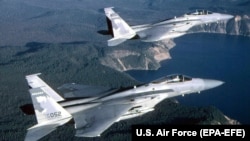
WASHINGTON -- A reported incident involving a US F-15 over Iran is drawing renewed scrutiny to the risks American aircraft face when operating in heavily defended airspace, underscoring a broader reality: Even one of the world’s most successful fighter jets is not immune in contested environments.
For decades, the F-15 has been a symbol of US air superiority. Across multiple conflicts, it has recorded more than 100 air-to-air kills -- and, notably, has never been lost in air-to-air combat.
That record still stands. But recent events, alongside historical losses to ground-based defenses, are adding new context to the aircraft’s long combat history.

Earlier in March, three US F-15E Strike Eagles were reportedly shot down in a friendly fire incident involving a Kuwaiti F/A-18 Hornet during the opening stages of the ongoing Operation Epic Fury conflict with Iran.
The episode, still under investigation, did not result in fatalities, with all crews safely ejecting. Even so, it marks one of the more unusual friendly fire incidents involving the US Air Force in recent years and is expected to be closely studied.
Beyond such incidents, a small number of F-15s have been lost in combat zones -- primarily to ground-based air defenses rather than enemy aircraft.
During operations over Iraq in the 1990s and early 2000s, several F-15s were downed by surface-to-air missiles and antiaircraft systems, highlighting a persistent vulnerability that remains relevant today.
Investments In 'Advanced Technologies'
“The US has invested in advanced technologies -- stealth, electronic attack, and space communications/PNT -- that help provide an advantage over other air forces,” retired US Air Force Brigadier General Houston R. Cantwell, a senior resident fellow for airpower studies at the Mitchell Institute for Aerospace Studies, told RFE/RL on April 4.
"This, combined with careful planning and precise intelligence on the adversary, has minimized losses to fighter aircraft,” he said.
That investment has significantly reduced risk over time. The last confirmed US warplane shot down in combat was an A-10 during the 2003 Iraq War.
Since then, advances in stealth technology -- reducing radio-frequency signatures and complicating radar detection -- have further improved survivability.
Yet, Cantwell cautioned, those advantages have limits -- especially over a country like Iran.
“Countries like Iran have a very advanced integrated air defense system (IADS),” he said. “This system has been degraded over the past month, but that does not mean it has been 100 percent destroyed.”
Iran retains a mix of radar-and infrared-guided missiles, along with antiaircraft artillery. Its size alone complicates efforts to neutralize threats.
“Iran is a huge country. The US cannot hope to completely eliminate any air threat just based on its size,” Cantwell said. “So long as combat missions are flown over Iran, there will be some threat to the aircraft.”
Even advanced fighters like the F-15 rely on defensive countermeasures such as chaff and flares -- tools that improve survivability but offer no guarantees. “Even these systems are not 100 percent effective,” he said.
Adapting To Evolving Threats
The risks highlighted by the F-15 incident reflect a broader shift in how US adversaries prepare for conflict.
“I will say that the US [and Israeli] preference for stand-off warfare -- fighting from the sky and avoiding the deployment of land forces -- has likely increased our potential adversaries’ preparation for conflict with the US,” retired US Army Lieutenant Colonel Amos Fox, a fellow at Arizona State University’s Future Security Initiative, told RFE/RL.
“They understand how the US wants to fight -- airpower and long-range strike -- and thus they’ve invested in ways to offset that preference,” he said.
Fox pointed to growing cooperation among US rivals and the spread of military technology.
“As we’ve seen in both Ukraine and now in Iran, our adversaries also see us as an adversary and will work together to see us fail,” he said.
“The diffusion of targeting information, weapons systems, and defensive systems shouldn’t come as a surprise to anyone -- and we’ve likely only seen the tip of the iceberg.”
Lessons From Past Conflicts
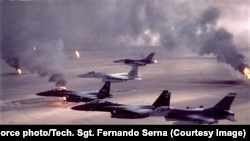
Historically, US air campaigns have faced higher losses under different conditions. During the 1991 Gulf War, coalition forces lost dozens of aircraft.
“The coalition lost nearly 100 aircraft in Desert Storm, but that campaign had very different objectives and timelines compared to Epic Fury,” Cantwell said.
Since then, US strategy has focused heavily on neutralizing enemy air defenses early in a conflict.
“IADS continue to evolve -- making them the priority target at the beginning of any air campaign,” Cantwell said. “The US and Israel have focused on these systems to permit use of the air by numerous other assets.”
Still, suppressing such systems remains a complex and ongoing effort. “Keeping these assets degraded or destroyed is difficult,” he added.
Technology And The Future Fight
To reduce risk to pilots, the US has increasingly turned to unmanned systems such as the MQ-9 Reaper and RQ-170 Sentinel.
“The evolution of unmanned assets like the MQ-9 and RQ-170 permits penetration of these threats without risk to aircrew,” Cantwell said. “MQ-9s have been very effective searching for mobile targets and destroying them without risking aircrew deep in Iran.”
Next-generation concepts, including collaborative combat aircraft (CCA), aim to push this approach further by pairing unmanned systems with crewed jets.
“These aircraft will team with manned aircraft and permit the penetration of dense threat environments, while providing additional weapons at the disposal of a ‘quarterbacking’ fighter or bomber jet,” Cantwell said. “These CCAs might be essential to penetrate IADS in the early days of any campaign.”
A Record -- With Caveats
For pilots forced down behind enemy lines, the risks remain immediate and severe.
“Evasion and health are primary,” Cantwell said. “You need to blend in while ensuring you’re taking care of your health -- food, water, and shelter. Evade until you can find an appropriate pick-up location.”

Rescue missions have grown more complex as air defenses improve.
“These missions require advanced packages of aircraft and space capabilities,” he said. “The helicopter carries the pararescue team, but they require tanker support, air cover from fighters and attack aircraft, and timely intelligence from ISR assets like the MQ-9.”
The F-15’s unmatched air-to-air record remains intact. But its history -- and recent incidents -- underscore a more nuanced reality: Dominance in the air does not eliminate danger from the ground, human error, or evolving adversary tactics.
As Cantwell put it, as long as aircraft operate over heavily defended territory, “there will be some threat to the aircraft.”

