Accessibility links

Breaking News

Georgian Security Forces Use Force To Break Up Second Day Of 'Foreign Agent' Law Protests

Updated
Georgian 'Foreign Agent' Law Triggers Brawls And Street Clashes
please wait

No media source currently available

0:00 0:03:37 0:00

TBILISI –- Security forces and police have used tear gas and water cannons to break up a second straight day of demonstrations in the Georgian capital against parliament’s move toward approving a controversial "foreign agents" law that critics say mirrors Russian legislation and could push the country toward authoritarianism.

The renewed protests on March 8, called for by opposition parties and activists, brought thousands of demonstrators onto the streets and followed violent clashes between police and protesters the previous day that resulted in dozens of detentions and injuries.

Security forces and police assembled on Tbilisi’s central Freedom Square and began marching toward the heart of the demonstration in front of the parliament building, where participants carried Georgian and EU flags and chanted against the law that has drawn sharp criticism from the West.

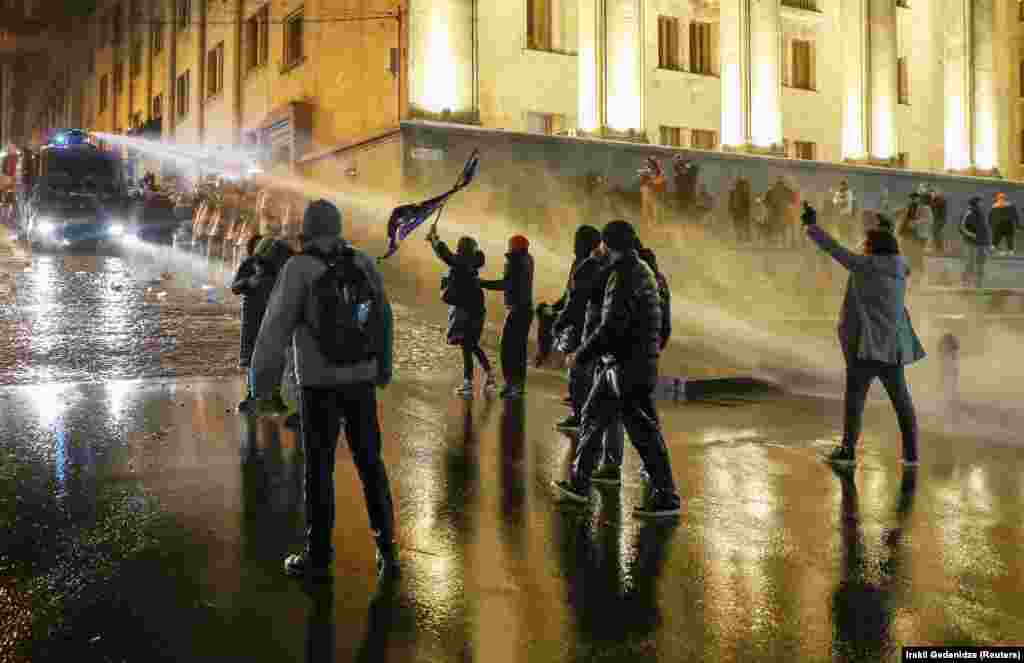
The security forces used tear gas, stun grenades, and water cannons to disperse the crowd, correspondents for RFE/RL’s Georgian Service reported from the scene, and many demonstrators ran for cover in a nearby church and museum or ran down smaller streets to escape.

There were reportedly no signs of demonstrators hurling Molotov cocktails or stones at security forces, as was claimed by the Interior Ministry following the March 7 demonstrations.

Security forces also used force to disperse those demonstrations, which the Interior Ministry later said resulted in the detention of 77 people and left about 50 police officers injured. The ministry did not say how many protesters were injured. Those detained face charges of minor hooliganism and failing to obey the demands of law enforcement officers.

Firebombs, Tear Gas In Tbilisi As 'Foreign Agents' Protest Turns Violent
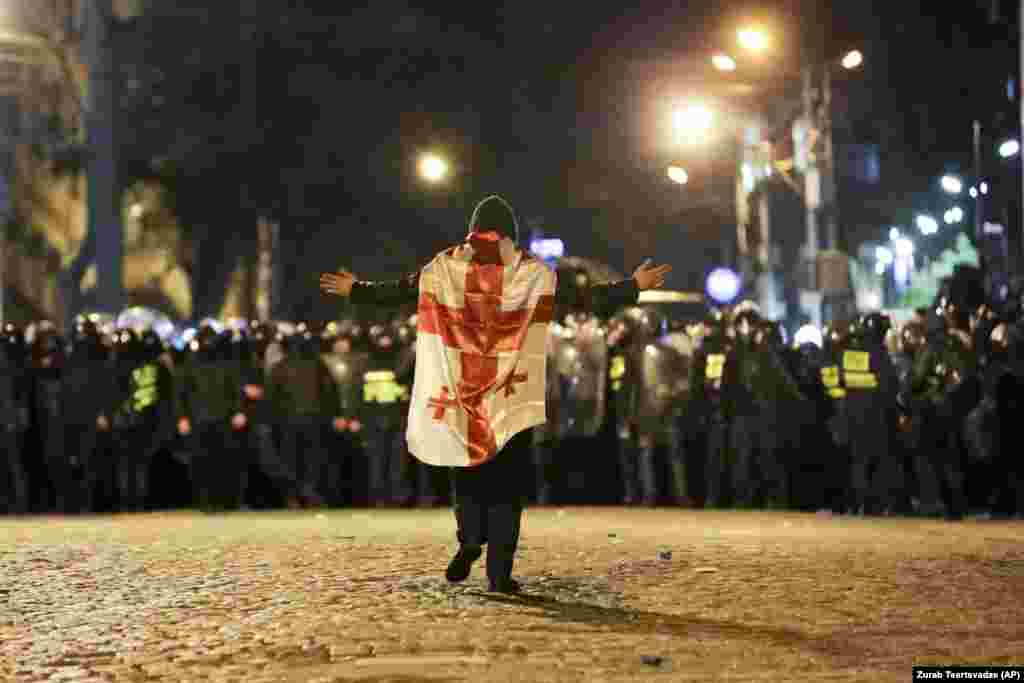
A protester wearing the Georgian flag walks toward a line of riot police outside the Georgian parliament building on March 7.<br />
<br />
Violent protests broke out after legislators gave preliminary backing to a bill that would require organizations operating in Georgia that receive more than 20 percent of their funding from abroad to register as a &quot;foreign agent.&quot;&nbsp;&nbsp;
1/13 A protester wearing the Georgian flag walks toward a line of riot police outside the Georgian parliament building on March 7.

Violent protests broke out after legislators gave preliminary backing to a bill that would require organizations operating in Georgia that receive more than 20 percent of their funding from abroad to register as a "foreign agent."  
At least 50 people were detained by police outside Georgia's parliament building after protestors attempted to storm the legislature in central Tbilisi overnight on March 7-8 over a controversial new law.
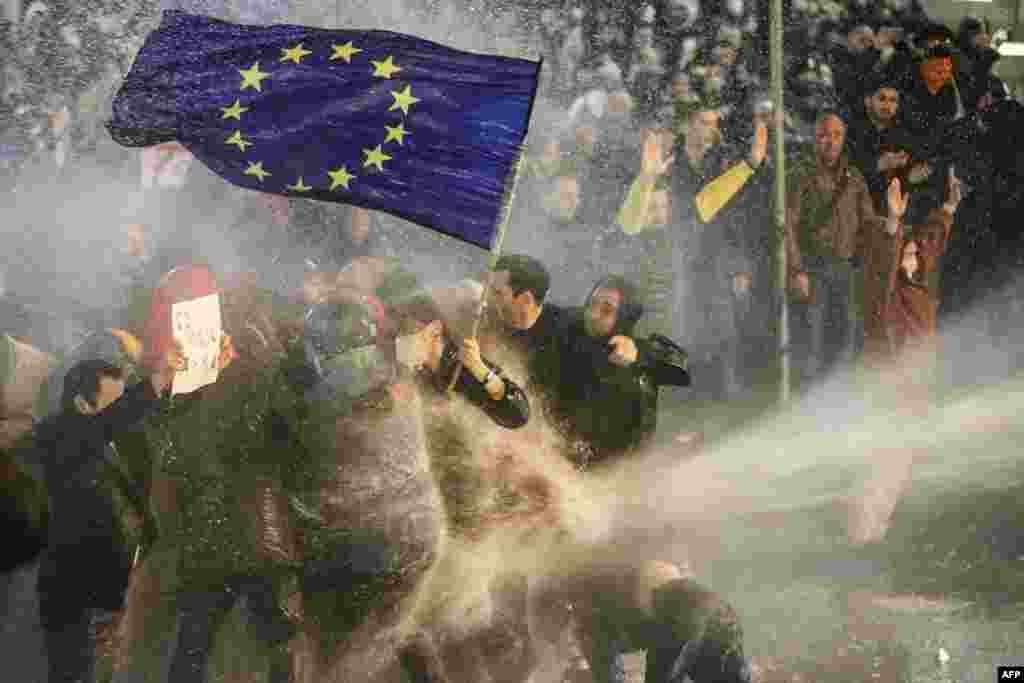
Protesters holding an EU flag are hit with a water cannon during the protest on March 7. The EU&#39;s foreign policy chief has called the bill a &quot;very bad development&quot; for the Caucasus country.&nbsp;
2/13 Protesters holding an EU flag are hit with a water cannon during the protest on March 7. The EU's foreign policy chief has called the bill a "very bad development" for the Caucasus country. 
At least 50 people were detained by police outside Georgia's parliament building after protestors attempted to storm the legislature in central Tbilisi overnight on March 7-8 over a controversial new law.
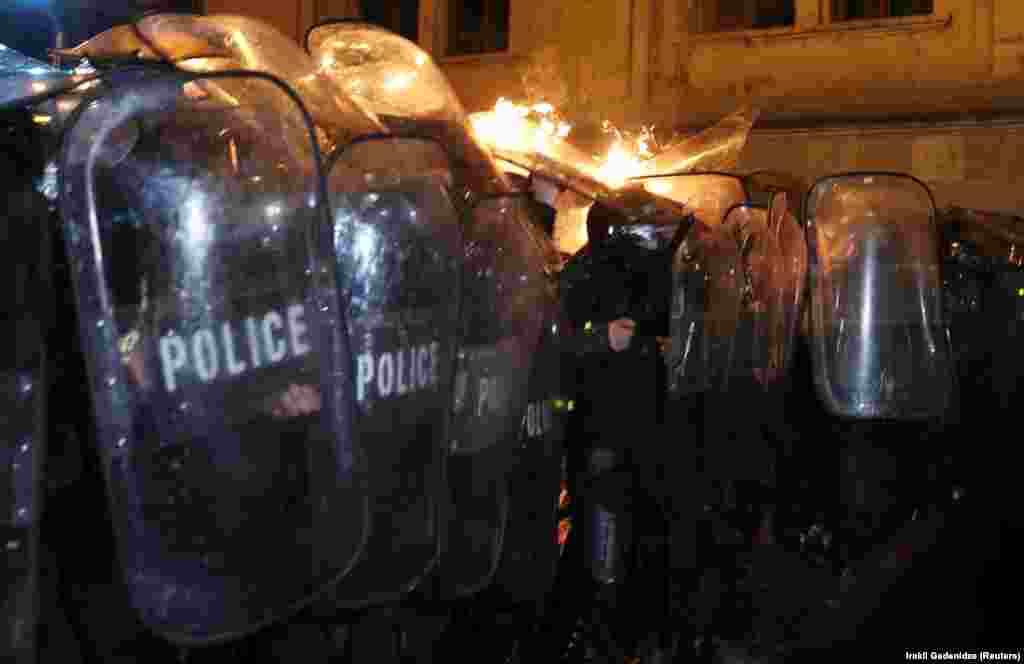
Police are hit by a firebomb during the protest. AFP reported seeing at least three Molotov cocktails thrown at police.&nbsp;
3/13 Police are hit by a firebomb during the protest. AFP reported seeing at least three Molotov cocktails thrown at police. 
At least 50 people were detained by police outside Georgia's parliament building after protestors attempted to storm the legislature in central Tbilisi overnight on March 7-8 over a controversial new law.
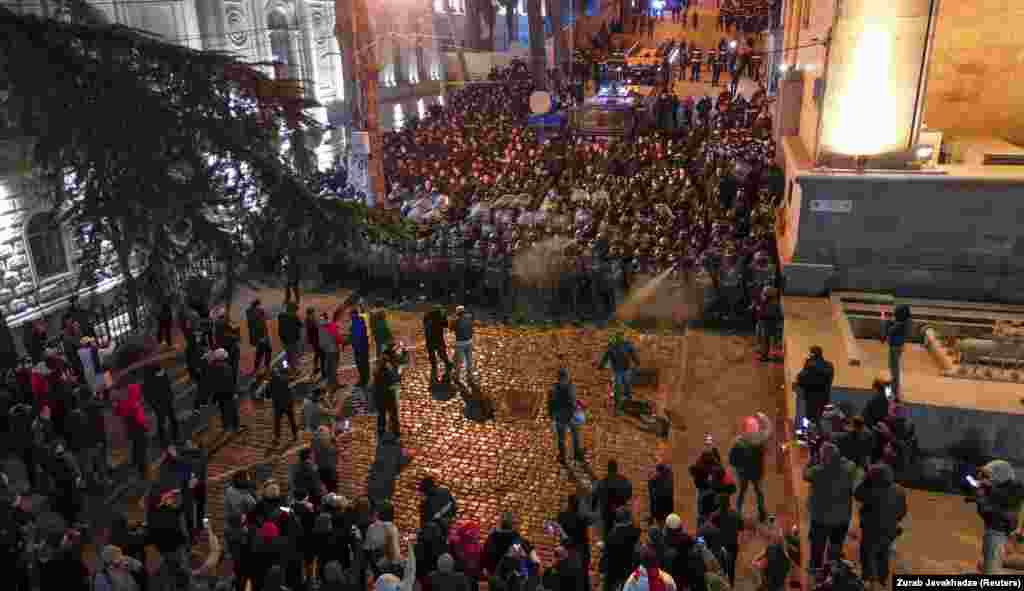
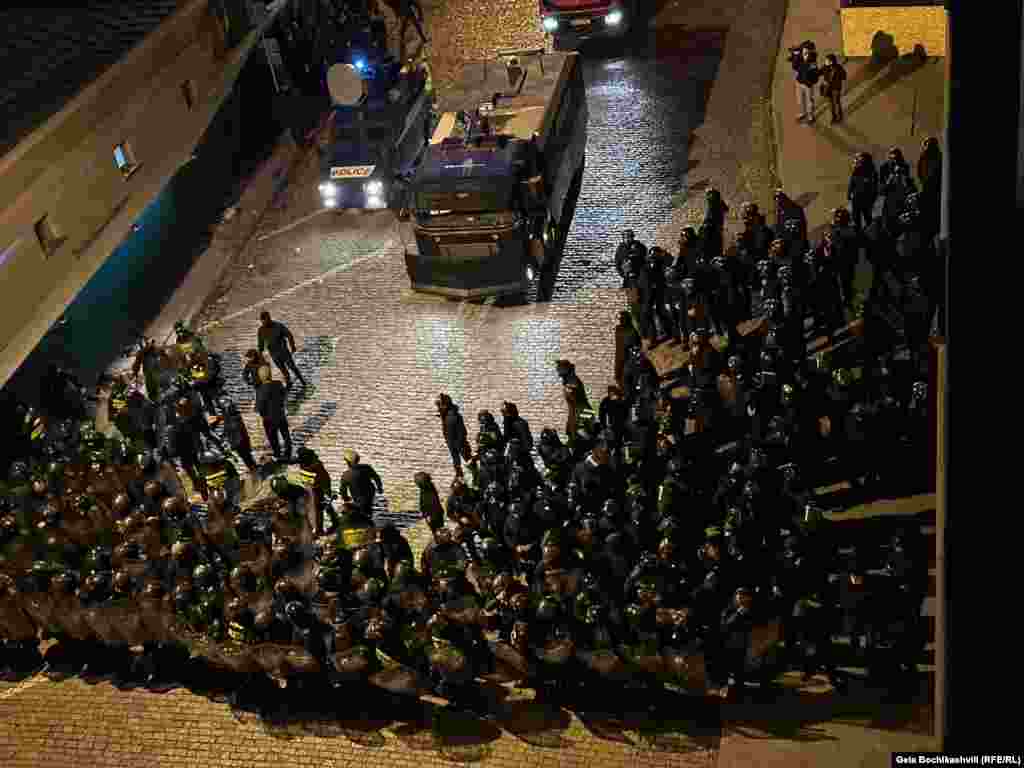
A wall of police faces protesters on a street that leads to the rear entrance of Georgia&#39;s parliament building (seen on right).&nbsp;
4/13 A wall of police faces protesters on a street that leads to the rear entrance of Georgia's parliament building (seen on right). 
At least 50 people were detained by police outside Georgia's parliament building after protestors attempted to storm the legislature in central Tbilisi overnight on March 7-8 over a controversial new law.
A woman who was affected by tear gas receives aid during the protest.&nbsp;<br />
<br />
Georgian President Salome Zurabishvili applauded the protesters while on a visit to the United States. &quot;You represent a free&nbsp;Georgia, a&nbsp;Georgia&nbsp;which sees its future in the West, and won&#39;t let anyone to take this future away,&quot; she said in a video address.&nbsp;
5/13 A woman who was affected by tear gas receives aid during the protest. 

Georgian President Salome Zurabishvili applauded the protesters while on a visit to the United States. "You represent a free Georgia, a Georgia which sees its future in the West, and won't let anyone to take this future away," she said in a video address. 
At least 50 people were detained by police outside Georgia's parliament building after protestors attempted to storm the legislature in central Tbilisi overnight on March 7-8 over a controversial new law.
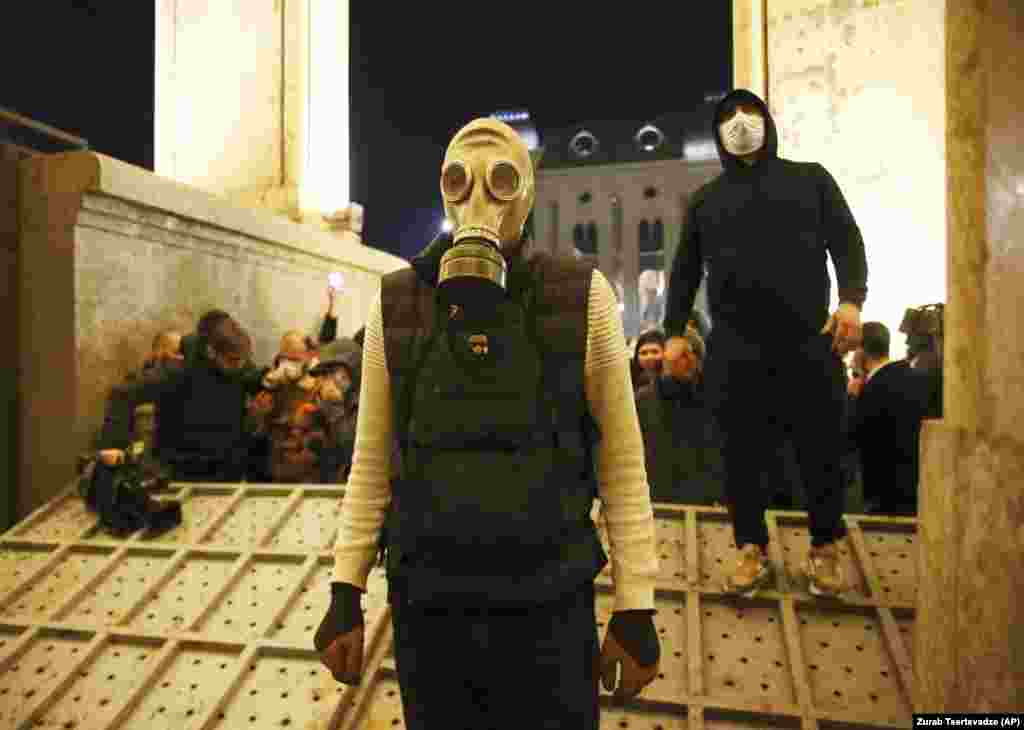
A protester wears a gas mask at the entrance to the parliament building, on Tbilisi&#39;s Shota Rustaveli Avenue, after a steel barrier designed to stop protesters was toppled.&nbsp;
6/13 A protester wears a gas mask at the entrance to the parliament building, on Tbilisi's Shota Rustaveli Avenue, after a steel barrier designed to stop protesters was toppled. 
At least 50 people were detained by police outside Georgia's parliament building after protestors attempted to storm the legislature in central Tbilisi overnight on March 7-8 over a controversial new law.
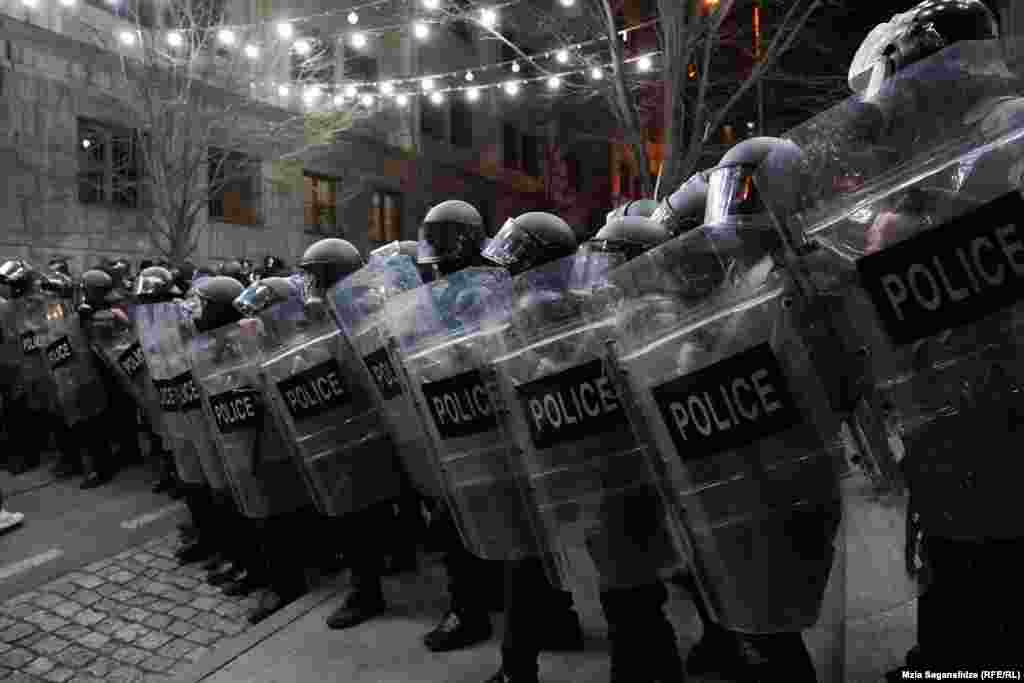
Riot police line up to force protesters away from the parliament.&nbsp;
7/13 Riot police line up to force protesters away from the parliament. 
At least 50 people were detained by police outside Georgia's parliament building after protestors attempted to storm the legislature in central Tbilisi overnight on March 7-8 over a controversial new law.
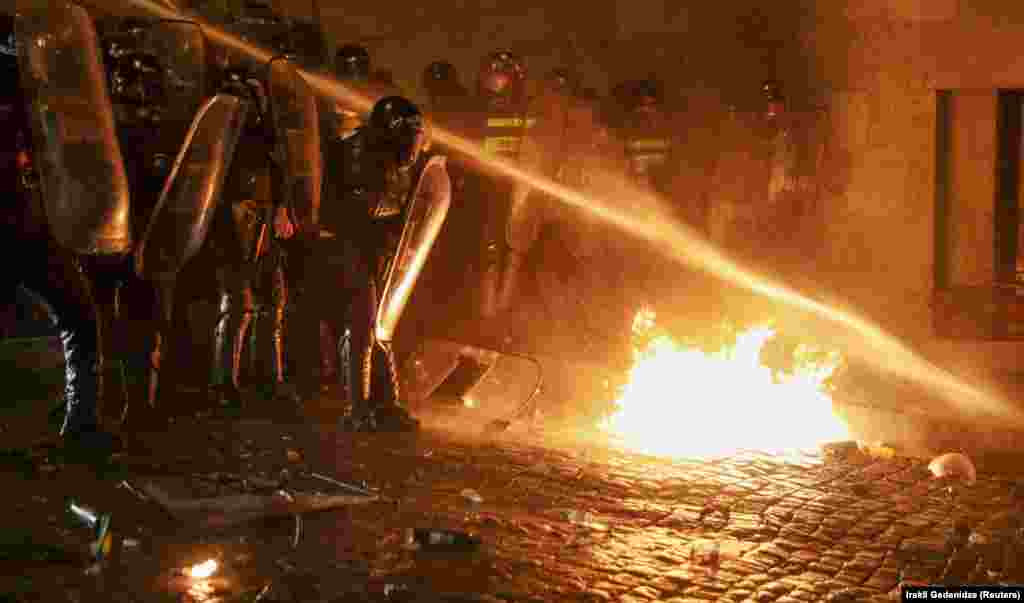
A fire is extinguished by a water cannon.&nbsp;<br />
<br />
&nbsp;
8/13 A fire is extinguished by a water cannon. 

 
At least 50 people were detained by police outside Georgia's parliament building after protestors attempted to storm the legislature in central Tbilisi overnight on March 7-8 over a controversial new law.
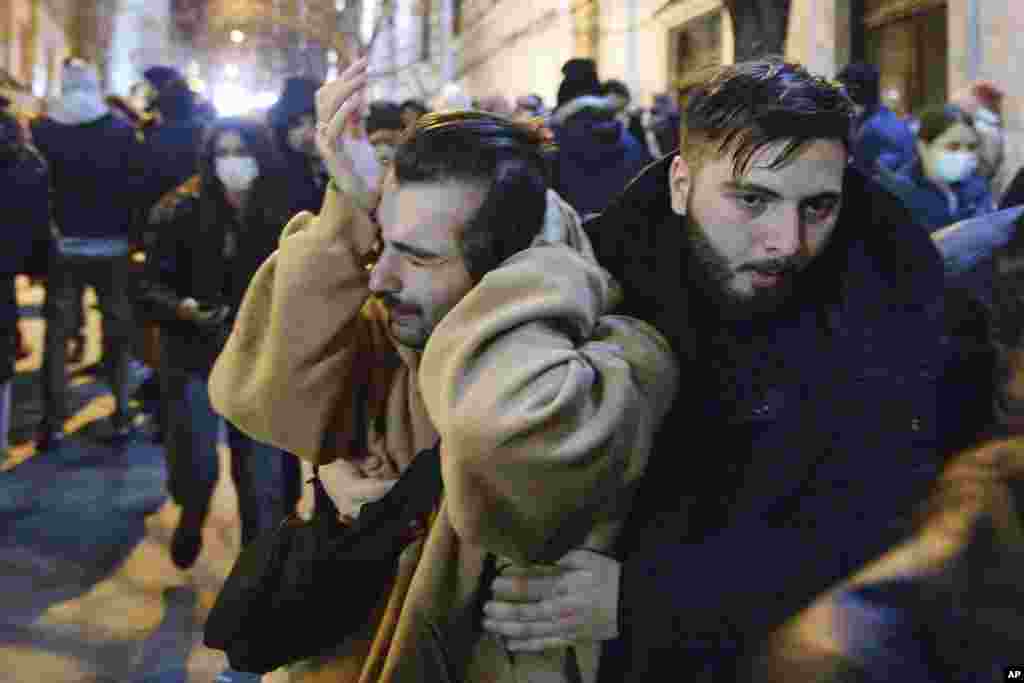
A protester wipes his eyes after tear gas was fired at protesters.&nbsp;
9/13 A protester wipes his eyes after tear gas was fired at protesters. 
At least 50 people were detained by police outside Georgia's parliament building after protestors attempted to storm the legislature in central Tbilisi overnight on March 7-8 over a controversial new law.
A protester is toppled as he is hit by a water cannon on a street that leads to the rear entrance of the parliament.&nbsp;
10/13 A protester is toppled as he is hit by a water cannon on a street that leads to the rear entrance of the parliament. 
At least 50 people were detained by police outside Georgia's parliament building after protestors attempted to storm the legislature in central Tbilisi overnight on March 7-8 over a controversial new law.
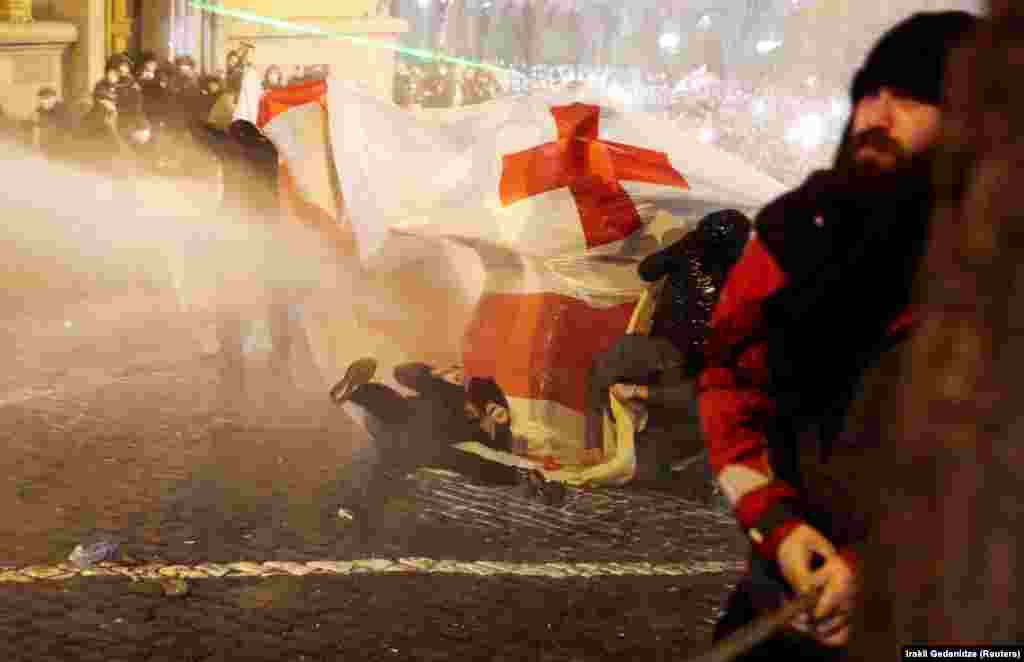
Protesters, one waving an EU flag, are sprayed by a water cannon.&nbsp;
11/13 Protesters, one waving an EU flag, are sprayed by a water cannon. 
At least 50 people were detained by police outside Georgia's parliament building after protestors attempted to storm the legislature in central Tbilisi overnight on March 7-8 over a controversial new law.
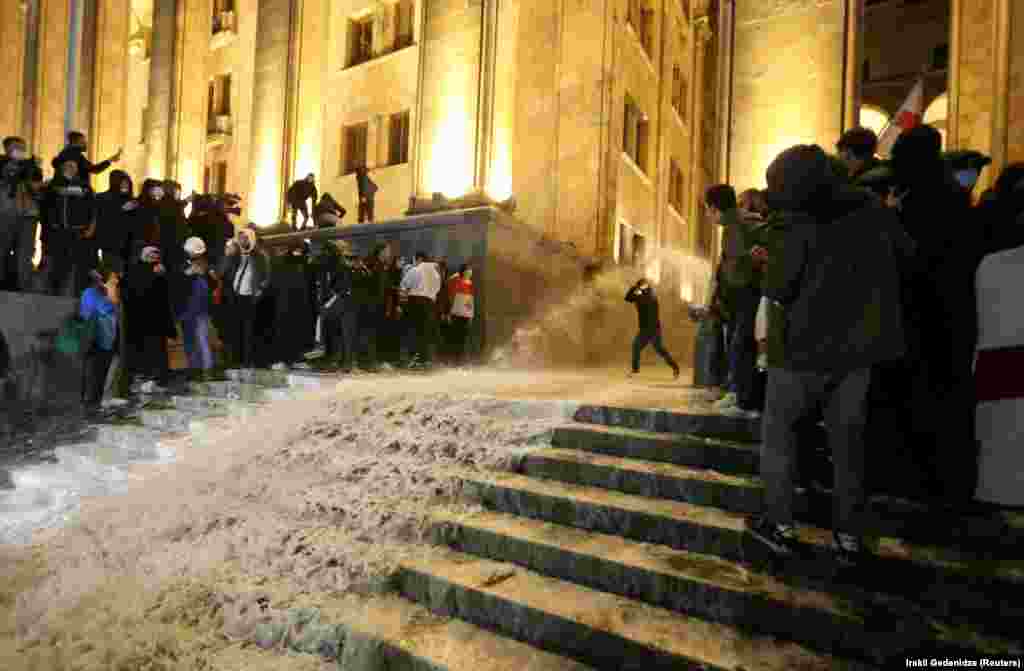
Water streams down the steps of parliament.<br />
<br />
Video from the protests showed police inside the the building spraying protesters with water mixed with tear gas as the crowd attempted to storm the legislature.&nbsp;
12/13 Water streams down the steps of parliament.

Video from the protests showed police inside the the building spraying protesters with water mixed with tear gas as the crowd attempted to storm the legislature. 
At least 50 people were detained by police outside Georgia's parliament building after protestors attempted to storm the legislature in central Tbilisi overnight on March 7-8 over a controversial new law.
Georgian police and vehicles are seen alongside the parliament.&nbsp;<br />
<br />
The protests are reportedly set to continue on March 8.&nbsp;
13/13 Georgian police and vehicles are seen alongside the parliament. 

The protests are reportedly set to continue on March 8. 
At least 50 people were detained by police outside Georgia's parliament building after protestors attempted to storm the legislature in central Tbilisi overnight on March 7-8 over a controversial new law.
Previous slide
Next slide

The initial protests erupted as lawmakers took up the controversial "foreign agents" law on March 7. The proposed legislation, which is backed by the ruling Georgian Dream party and was approved in a first reading, would force civil society organizations that receive more than 20 percent of their funding from abroad to be classified as "foreign agents."

Some have likened the bill to legislation passed in Russia, where all organizations or individuals receiving financial support from abroad can be declared as "foreign agents," a label that stigmatizes them and forces them to submit to audits. Later revisions of the law targeted foreign-funded media.

Protesters at the March 8 demonstrations were heard chanting "No to the Russian law" and singing the Georgian, Ukrainian, and EU anthems. One banner held during the renewed protests, which took place on International Women’s Day, said: "Women against total control."

The second straight day of protests was called for by Nika Melia, one of the leaders of the main opposition United National Movement (ENM), and rights groups had also planned to hold further actions outside of parliament later in the day.

Social media footage also showed smaller protests held in Georgia’s second-largest city, Batumi.

The leader of the right-wing, libertarian Girchi party, Zurab Japaridze, was among those detained on March 7 and was severely beaten by police, according to his lawyer, Vakho Barabashvili.

President Salome Zurabishvili has said she will veto the bill, although parliament can override her veto.

U.S. State Department spokesman Ned Price called for restraint from both sides on March 8, telling reporters that “we urge the government of Georgia to respect the freedom of peaceful assembly and peaceful protests.”

"We are standing with the people of Georgia and the aspirations that they have," Price said.

In a joint statement on March 8, the foreign ministers of Estonia, Latvia, and Lithuania called on the Georgian government "to respect the right of people to a peaceful protest."

"The first reading of the law on foreign agents passed by the Georgian parliament raises serious questions about the prospects of democracy in Georgia. We call on the parliament of Georgia to responsibly assess the real interests of the country and refrain from decisions that may undermine aspirations of Georgia's people to live in a democratic country which is advancing toward the EU and NATO," the statement said.

The United States and the European Union also have criticized the legislation.

With reporting by AFP and Reuters
NOTE: This article has been amended to clarify Nika Melia's status in the United National Movement.
  • 16x9 Image

    RFE/RL's Georgian Service

    RFE/RL's Georgian Service is a trusted source of politically and financially independent journalism in a country where much of the media is aligned with the government or the opposition.

This item is part of
XS
SM
MD
LG