




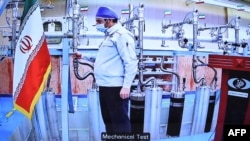
WASHINGTON -- As conflicting signals continue to emerge from Washington and Tehran over reports of a possible interim agreement, the White House has struggled to clarify whether the US and Iran are actually on the verge of a deal.
Treasury Secretary Scott Bessent told reporters that negotiations were ongoing and stressed that President Donald Trump would not accept a “bad deal” for the US.
The uncertainty comes amid reports that Washington and Tehran may be discussing a 60-day framework aimed at extending a cease-fire and reopening negotiations over Iran’s nuclear program.
The reported diplomacy has exposed divisions both within the Trump administration and among Republicans, with critics accusing the White House of softening its stance toward Tehran even as tensions continue in the Strait of Hormuz.



To better understand what may be happening behind the scenes, RFE/RL spoke with Alexander Gray, who served as chief of staff of the National Security Council during President Donald Trump’s first term and is now CEO of the geopolitical consulting firm American Global Strategies.
'I Think We’re Getting Very Close'
RFE/RL: Let’s start with the big picture. What do we actually know today about the reported US-Iran agreement, and how close does this appear to be to final approval from President Trump?
Alexander Gray: Well, I think the president has made it clear that, pending something that would be unexpected at this point, he would like to find a deal. His goal is to conclude the conflict in a way that is consistent with his long-standing comments over more than a decade that Iran must not have a nuclear weapon. He has been very consistent and very clear about that objective.
So, presuming that the Iranians are operating within the realm of the basic US priorities here -- reopening the strait to normal operations and making progress toward nuclear dismantlement -- I think we are moving very much in a positive direction toward ending this conflict.
RFE/RL: Given the mixed signals coming from both sides, does that suggest negotiations are entering the final stretch, or that major disagreements still remain behind closed doors?
Gray: I think we are at the finish line. I think we’re getting very close. Only the people directly involved know just how close, and obviously the president is going to reserve for himself the ultimate authority to determine whether this deal meets his long-stated goals.

I think the other thing that we have long known is that, on the Iranian side, they have an extremely faction-ridden government right now. As the US and Israel have eliminated so much of their governing structure in recent months, an entity that was already divided by factions, even in peacetime, has become even more so.
My sense is that there are elements of the Iranian Revolutionary Guards Corps and other hard-line factions that would very much like to derail this peace effort. They are ideologically motivated and do not want to see a negotiated settlement. So I think there is a lot of work being done on the Iranian side to bring those factions under control and make sure they can actually execute whatever deal is agreed to.
Strait Of Hormuz At The Center Of Negotiations
RFE/RL: One issue clearly at the center of all this is the Strait of Hormuz. Secretary Bessent says the US will not accept any arrangement that allows Iran to control passage through the strait. What exactly is Washington demanding right now when it comes to shipping security and freedom of navigation?
Gray: My sense is that they want to return to the prewar, pre-conflict norm of freedom of navigation in the Strait of Hormuz.
And remember, this is not just about the Strait of Hormuz. If the US and the broader international community allow Iran to hold the strait hostage, this is going to be noticed by bad actors elsewhere -- in places like the Black Sea, the South China Sea, the East China Sea, and beyond.
So we have a global obligation to ensure that the strait is not turned into a place where freedom of navigation can be restricted by Iran or anyone else.
RFE/RL: At the same time, the administration is increasing sanctions pressure while still pursuing diplomacy. Another sanctions announcement was made just moments ago. Is that a negotiating tactic ahead of a final deal, or does it reflect concern that talks could still collapse?
Gray: Look, anything could happen. We’ve seen two skirmishes over the last couple of days where Iran engaged in bad behavior and the US had to respond militarily.
But all that being said, I think the Iranians have suffered an extraordinary amount. The blockade the US has imposed on them is working. All of this is moving Iran in the right direction -- into the state of mind and under the kind of economic and social pressure that I think would compel them to make a deal with the US.

So again, anything can happen, particularly when you have ideological factions within the Iranian regime that are dead set against any peace with the US and Israel. But I think the rational and logical conclusion of where this conflict has taken us is that Iran is going to make peace with the US in the not-too-distant future.
RFE/RL: From your perspective, what is the single biggest obstacle still standing in the way tonight?
Gray: Look, I think the biggest obstacle is that Iran has long viewed nuclear weapons as its biggest strategic card. Nuclear weapons ensure regime survival, and the fact that Iran has threatened for 25 years and made episodic progress toward a nuclear weapon is part of the reason why it has avoided the fate of other countries in the Middle East that experienced regime change.
It is very difficult for any faction within the Iranian regime to advocate for anything approaching dismantlement of the nuclear program.
And I think even if there are factions -- and I have reason to think there probably are -- that want to make concessions to the US on the nuclear side, there will be other factions in Tehran that strongly oppose that. So there is a huge internal balancing act within the regime itself over how to reach a point where they can meet President Trump’s demands on the nuclear issue.
Gulf States Recalibrating Toward Washington
RFE/RL: What role are Gulf countries playing behind the scenes right now, and how delicate is that diplomacy becoming?
Gray: It’s very delicate. Iran made what I think was a huge strategic mistake by launching attacks against numerous Gulf countries and US bases -- and not just US bases, but also energy and civilian infrastructure in places like Saudi Arabia, Kuwait, the UAE, Qatar, and elsewhere.
By doing that, Iran has realigned the Middle East in ways I don’t think it expected.
Just a couple of years ago, we were talking about China making deals with Saudi Arabia and the UAE, perhaps even establishing a military base in the Gulf. There were questions about whether the UAE felt confident the US would remain a long-term partner.
I think all of that has changed. The region is becoming much more closely aligned with the US as its long-term security partner of choice.
So even beyond this obviously dangerous moment of conflict, I think the medium-term future of the region is one of greater alignment between the Gulf Arab countries and the US -- and potentially, through expansion of the Abraham Accords, with Israel as well.
RFE/RL: If President Trump approves this framework, what could the next 48 to 72 hours look like? Are we talking about immediate de-escalation measures and formal announcements, or still a long road toward implementation?
Gray: I would caution that implementation -- particularly with a regime that has such difficult internal dynamics -- is probably going to take longer than everyone would like, and there may be false starts.
But we also have to remember that Iran is on the brink of economic collapse. Its energy infrastructure is nearing the point of complete destruction, perhaps permanently, because of the effects of the blockade. Iran has had to reroute supply lines from the Gulf to Central Asia. The impact on the Iranian economy and society has been extremely severe.
So even though there will be factions that resist this, and there may be tactical setbacks, I think we have to remember that Iran does not have many alternatives but to ultimately reach a point where this accord holds.
RFE/RL: On the flip side, if this agreement falls apart, how quickly could tensions around the Strait of Hormuz escalate again, and how prepared is the US for that possibility?
Gray: The US has had military plans for handling the Strait of Hormuz for more than 40 years, and the US Navy knows exactly what to do. It would be a difficult operation, but it is one they have trained for extensively.
The assets required for such an operation are already in the region. Central Command has what it needs to execute if the president gives that order.
But as I said, I think the Iranians are nearing the breaking point, and I think the president and his team are close to getting what the US wants so we can avoid that possibility.

