




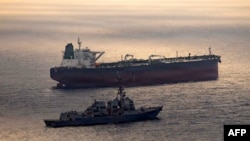
WASHINGTON -- Military operations between the US and Iran have renewed attention on the Strait of Hormuz, the narrow waterway through which roughly one-fifth of the world's seaborne oil trade usually passes.
Despite a significant US military presence, shipping companies remain reluctant to transit the strait, highlighting a reality that extends beyond naval power: the greatest challenge may be restoring confidence among commercial operators.
RFE/RL spoke with naval strategist and maritime security analyst Joshua Tallis, a research program director at the Center for Naval Analyses, about the evolving military balance, Iran's asymmetric capabilities, freedom of navigation, diplomacy, and what success would actually look like in the Strait of Hormuz.
The interview has been edited for length and clarity.
RFE/RL: Just to set the stage, how would you characterize the security environment in the Strait of Hormuz today?
Joshua Tallis: I'd characterize the current security environment today -- we're talking on July 16 -- as probably pretty similar to what we would have been looking at in May.
We've snapped back, after an interregnum with the cease-fire, to a period of fairly significant uncertainty, where we simply don't know how this US administration will resolve the seeming advantage that Iran has in its ability to impose costs on vessels transiting the Strait of Hormuz and its ability to create a larger dampening effect across the broader maritime marketplace, which ultimately governs whether individual shipowners are willing to send vessels through the Strait.
RFE/RL: Despite heavy US military activity, commercial shipping remains hesitant to transit the strait. Does that suggest the problem is no longer about controlling the waterway, but about restoring confidence?
Tallis: I would break it into two parts. The military dimension matters, but the military dimension is more than naval. Right now, we believe there is potential Iranian mining in the center of the Strait of Hormuz -- along the internationally recognized traffic separation scheme, which under normal circumstances is where most vessel traffic travels in and out of the Persian Gulf and into the Gulf of Oman. Because that central lane is no longer regarded as particularly safe or viable, there are two alternative routes.
One goes south through Omani territorial waters, which is the route the US is promoting. The other goes north through Iranian territorial waters, which is the route Iran is promoting -- and the route where Iran is reportedly imposing a tax or toll on vessels transiting through.
One point that can be easy to overlook is that Iran itself needs the strait to remain viable because the regime depends heavily on exporting its own oil to finance itself."
The military challenge is that safeguarding ships through the strait doesn't simply mean protecting them from mines or maritime threats. You also have to defend them against airborne threats: drones, cruise missiles, and ballistic missiles. For the US and other countries seeking to route shipping through the southern corridor while avoiding Iranian waters and Iranian tolls, defending against those airborne threats at the very close ranges involved in the strait is extremely difficult.
Beyond that military challenge are the market forces. We continue to see elevated war-risk insurance premiums. Shippers worry about vessels becoming trapped inside the Persian Gulf if hostilities escalate. Shipowners are understandably concerned about losing ships or crews. For many companies transporting petroleum and hydrocarbon products, an individual vessel represents an enormous financial investment.
Those market dynamics can take a very long time to recover, as we've seen in the Red Sea and Bab al-Mandab after Houthi attacks. So yes, there's a military challenge, but fundamentally this has become a battle over the ability to defend merchant vessels against airborne threats.
RFE/RL: You've argued that Iran's asymmetric capabilities -- mines, drones, missiles, and fast attack craft -- remain dangerous even if much of its conventional navy is degraded. Are we seeing that play out now?
Tallis: We are. I would add the caveat that geography is an important factor. Iran is not trying to project asymmetric capabilities over an extremely long distance. It is operating very close to the Strait of Hormuz, and that geographic proximity gives it the advantage of leveraging inexpensive, marginally effective capabilities -- mines, low-cost unmanned aerial vehicles, the occasional low-cost surface drone -- to create sustainable, low-cost methods of imposing risk.
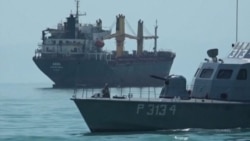

Collectively, those systems give Iran a wide variety of sustainable and inexpensive ways to shape market behavior by making large-scale commercial traffic through the strait less attractive.
RFE/RL: Can air strikes alone significantly reduce Iran's ability to threaten shipping, or are these asymmetric maritime threats far more difficult to eliminate than to suppress?
One of the enduring challenges for the US is that Iran will always possess the geographic advantage because of its proximity to the strait."
Tallis: They are extremely difficult to eliminate. Part of the reason is distributed production. When you're talking about low-cost aerial drones or inexpensive cruise missiles, those systems can be produced in a much wider range of facilities than sophisticated, high-end weapons.
Finding all of the industrial infrastructure that supports those capabilities is considerably harder. They can also be launched without the extensive infrastructure required for systems like short-range ballistic missiles. In some cases, they don't even depend on coastal radar networks.
Because these systems are cheaper, easier to manufacture across multiple locations, and less dependent on visible infrastructure, they're much harder to locate and destroy. That leaves defenders in a position where they must continuously defend against them, imposing substantial financial and technical costs.
RFE/RL: If Washington's objective is freedom of navigation rather than regime change, what would success actually look like? Is reopening the strait enough, or does commercial confidence have to return as well?
Tallis: If freedom of navigation is the end goal, success means more than simply reopening the strait. It means a return to normal traffic volumes -- well over 100 ships transiting the strait each day -- and that traffic moving through the internationally recognized traffic separation scheme, without taxes, tolls, or tariffs imposed by Iran or any other local actor.
Those are all essential components of freedom of navigation. It isn't simply about commercial traffic moving again. It is about commercial traffic moving through internationally recognized shipping corridors without coercion or taxation, both of which would be regarded as illegal under international law.

RFE/RL: US President Donald Trump has warned that Iran could face additional military strikes unless it returns to negotiations. Some observers describe that strategy as trying to "bomb Iran back to the negotiating table." How do you view that approach?
Tallis: At an abstract level, compellence -- the use of force to push a competitor toward a negotiated outcome, whether restoring the status quo or establishing a new one after conflict -- is a normal way that states use military power in pursuit of diplomatic objectives. Whether it will work in this specific case is, of course, open to extensive debate.
One of the enduring challenges for the US is that Iran will always possess the geographic advantage because of its proximity to the strait.
From my perspective, it is extremely unlikely that there is an exclusively military solution to reopening the Strait of Hormuz. At some point -- even if military force is used to compel Iran to accept more reasonable terms -- military coercion will have to be paired with diplomacy to achieve a settlement that restores freedom of navigation in the way I described earlier.
RFE/RL: If negotiations were to resume, how central would maritime security be? Could guarantees around shipping become one of the earliest confidence-building measures?

Tallis: I think they certainly could. One point that can be easy to overlook is that Iran itself needs the strait to remain viable because the regime depends heavily on exporting its own oil to finance itself.
That creates potential advantages for both Iran and the US. Confidence-building measures that restore the flow of hydrocarbons through the strait would benefit the global economy while also allowing Iran to increase its own oil and gas exports.
If you're looking for areas where early confidence-building measures could create genuine win-win outcomes, restoring normal commercial traffic through the Strait of Hormuz is probably one of the strongest examples.
RFE/RL: One lesson from the Red Sea was that protecting warships is one thing; persuading commercial shipowners to accept risk is something very different. Are we seeing the same strategic dilemma emerge in the Strait of Hormuz?
Tallis: They're close cousins, but there are important differences. In the Bab al-Mandab [a Red Sea strait between Yemen and Africa], the type of maritime commerce most heavily affected was container shipping. That industry is highly consolidated. Roughly half a dozen companies control the overwhelming majority of global container traffic, and they're extremely risk-averse. They also operate on fixed schedules, so changing routes creates significant disruptions throughout the broader supply chain.
The other important distinction is that there was an alternative route. Those same companies accepted the one-time cost of rerouting around Africa rather than using the Suez Canal, and they have largely continued doing so because they remain risk-averse and because frequent routing changes create major logistical disruptions.

The Strait of Hormuz is different in two important respects.
First, there is no meaningful alternative route. There isn't sufficient pipeline capacity to move Gulf oil and gas exports outside the Persian Gulf, creating enormous pressure for shipping to continue despite elevated risks.
Second, the sector most affected is oil and natural gas shipping, which has a far more dispersed ownership structure. There are dozens and dozens of owners, and there's a much more active spot market.
That makes it more likely you'll see a small- to medium-sized group of shipowners willing to accept greater risk earlier than the larger, more established players.
So I think you'll see stronger commercial pressure to keep exporting oil because there simply isn't another route. And because ownership is much more distributed, you may also see a meaningful minority of shipowners willing to absorb higher levels of risk much sooner than we saw in the Red Sea.

