




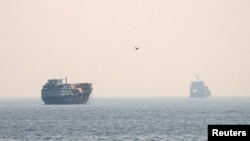
WASHINGTON -- As Washington and Tehran trade accusations over the collapse of their latest cease-fire, the real battle may be unfolding far from the headlines -- in the shipping lanes of the Strait of Hormuz.
For Noam Raydan, the William Sudhaus Senior Fellow at The Washington Institute for Near East Policy, the unraveling of the 60-day memorandum of understanding (MoU) was always likely to expose unresolved disputes over who controls one of the world's most strategic waterways.
Speaking to RFE/RL, Raydan explains why Iran's campaign at sea goes far beyond isolated ship attacks, what recent tanker strikes reveal about Tehran's strategy, and why the coming days of ship-tracking data could determine whether a new maritime order is taking hold.

RFE/RL: Looking back, was the MoU fatally flawed from the beginning, or did the speed of its unraveling surprise you?
Noam Raydan: There were several paragraphs in it that made it clear, at least to me, that they were going to cause some problems, specifically on the maritime scene in the Strait of Hormuz.
With respect to the future management of the Strait of Hormuz, the memorandum of understanding was very unclear. This has been one of the points Iran has been insisting on: Tehran wants to play a central role in drafting the future management of the Strait of Hormuz.
At the same time, there has been pushback against Iran. Regional countries have their own reservations, as does the international shipping community, because we've seen Iran, from time to time, talk about transit fees or even maritime service fees.
So, going back to the memorandum of understanding, for me, as a person who focuses on energy and shipping, the paragraph dealing with the future maritime management of the Strait of Hormuz was not clear. I believe we will continue facing uncertainty with respect to how the Strait of Hormuz will be managed.
As I've been saying since March, there is a new navigational order in the region. There is no easy way to go back to the old maritime order. We should expect Iran to put up a lot of barriers to ensure there are no alternative systems in the Strait of Hormuz.
By that I mean Iran wants ships to use the Iran-controlled lanes instead of the alternative system -- the routes guided by US forces in the region.
RFE/RL: Has this high-stakes blame game effectively closed the door on diplomacy, or are we simply seeing the opening phase of a much harder negotiation?
Raydan: I'll be very honest with you: we're not seeing a resolution yet. Every time we think things might gradually be resolved through diplomacy, we see developments -- just like yesterday -- that take us back to square one.
With respect to the Strait of Hormuz, reopening it to international commerce and international shipping, getting rid of all the ship attacks that Iran has been carrying out, and ending the repeated threats to close the Strait again, I believe we're going to continue seeing these things. I don't see a resolution for the Strait of Hormuz. I don't know whether diplomacy will actually help reach a resolution there.

What I am certain about is that Iran will ensure there won't be an easy way to go back to the old navigational order. So we should expect Iran to continue its threats against shipping in the region. They're already doing it. For instance, today they again threatened to close the Strait of Hormuz.
RFE/RL: Are the latest attacks less about violating a ceasefire than about enforcing Iran's claim over who controls the shipping lanes?
Raydan: Yes, because Iran wants to ensure that it plays a central role in deciding how ships transit the Strait of Hormuz.
Up until now, we're not seeing ships using the old routes that commercial vessels used before the war. Right now, we see the northern route, which is controlled by Iran, and we see the southern route around Oman, which, as I said, is protected by US forces.
What Iran is doing right now is trying its best to keep the risks very high on the Omani route in order to force vessels to move north, into the old routes -- meaning into Iranian waters -- and use the lanes controlled by Iran.
You might ask whether vessels are worried about using the Omani route. We need to continue monitoring the data until tomorrow. Today we won't have the full picture because many ships turn off their AIS signals while transiting these routes, so it takes time to add up all the numbers. What I can tell you today is that ships are using the Iran-controlled route.
And we should expect Iran, again, to continue issuing threats and to continue keeping the risks very high on the Omani route so that it makes sure vessels follow its orders under this new navigational order that Iran is trying to shape.
RFE/RL: One of the vessels struck was the Qatari LNG carrier Al Rekayyat, sailing through the US-protected corridor near Oman. What does the targeting of a Qatari gas tanker, alongside Saudi-linked crude oil tankers, tell us?
Raydan: As someone who has been tracking ship attacks in the Middle East since 2017, yesterday's attacks against the Qatari-owned liquefied natural gas tanker, as well as two crude oil tankers, represented a very clear escalation from Iran.
The reason I say escalation is because this was the first time during this war that we saw Tehran launch an attack against a laden LNG tanker -- meaning a tanker carrying cargo. That was very dangerous because it could have caused an environmental disaster and, of course, could have led to many deaths among seafarers. Fortunately, that did not happen, although the ship appears to have been damaged. The crude oil tankers were also laden.


Given my experience covering the Red Sea crisis, when the Houthis were carrying out their own maritime campaign, I can tell you that these kinds of attacks can eventually lead to an environmental disaster. We saw something similar in the Red Sea in 2024, when regional and international efforts came together to avert one.
What worries me right now is that Iran is going to continue escalating. What also worries me is that Iran may continue carrying out these dangerous attacks and eventually bring us to a point where we could see an environmental disaster, specifically on the Omani route.
The reason I'm concerned about that scenario is because, as I said earlier, Iran wants to ensure the risks remain very high on the Omani route so that ships ultimately decide to use the Iran-controlled route instead. We need to be prepared to see how Iran is going to continue using different methods and different tactics to keep the risks very high on the Omani route so that, in the end, vessels decide to follow the Iran-controlled route. This is where we are right now.
This is the phase I'm monitoring -- how Iran is going to continue making it so difficult to return to a status quo that does not serve its objectives. Again, the Strait of Hormuz will remain at the heart of this war.
RFE/RL: President Trump has suggested imposing a complete naval blockade on Iranian ports. Would that destroy Tehran's ambition to turn the Strait of Hormuz into a source of political and economic leverage?
Raydan: There are questions right now about whether Iran's leverage is still working. Based on what they are doing at this time, I would say yes, they still have leverage. They are still putting a lot of pressure on shipping, and by doing that they are also putting a lot of pressure on oil markets. As we saw, prices reacted to the latest escalation between the two sides. Iran still has leverage through the Strait of Hormuz.
On top of attacking shipping in the Strait of Hormuz, Iran is also willing to return to attacking critical energy infrastructure in the region. By that I mean critical energy infrastructure in Gulf states that play a very key role in the energy markets, such as Saudi Arabia and the United Arab Emirates.
A couple of months ago, I said we should continue watching how Iran would also ensure that any alternative routes regional countries develop to bypass the Strait of Hormuz would also come under pressure.
We need to continue preparing ourselves to see how Iran will escalate because, based on yesterday's attacks, they are really willing to take this escalation to a completely different level.
RFE/RL: Iran has again threatened to close the Strait entirely if the US launches additional strikes. You've argued previously that a complete closure would be economically suicidal for Tehran because Iran also depends on the waterway. Has Iran's calculation fundamentally changed?
Raydan: I still don't see Iran backing down. Even if a naval blockade returns, I don't see Iran easily letting go of the most important card it has been playing in this war, which is the Strait of Hormuz. I don't see Iran de-escalating. Even when the naval blockade was first implemented, we saw Iran continue its threats and continue attacking ships. They didn't back down.
Instead, they tried to come up with different ways to bypass the blockade, and we should expect that to continue if the United States decides to reimpose those restrictions.
Iran has been under sanctions for several decades. Those of us who track sanctioned ships and Iranian oil flows have repeatedly seen Tehran develop different ways to bypass sanctions. Although it may be difficult to bypass another naval blockade, we should still expect Iran to continue trying to circumvent restrictions on its energy exports.
RFE/RL: Some analysts argue the world is unlikely to return to a full-scale regional war because the economic consequences would simply be too severe. Can global energy markets absorb a prolonged US naval blockade and lower Iranian exports?
Raydan: That's a very good question. Right now we're seeing different trends in the oil market.
Over the past few weeks, we've seen more oil coming onto the market, and oil flows from the region have gradually been recovering. Now we have another issue. There is more oil available, but demand is not increasing in parallel. So we do have enough oil at this time.
With respect to Iranian oil, here's something people may not be paying enough attention to: it is no longer being offered at the same discounts we saw in the past.
At the same time, other Middle Eastern crude grades are also being offered at discounts, and they appear to be competing directly with Iranian oil. For that reason, some buyers, particularly in Asia, have not been absorbing Iranian oil in the same way they did before. Here I'm referring specifically to China, which remains a key buyer of Iranian oil. As we know, however, China has significantly reduced its imports over the past two months. It is not importing Iranian oil in the same way it was before the war.
So, to come back to your question, we have different trends taking place in the market. We are seeing enough oil, but at the same time demand is not recovering in parallel. Will prices jump the way they did at the beginning of the war? I'll be very honest -- I cannot predict how prices will behave, and I'll leave it there.
RFE/RL: NATO leaders have expressed varying levels of support for Washington's latest military action. But from your perspective, what will tell you over the next 24 to 48 hours whether this conflict has crossed the point of no return?
Raydan: As someone who keeps her eyes on ships in the region, I'll definitely be watching the behavior of ships and the routes they choose -- the northern route controlled by Iran and the southern route around Oman.
I'll also be watching the behavior of some regional countries. But my main focus remains ships, particularly energy flows.
The Omani route is where we saw at least three tankers attacked yesterday. By tomorrow we should have a much better idea of the status of shipping on that route. It will tell us whether Iran has succeeded in forcing ships either to reroute or to rethink using the Omani route and instead return to the Persian Gulf through the Iran-controlled lane. We'll know more because a lot of ships turn off their AIS signals, and that doesn't allow us to track them in real time.
We have to wait for them to reappear in the Gulf of Oman before we know whether they actually transited the Omani route or chose the Iran-controlled route instead. By tomorrow, because we'll have much more solid data, we'll have a much better idea of whether Iran's strategy is succeeding.

