




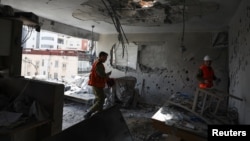
Iran threatened to attack energy facilities throughout the Persian Gulf region after announcing that its massive South Pars gas field was hit on March 18 in the first reported strike on the country's Gulf infrastructure since the US and Israel began a bombardment campaign on the last day of February.
Hours after Iran vowed to retaliate, Qatar reported a fire at its main gas hub, Ras Laffan, after an alleged Iranian missile attack, with emergency crews deployed to contain the blaze and state giant QatarEnergy reporting "extensive damage." Qatar demanded that Iran's military and security attaches and their staffs leave the country within 24 hours.
Saudi Arabia said it had destroyed four ballistic missiles headed toward Riyadh, and reported an attempted drone attack on a gas facility in the east. Fragments of one of the missiles fell near a refinery south of the capital, the Saudi Defense Ministry said.
Meanwhile, Iran confirmed the death of its intelligence minister, Esmail Khatib, a day after it acknowledged that two other senior figures had been killed. In Washington, the top US intelligence official said Iran’s government "appears to be intact but largely degraded by Operation Epic Fury,” the US name for its military operation.
“Even so, Iran and its proxies remain capable of and continue to attack US and allied interests in the Middle East," US Director of National Intelligence Tulsi Gabbard told a Senate hearing. "If a hostile regime survives, it will seek to begin a years-long effort to rebuild its missiles and UAV (drone) forces.”
South Pars is the Iranian part of the world's largest natural gas deposit, which the country shares with Qatar, across the Gulf. "A spokesman for Iran’s central command said Tehran would “severely strike the origin of this aggression,” calling it legitimate to hit the attacker’s “fuel, energy, and gas infrastructure.”
Qatari Foreign Ministry spokesman Majed Al-Ansari described the targeting of facilities linked to South Pars as a “dangerous and irresponsible step,” warning that attacks on energy infrastructure threaten global energy security, regional stability, and the environment.
Qatar blamed Israel for the attack, which was also criticized by the United Arab Emirates.
Global oil prices -- which have risen as a result of the war and Iran's virtual blockage of the Strait of Hormuz, a key corridor for Gulf oil -- increased after news of the strike, which increased concerns about dangers to energy infrastructure in the region as the conflict persists.
“The attack...indicates Israel’s willingness to hit aspects of Iran’s energy infrastructure, and then of course Iran’s willingness to retaliate against other energy targets," Gregory Brew, a historian of Iranian oil and a senior analyst at the Eurasia Group, told RFE/RL's Radio Farda.
It's unclear if "Israel is going to start targeting energy infrastructure more broadly -- this could be a warning shot, a prelude to a more significant campaign. It’s also unclear if Iran’s retaliation against [Gulf] energy targets is going to be significant enough to deter additional attacks, given that its capabilities have been degraded," he said.
"So we will have to wait and see but this does suggest that without de-escalation , likely led by President Trump, this war is going to continue and could very well escalate to a point where energy becomes a more prominent target," Brew said.
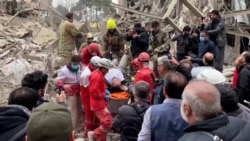

Trump asserted on March 17 that the US campaign "will be over in a week or two and it won't take long." He did not provide a more specific time frame, but added that "everything is moving very quickly" and that "we are well ahead of schedule."
Gabbard's appearance at the Senate left questions about the state of Iran's nuclear program. Her prepared remarks said that Tehran's enrichment capability had been destroyed in US-Israeli strikes last June and that the US had not seen efforts to rebuild, while her oral testimony suggested Iran was attempting to recover from damage.
Intelligence chief Khatib was the latest in a growing number of senior Iranian figures who have been killed since the longtime supreme leader, Ali Khamenei, died on February 28, the first day of the US-Israeli campaign. His son, Ayatollah Mojtabi Khamenei, has not been seen in public since he was named as the new supreme leader.
Acknowledging Khatib's demise in an X post on March 18, which also named the head of Iran's security chief, Ali Larijani, and the country's defense minister, Aziz Nasirzadeh, who died in earlier attacks, Iranian President Masud Pezeshkian said that their "cowardly assassination" had "left us in mourning."
Early on March 18, a barrage of Iranian missiles killed two people in Israel, near Tel Aviv, as Tehran vowed revenge for the assassination of Larijani. Tehran said the overnight attacks, which brought the war's death toll in Israel to at least 14, were to "honor" Larijani's death.
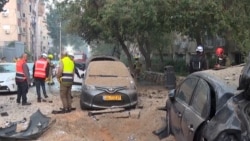
A statement read by the Islamic Revolutionary Guards Corps (IRGC) on state television said the attacks used Khoramshahr-4 and Qadr missiles, both of which carry multiple warheads.
Israel has accused Iran of repeatedly using cluster munitions, which split into several smaller bombs midflight and spread over a wide area, making them difficult to intercept.
Iranian media on March 18 reported strikes in Lorestan Province and Hamedan city, both in the west of Iran, as well as the southern Fars Province.
Israel also intensified its strikes on targets that it said are related to Iranian-backed Hezbollah -- which the United States and Israel have deemed a terrorist organization -- in Lebanon. Several people were reported dead in the attacks, which are bolstering concerns that the conflict could be widen throughout the Middle East.
Meanwhile, Rosatom, the Russian operator of the Bushehr nuclear power plant in western Iran, said a projectile hit an area near the facility on March 17, though no damage or injuries or release of radiation were reported.
International Atomic Energy Agency Director General Rafael Grossi reiterated the IAEA's "call for maximum restraint during the conflict to prevent risk of a nuclear accident," the nuclear watchdog said in a post on X.
Russian-built Bushehr, on the Gulf coast, is Iran's sole nuclear power plant; it is fueled by uranium produced in Russia, not Iran, and is monitored by the IAEA. Russia has evacuated some staff, but hundreds remain.
Several explosions were also heard in Jerusalem on March 18, following the Israeli military's announcement that it had detected a new wave of missiles fired from Iran.
Larijani was killed along with his son Morteza, his deputy Alireza Bayat, and several bodyguards, the Secretariat of Iran's Supreme National Security Council said in a statement late on March 17. Larijani was secretary of the council and one of the most powerful figures in Iran following Ali Khamenei's killing.
Separately, the IRGC confirmed the death of Qolamreza Soleimani, commander of Iran's paramilitary Basij force, giving few details. The Israel Defense Forces (IDF) had said Soleimani and Larijani were killed in the same series of strikes on March 16.
Khatib was killed in a targeted strike on Tehran, the IDF said. "Khatib played a significant role during the recent protests throughout Iran, both with regards to the arrest and killing of protesters," it said in a statement published on Telegram.
Israeli Defense Minister Israel Katz said that Prime Minister Benjamin Netanyahu and the Defense Ministry had previously authorized the Israeli military to target any senior Iranian official without requiring additional approval.
The US-Israeli offensive against Iran has shown no signs of letting up, and air raid sirens were heard in several locations around the Middle East on March 18.
Several loud explosions were heard in Dubai early in the day as officials in the United Arab Emirates said the country's air defense systems had intercepted 13 ballistic missiles and 27 drones launched by Iran on March 18.
According to Emirati officials, more 2,000 drones and missiles have been fired at the country by Iran since the start of the war.
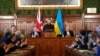
Trump said on March 17 that the United States had been informed by most of its NATO allies that they don't want to get involved with the country's military operation in Iran.
Trump had called for help securing shipping through the Strait of Hormuz, which Tehran has effectively shut down with attacks on vessels and threats of more.
Some countries had said they'd consider such a move, but many others rejected getting involved.
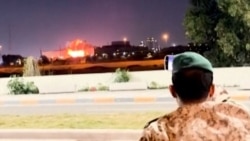
A senior official of the United Arab Emirates said the country is considering joining the US naval initiative.
Anwar Gargash, diplomatic adviser to the UAE president, said negotiations are continuing in this regard, but a final decision has not yet been made, and emphasized that ensuring trade and energy security is the shared responsibility of major countries.
Iran's targeting of crude oil and gas producing nations around the Gulf has pushed energy prices up sharply in many countries.

