


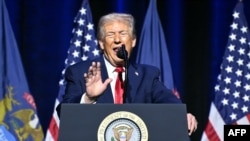
US President Donald Trump has told protesters in Iran that "help is on the way" as the death toll after more than two weeks of anti-government protests continues to increase, sparking a global outcry.
In an interview with to CBS News Trump said the US will take “very strong action” in Iran if the regime starts hanging protesters. "We don't want to see what's happening in Iran happen," he said. "It's not gonna work out good."
He added that the administration is waiting for an official confirmation of the number of protesters killed by Iranian security forces.

Trump refused to elaborate of the kind of action US might take, but added that the "end game is to win," alluding to recent US air strikes that disabled Iranian nuclear program or the extraction of Venezuelan President Nicolas Maduro from Caracas who then was incarcerated in US and is awaiting trial on criminal charges.
Earlier in the day Trump called on Iranians to "keep protesting" and "take over institutions," following a series of stern warnings that said the United States was "watching the situation very carefully" and insisting authorities refrain from killing protesters in one of the biggest challenges to clerical rule since the 1979 Islamic Revolution.
"I have cancelled all meetings with Iranian Officials until the senseless killing of protesters STOPS. HELP IS ON ITS WAY," he said on social media.
His comments followed a social media post late on January 12 saying any country doing business with Iran will face a tariff rate of 25 percent on any trade with the United States. He gave no further details.
The uprising in Iran was sparked by spiraling inflation and a free fall of the currency but has since turned into a broader antigovernment protest.
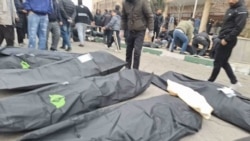
Rights groups say officials have waged a brutal crackdown on the demonstrations with many fatalities.
The independent US-based rights monitor HRANA said on January 13 that its verified death toll in the protests had risen to 2,003 people.
Earlier the same day, Reuters quoted an unnamed Iranian official reporting the number of deaths at around 2,000, the first time authorities have acknowledged the high death toll after more than two weeks of nationwide unrest.
The tense situation in the country prompted the Washington to issue a warning to US citizens to leave Iran as soon as possible.
Some say that with Internet access cut by authorities to limit the flow of information between protesters and to the international community, the actual death toll may be much higher.
"It's about five days now that all connections have been shut down, and there is no way to communicate with Iran. They can easily kill people there without the world knowing about it," one man, who was protesting outside the Iranian Embassy in the Armenian capital, Yerevan, told RFE/RL when asked if he had been able to communicate with relatives still inside Iran.
Demanding More Than Reforms
Another noted the tone of the current demonstrations has changed.
"Previous protests called for reforms in Iran. This time, people are no longer demanding reform. They are demanding a change of the system," they said.
"What you see today is that people at protests are not talking about reforms. They are naming ayatollahs and mullahs whom they want out of the country."
Trump's warning came amid a global outcry over the deadly actions of Iranian authorities.
Britain on January 13 condemned Iran's leadership for the "horrendous and brutal killing" of protesters and summoned the Iranian ambassador "to answer for the horrific reports that we are hearing."
"The United Kingdom condemns in the strongest of terms the horrendous and brutal killing of Iranian protesters, and we demand that the Iranian authorities respect the fundamental rights and freedoms of their citizens," British Foreign Minister Yvette Cooper told parliament.
German Chancellor Friedrich Merz said Iran's leadership appears to be in its "final days and weeks."
"When a regime can only maintain power through violence, then it is effectively at its end. The population is now rising up against this regime," he told reporters during a trip to India.
In a sign of the brutality of the crackdown, rights groups said on January 13 that Iran is set to execute the first protester charged in the unrest.
The groups, including Norway-based Iran Human Rights and Hengaw, quoted sources as saying that 26-year-old Erfan Soltani, charged with "waging war against God" due to his role in protests that have rocked the country since late last month, would be executed on January 14, six days after his arrest.
Iranian officials have not commented publicly on the reports about Soltani. But the Tasnim news agency, which is close to the Islamic Revolutionary Guards Corps (IRGC), reported on January 13 that the judiciary had issued its first indictments against several protesters.
'Killing Of Peaceful Demonstrators Must Stop'
Serious cases, including those charged with "waging war against God," an offense subject to the death penalty under Islamic law in Iran, would be prioritized, the agency said.
"The killing of peaceful demonstrators must stop, and the labelling of protesters as 'terrorists' to justify violence against them is unacceptable," United Nations human rights chief Volker Turk said in a statement on January 13, decrying the authorities' decision "to inflict brutal force to repress legitimate demands for change."
A doctor inside Iran has told RFE/RL’s Radio Farda that security forces have stormed hospitals and executed wounded protesters amid a brutal state crackdown on nationwide antiestablishment protests.
The doctor, who said she works in a hospital in southern Iran, said members of Iran’s security forces had “finished off” protesters who had been admitted to hospital for treatment.
“They killed many [demonstrators], arrested many, and many are on the run,” said the doctor, who spoke to Radio Farda on condition of anonymity for fear of retribution. “The situation is very bad.”
RFE/RL could not independently verify the doctor’s claims.
In the last major wave of protests in 2022 when people took to the streets nationwide under the slogan "Women, Life, Freedom" following the death of Mahsa Amini while she was in police custody for allegedly improperly wearing her headscarf, at least 12 people tied to the unrest were executed.