

Iran
Iran Deploys Drones To Target Internal Threats, Protect External Interests
Charred tents, a burned-out motorcycle, and a damaged white SUV vehicle. This was the aftermath of a reported drone strike carried out by the Islamic Revolutionary Guards Corps (IRGC) in southeastern Iran.

The December 28 strike in Rigan county in Kerman Province appears to mark the first time the IRGC, Iran’s elite military force, has used drones to target security threats inside the country.
The IRGC said the “precise” operation killed a prominent “bandit” and two of his accomplices who had been fomenting unrest in the area, including killing two IRGC members days earlier.
Rigan county neighbors Sistan-Baluchistan, a volatile province near the border with Pakistan and Afghanistan where drug smugglers, separatists, and militant groups operate. The province's population is mainly ethnic Baluch.
Baluch sources reported that the drone killed at least four Baluch fighters while they were asleep.
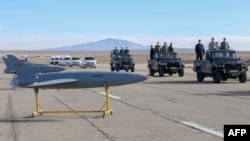
The attack has served to highlight Iran's expanding drone capabilities, which Tehran is also increasingly deploying beyond its borders.
Iran has supplied unmanned aerial vehicles (UAVs) to its proxies in the Middle East and employed them during reconnaissance, sabotage, and attack missions in the region, analysts said.
Cheap But Effective
Analysts said that, even though Iran’s drone program lacked sophistication, it still posed a significant threat in the region, where there has been a surge in drone attacks carried out by nonstate actors with ties to Tehran.
“Think of it as the Toyota Corolla of drones,” said Aaron Stein, the research director at the Foreign Policy Research Institute, a U.S.-based think tank, referring to the dependable Japanese-made passenger car.
“They are ubiquitous and good enough to get you there, but not fancy and flashy,” Stein told RFE/RL, adding that many Iranian drones are believed to be pieced together from commercial parts.
He added that Iranian drones pose a threat to U.S. forces stationed in the region, including in neighboring Iraq, where American military installations have been targeted by pro-Iranian militias.
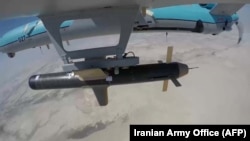
“Iran’s proliferation of UAVs across the region threatens international peace and stability,” Deputy U.S. Secretary of the Treasury Wally Adeyemo said in October while announcing sanctions against two IRGC officials, two other individuals, and two companies, which Washington said provide critical support to the IRGC’s drone program.
“Iran and its proxy militants have used UAVs to attack U.S. forces, our partners, and international shipping,” Adeyemo added.
Jeremy Binnie, a defense analyst at Janes, a Britain-based open-source intelligence company, said Iranian drones have made pro-Iranian armed groups in Iraq, Syria, and Yemen unpredictable.
“The long-range UAVs can be programmed with nondirect flightpaths so they can attack targets from unexpected directions,” Binnie told RFE/RL.
“Such weapons have proven difficult to stop, partly because air defense radar systems were typically developed to detect far faster threats with larger radar and/or heat signatures and also because the air defense systems designed to intercept such low-flying threats only have a short-range,” he added.
Binnie said the “relatively unsophisticated” drones have allowed pro-Iranian proxies to “carry out low-level attacks that maintain pressure on their adversaries, as we see regularly in Iraq and Yemen,” where they have been used by Huthi rebels.
Difficult To Stop
Analysts said drones have also allowed Tehran to maintain plausible deniability even as it carries out covert operations in the region.
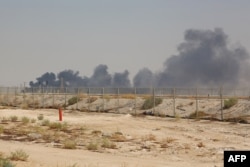
In 2019, a drone attack on Saudi Arabia's oil facilities halted more than half of the nation’s daily output. The Iran-aligned Huthis claimed responsibility for the attack, while U.S. officials blamed Iran.
In November 2020, a drone exploded near the front door of the Baghdad residence of Iraqi Prime Minister Mustafa al-Kadhimi, injuring his bodyguards. Some officials blamed the attack on Iran-backed militias, although some reports suggested that Tehran had not ordered the strike.
In recent months, reports have emerged of Iranian-made Mohajer-6 drones being spotted in Ethiopia amid a raging civil war in the East African nation.
In August, the United States, Britain, and Israel accused Iran of carrying out a drone attack on an oil tanker in the Arabian Sea that killed two people on board.
In September, the IRGC said it had used drones to target Kurdish armed groups based in Iraq’s northern Kurdistan region.
On January 17, the Huthis claimed responsibility for an attack targeting a key oil facility in the United Arab Emirates, saying it used missiles and drones. The attack killed three people and caused a fire near the airport of the capital, Abu Dhabi. Iran has been widely accused of supplying arms to the Huthis.
"As for who's responsible for it, I think that we should take the Huthis at their word,” tweeted Dave Des Roches, a senior fellow at the Washington-based Gulf International Forum (IGF) and an associate professor at the Near East South Asia Center for Security Studies. “The only question is how much of it is Huthi/Huthis, how much of it is Iran/Huthis."
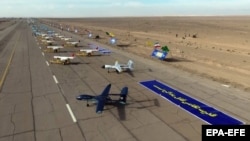
Binnie said Iran, reeling from years of crippling U.S. sanctions over its nuclear program, had developed drones as “a low-cost way” to compensate for its lack of a modern air force.
“The Iranian military, especially the IRGC, has invested heavily in developing a wide range of UAVs,” he said.
They include “long-endurance surveillance and attack platforms like the Shahed-129,” so-called “suicide” drones that are effectively slow cruise missiles, and stealth drones “for penetrating well-defended airspace,” said Binnie.
Boosting Its Arsenal
Tehran’s drone program dates back to the devastating 1980-88 Iran-Iraq War, when Iranian forces started to use drones for reconnaissance purposes.
In 2012, Iran claimed it had reverse engineered an advanced U.S. drone it had captured the year before. State media claimed that the move led to the development of a newer range of combat drones.
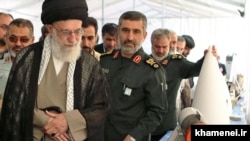
IRGC aerospace commander Amir Ali Hajizadeh said last year that the decision to boost the country's arsenal of drones came after a meeting held “three or four years ago” with Supreme Leader Ayatollah Ali Khamenei.
Hajizadeh said Khamenei praised the drone program while stating that the country’s stockpile was too low.
“After that we all mobilized to increase the number of UAVs,” Hajizadeh was quoted as saying by the hard-line Fars news agency.
In recent years, Iran has become a prolific drone producer and showcases its surveillance, attack, and weaponized drones during military parades.

More News
Iran's Judiciary Issues Another Warning Against Protests Over Amini's Death
Iran's judiciary has once again warned government opponents not to take to the streets to mark the anniversary of the death of Mahsa Amini next month as tensions rise a year after the 22-year-old died while in police custody for an alleged violation of the country's head scarf law.
Deputy Judiciary Chief Sadeq Rahimi told reporters on August 24 that Iranian intelligence and security agencies are "vigilantly monitoring" potential protest activities and that "any group aiming to disrupt social structures in the coming days will be identified and handed over to the judiciary."
Amini was detained by the morality police while visiting Tehran in September 2022 because she was allegedly wearing a head scarf, or hijab, improperly. Witnesses say security agents beat her during her arrest, while official autopsy reports blamed it on health conditions the family claims she didn't have.
Amini died on September 16 after being moved to a hospital, sparking mass protests that have continued for most of the past year.
Authorities have responded to the biggest challenge to the Islamic leadership since it came to power following the 1979 revolution with a heavy-handed crackdown that has seen hundreds killed, thousands arrested, and harsh penalties, including the death sentence for offenders.
Rahimi cautioned those pardoned by Iran's Supreme Leader Ayatollah Ali Khamenei earlier this year for violations committed during the protests would be hit with even harder penalties if they are detained again.
Many lawyers, human rights activists, imprisoned protesters, and former political prisoners have dismissed the amnesty decree as a thinly veiled attempt at propaganda in the face of such strong dissent.
The government, fearing a flare-up in protests next month on the anniversary of Amini's death, has been ramping up warnings against activists and families of those killed in the protests.
In a statement released on August 21, Amnesty International detailed the situation of 36 families from 10 provinces in Iran who have suffered human rights abuses in recent months at the hands of Iranian law enforcement.
The August 16 arrest of 12 women's rights activists who are accused of planning events ahead of the anniversary of Amini's death has intensified concerns that officials will stop at nothing to try and quell any unrest.
The Telegram channel of the Iranian Student Guild Councils highlighted the delay in the academic calendar of major universities, attributing it to the upcoming anniversary of Amini's death. The channel also reported an increase in "contacts from security agencies with students" as the anniversary approaches.
Reports say many students have been coerced into signing commitments to abstain from potential student protests and online activities that align with the protests.
In recent weeks at Azarbaijan Civil University, security personnel have allegedly threatened students and their families with potential arrests and university expulsions.
Written by Ardeshir Tayebi based on an original story in Persian by RFE/RL's Radio Farda
Jailed Iranian Rapper Says He Was Tortured And Forced To Confess In Prison
Jailed Iranian dissident rapper Saman Yasin, who was detained during the nationwide protests in Iran last year, says he has endured mock executions, beatings, and other forms of torture while in prison on a charge to which he was forced to admit guilt.
In an audio file released by the Kurdistan Human Rights Network on August 23, Yasin detailed harrowing accounts of physical and psychological torture he says he has endured since being taken into custody. He also says prison officials threatened to harm his family if he didn't admit to being involved in the shooting of a paramilitary officer during the protests.
In the audio clip, the second one he has released in the past two months, Yasin says he was transferred to the Amin Abad Psychiatric Hospital, tied to a bed, and drugged.
"I was forcibly tied to the hospital bed by some prison soldiers and prison personnel. My hands were handcuffed and my feet were bound. I was given an injection in the arm and I was unconscious for 24 hours," he said.
Yasin was arrested by security forces during nationwide protests in 2022. Initial reports suggested he was first taken to a local police station before being transferred to Evin prison and subsequently to the Greater Tehran prison.
The judiciary's news agency reported that Yasin was accused of "waging war against God," a charge that led to a death sentence from the Tehran Revolutionary Court. However, the Supreme Court has since accepted Yasin's appeal for a retrial and referred his case back to the Revolutionary Court.
A source with direct knowledge of the situation told RFE/RL's Radio Farda that before the first court session, the appointed lawyer asked Yasin to "take the blame for a shooting to have his life spared."
Yasin describes a "mock execution" set up by prison officials that he endured before being moved to the Rajai Shahr prison in Karaj, along with two other detainees, Mohsen Shekari and Mohammad Boroghani. Shekari was executed in December shortly after his transfer.
Yasin lamented the lack of access to his appointed lawyer, accusing his public defender of being unresponsive. In a letter made public recently, the rapper had pleaded for a meeting with his legal representative and access to his case files ahead of a court hearing scheduled for September.
Over recent months, Yasin has consistently maintained his innocence, releasing multiple audio files to publicize his claims. He has also reportedly launched at least one hunger strike in protest.
Since the September 2022 death of Mahsa Amini in custody after she was detained for allegedly wearing a head scarf improperly, Iranians have flooded the streets across the country to protest a lack of rights, with women and schoolgirls making unprecedented shows of support in the biggest threat to the Islamic government since the 1979 revolution.
The judiciary, at the urging of lawmakers, has instituted harsh penalties, including the death sentence, for offenders.
Meanwhile, judges have also recently begun sending offenders to psychiatric centers as part of their punishment, a move prominent psychiatry boards in Iran have said is an abuse of judicial authority.
Written by Ardeshir Tayebi based on an original story in Persian by RFE/RL's Radio Farda
Ebrahim Golestan, Prominent Iranian Writer And Filmmaker, Dies At 100
Ebrahim Golestan, a prominent Iranian writer and filmmaker, died at the age of 100 in Britain on August 22, his daughter said. Golestan’s literary career started with translating stories by Ernest Hemingway and William Faulkner. He established the Golestan Films studio in 1957 and produced documentaries for the National Iranian Oil Company. His landmark The House Is Black short film in 1963 explores the emotional effects of chronic illness. Golestan left Iran and moved to Britain in 1975, four years before the Islamic Revolution. He never returned to Iran but kept in contact with Iranian cultural figures. To read the original story by RFE/RL’s Radio Farda click here.
- By Reuters
BRICS Invites Iran, Five Others To Join Developing World Bloc
Iran has been invited to join the BRICS group of developing nations along with Saudi Arabia, Ethiopia, Egypt, Argentina, and the United Arab Emirates, in a move aimed at growing the clout of a bloc that has pledged to champion the "Global South." Expansion could also pave the way for dozens of interested countries seeking admission to BRICS -- currently Brazil, Russia, India, China, and South Africa -- at a time when geopolitical polarization is spurring efforts by Beijing and Moscow to forge it into a viable counterweight to the West. The new candidates become members on January 1, 2024. To read the original story by Reuters, click here.
Father Of Executed Iranian Protester Detained As Anniversary Of Amini's Death Nears
Iranian authorities have reportedly arrested Mashallah Karami, the father of Mohammad Mehdi Karami, who was arrested and then executed for his participation in the nationwide protests sparked by the death of Mahsa Amini while in police custody last September.
RFE/RL’s Radio Farda reported that Karami was detained on August 22 during a raid by security forces at his residence.
Sources close to the Karami family told Radio Farda that during the raid, not only were family members taken into custody, but all of their electronic devices, including laptops and mobile phones, were confiscated.
While Mohammad Mehdi Karami's mother and brother were briefly detained and subsequently released, the father remains in detention, the sources said.
Mohammad Mehdi Karami was sentenced to death in early December. Prosecutors accused him of being involved in the death of a member of the Basij paramilitary force during an anti-government demonstration.
Mohammad Hosseini was also sentenced to death in the case and executed in January.
Karami and Hosseini had denied the charges against them and said they had been tortured in prison.
Iranian officials have repeatedly expressed concerns in recent weeks about the possibility of protests escalating as the September 16 anniversary of Amini's death approaches.
In Tehran and other Iranian cities, several civil activists and demonstrators with a history of protesting have also been arrested or summoned in recent days to meet with judicial authorities.
Iranian security services, meanwhile, have initiated a series of "telephone summons" targeting students after Mostafa Rastegari, Supreme Leader Ayatollah Ali Khamenei's top representative for higher education, warned of the potential for fresh public protests originating from academic institutions and hinted that measures to deter protests were needed.
At least 500 people have been killed since the protests broke out after Amini, an Iranian Kurdish woman who was arrested while visiting Tehran for allegedly violating the country’s hijab law, died.
The protests began as a rebuke against the brutal enforcement of the mandatory head-scarf legislation but soon snowballed into one of the most sustained demonstrations against Iran’s theocracy since the 1979 Islamic Revolution.
Officials have blamed the West for inciting the protests and vowed to crack down even harder on the demonstrations.
Several thousand people have been arrested, including many protesters, as well as journalists, lawyers, activists, digital rights defenders, and others.
Written by Ardeshir Tayebi based on an original story in Persian by RFE/RL's Radio Farda
Afghan Media Watchdog Calls For The Release Of Detained Iranian Photojournalist
An Afghan press freedom organization has called for the release of an Iranian photojournalist detained by the Taliban, which has arrested around a dozen reporters over the past two weeks.
The semioffical Tasnim news agency in Iran reported on August 22 that Taliban security agents had apprehended its photojournalist, Mohammad Hossein Velayati, in Kabul three days earlier.
Velayati was reportedly detained at Kabul airport while trying to fly home after a 10-day reporting trip to the Afghan capital.
“We call for his immediate and unconditional release,” the Afghanistan Journalists Center (AFJC) said on August 22.
“[We want] an end to the harassment and targeting of journalists in Afghanistan,” it added.
Valayati’s arrest follows a recent deterioration in relations between Tehran’s clerical regime and the Taliban militants who have ruled Afghanistan since seizing power in August 2021.
Forces from the two sides clashed along their 900-kilometer-long shared border in May after Iranian President Ebrahim Raisi warned the Taliban against depriving his country of its share of water from the Helmand River.
In an interview on August 22, Hassan Kazemi Qomi, the Iranian president's special envoy for Afghanistan, said his country’s diplomats in Kabul were talking to the Taliban about Velayati’s release.
The Taliban has not commented on the arrest.
Tasnim reported that Velayati went to Afghanistan legally and criticized the arrest of its staff member without explanation.
“Given the negative perceptions that Iranians have of the Taliban's treatment of Iranian journalists, it is expected that the group will act quickly to secure the release of the Iranian photojournalist,” Tasnim said in a report.
The AFJC, however, said Velayati's whereabouts are still unknown, days after his arrest.
“This lack of information constitutes a violation of his visitation rights,” the statement said. “We urge the Taliban authorities to provide an immediate update to his family and colleagues and ensure the well-being of Velayati."
The arrest follows the detention of 11 Afghan journalists in seven Afghan provinces by the Taliban’s General Directorate of Intelligence (GDI) this month. Global and Afghan media watchdogs have condemned the detentions and have called for their swift release.
“It is essential that [the Taliban] put an end to these arbitrary arrests and uphold the principles of press freedom and freedom of expression,” the AFJC said.
Since returning to power two years ago, the Taliban has shut down independent radio stations, television studios, and newspapers.
International media and journalists, too, face severe restrictions and bans. The Taliban has banned international broadcasters and has expelled or banned several foreign correspondents from entering the country.
The ultraconservative Islamist group has also driven hundreds of Afghan journalists into exile.
Lawyer For Family Of Mahsa Amini Reportedly Ordered To Appear In Tehran Court
The lawyer for the family of Mahsa Amini, the 22-year-old Iranian woman whose death while in police custody sparked months of nationwide unrest, is due to appear in Tehran's Islamic Revolutionary Court on August 29 just weeks ahead of the first anniversary of the tragedy.
The France-based Kurdistan Human Rights Network reported that Saleh Nikbakht has been charged with propaganda against the system, for his media interviews and criticism of official findings on the cause of Mahsa Amini's death, which authorities blamed on health issues while the family and their supporters have rejected saying witnesses saw her being beaten when arrested.
In an interview with the Faraz website in January, Nikbakht said that "incomplete investigations had been carried out without [the family's] presence or participation as the complainant."
Beyond the dispute over Amini's death, the lawyer's comments on a range of issues, from women's rights to motorcycle driving licenses to the treatment of Afghan migrants, were cited as evidence of his alleged propaganda activities.
Amini was detained by the morality police while visiting Tehran in September 2022 because she was allegedly wearing a head scarf, or hijab, improperly. She died on September 16 after being moved to a hospital.
Nikbakht called on investigators to study the two-hour period between Amini's arrest and her transfer to the Morality Police Center instead of pushing him and her family to accept the "late arrival and failure" of medical staff as a major factor contributing to her death.
Amini's death prompted thousands of Iranians to take to the streets nationwide to demand more freedoms and women's rights. The widespread unrest, which continues, represents the biggest threat to the Islamic government since the 1979 revolution.
The government, fearing a flare-up in protests next month on the anniversary of Amini's death, has ramped up its crackdown against activists and families of those killed in the protests.
In a statement released on August 21, Amnesty International detailed the situation of 36 families from 10 provinces in Iran who have suffered human rights abuses in recent months at the hands of Iranian law enforcement.
Thirty-three of the cases involved families who had loved ones killed by security forces during the protests, two that lost a relative who was executed arbitrarily, and one family of a torture survivor who took their own life after being released from detention.
The August 16 arrest of 12 women's rights activists who are accused of planning events ahead of the anniversary of Amini's death have intensified concerns that officials will stop at nothing to try and quell any unrest.
Iranian officials have attributed the protests to Western instigation and have pledged a more aggressive crackdown. Over 500 individuals have lost their lives since the start of the protests, which also led to the arrests of thousands, including demonstrators, journalists, lawyers, activists, and digital rights defenders.
Written by Ardeshir Tayebi based on an original story in Persian by RFE/RL's Radio Farda
Iranian Sunni Cleric Calls For Colleague's Release Saying It Will Ward Off Unrest
Molavi Abdolhamid, a spiritual leader for Iran's Sunni Muslim population, has urged the country's authorities to promptly release Molavi Fathi Mohammad Naqshbandi, the Sunni imam of Rask in the northeastern Iranian province of Sistan-Baluchistan.
In a post on the social media platform X, formerly known as Twitter, Abdolhamid said Naqshbandi's arrest, due mainly to his criticism of the authorities, may exacerbate public discontent and could have broader negative implications. He also underscored the urgency of an early release, arguing it would be in the best interest of the community.
On August 20, the judiciary of Sistan-Baluchistan Province confirmed Molavi Naqshbandi's arrest, saying he is accused of "disturbing public sentiment through misleading speeches, defamation against the Islamic republic of Iran, actions detrimental to national security, and illicit occupation of state lands."
Local news source Haalvsh, a group that monitors rights violations in Iran's Baluchistan region, highlighted that the arrest was executed "with a degree of humiliation" as it was carried out publicly in front of Naqshbandi's associates.
The arrest comes amid increasing pressure on Abdolhamid and his supporters.
People in Sistan-Baluchistan, which borders Afghanistan and Pakistan, have been holding protest rallies every Friday since September 2022, when a demonstration turned deadly as security forces opened fire on demonstrators, leaving at least 96 dead and another 300 injured.
The government has unleashed a brutal crackdown on the months of unrest -- one of the deepest challenges to the Islamic regime since the revolution in 1979 -- that erupted following the September 16 death of 22-year-old Mahsa Amini while in police custody for an alleged dress code violation.
Sunni Muslims make up a majority of the population in Sistan-Baluchistan Province and Kurdistan but account for only about 10 percent of the population in Shi'a-dominated Iran overall.
Since Amini's death, more than 500 people have been killed in the police crackdown, according to rights groups. Several thousand more have been arrested, including many protesters, as well as journalists, lawyers, activists, digital rights defenders, and others.
Written by Ardeshir Tayebi based on an original story in Persian by RFE/RL's Radio Farda
- By Reuters
Iran Reportedly Builds Advanced Mohajer Drone With Enhanced Range
Iran has built an advanced homemade drone named Mohajer-10 with an enhanced flight range and duration as well as a greater payload, Iranian state media reported on August 22. Iranian media said the new drone has an operational range of 2,000 kilometers and can fly for up to 24 hours. Its payload can reach 300 kilograms, double the capacity of the Mohajer-6 drone. U.S. officials have accused Iran of providing Mohajer-6 drones, among other unmanned aerial vehicles, to Russia in its war against Ukraine. Tehran denies this. To read the original story by Reuters, click here.
- By RFE/RL
Iran Rights Group Says Number Of Activists' Arrests Piles Up
Iranian authorities have stepped up the detentions of rights activists, mainly women, the Center for Human Rights in Iran (CHRI) has warned. In a statement on August 21, CHRI said 22 activists had been detained in less than a month, as the anniversary approaches of the death in police custody of Mahsa Amini, a 22-year-old woman, in September last year. "Iranian authorities are rounding up activists around the country, especially women, to deliver a message of fear to the populace," CHRI said. Amini's death after being arrested for not wearing a head scarf "properly" sparked a wave of unprecedented protests across Iran.
Iran Executes Eight More Over Past 72 Hours In Prison 'Killing Fields'
Iran, which Amnesty International recently slammed for turning its prisons into "killing fields," has executed at least eight individuals -- most of whom were incarcerated for drug offenses -- in a span of three days, local activists said.
The Baluch Activists Campaign said on August 21 that four executions -- all linked to drug-related offences -- took place at the Zahedan prison. The group identified the victims as Abdulsamad Khadem, a 29-year-old from Zahak; Yaqub Ejbari, a father of eight from Qarqaruk village; Mohammad Anwar Barahui and an individual with the surname Qanbarzehi, both of whom were from Zahedan, which is located in the southeastern province of Sistan-Baluchistan.
In addition, two Baluch prisoners -- named Abdulsamad Shahuzehi and Mahmud Rigi -- were executed in the Zahedan prison on August 19 after being handed qisas (retribution) sentences for a joint murder dating back to 2012.
The advocacy group said that since April, 84 Baluch inmates, including four women, have been executed.
Separate reports from multiple media outlets also confirmed the execution of an unnamed individual in a prison in the southwestern Iranian city of Dezful on August 19 on charges related to drug offenses while the Human Rights News Agency reported a drug-related execution at the Sheiban prison on August 19. The individual, Abdulreza Qalavand, had been incarcerated for a decade before his execution.
Amnesty International says the regime in Tehran executes more people than any other country in the world other than China, and decried a situation that has turned the country's prisons into "killing fields."
“The shameless rate at which the authorities are carrying out drug-related executions, in violation of international law, exposes their lack of humanity and flagrant disregard for the right to life. The international community must ensure that cooperation in anti-drug trafficking initiatives do not contribute, directly or indirectly, to the arbitrary deprivation of life and other human rights violations in Iran,” said Diana Eltahawy, Amnesty International’s deputy director for the Middle East and North Africa in a report on June 2.
https://www.amnesty.org/en/latest/news/2023/06/iran-prisons-turned-into-killing-fields-as-drug-related-executions-almost-triple-this-year/
The Norway-based Iran Human Rights organization says that July alone saw 61 executions, with the list comprising 11 Baluchis and three Afghan nationals. Since the start of 2023, a verified total of 423 individuals have been executed in Iran, though insiders believe the actual figure could be significantly higher.
The rate of executions in Iran has been rising sharply, particularly in the wake of widespread protests that swept across the country last year following the death of 22-year-old Mahsa Amini while in police custody for an alleged head scarf violation.
Written by Ardeshir Tayebi based on an original story in Persian by RFE/RL's Radio Farda
Iranian Students Report Increased Restrictions Ahead Of New School Year
Independent student news outlets in Iran announced on August 20 that there has been a marked increase in restrictions on dormitories, especially in accommodation facilities for women, ahead of the new school year and the first anniversary of the death of Mahsa Amini while in police custody, which sparked months of unrest.
According to the Iranian Student Guild Councils, the clampdown, particularly in female dormitories, has reached unprecedented levels with some accommodation centers, such as the female dormitory of Tabriz Cultural University, having restrictions "more stringent than those in prisons."
A report from the group noted that during summer-term examinations the university has enforced a one-hour movement limit for female students residing in the dormitory, essentially keeping them inside the residence for 23 hours a day. All departures and arrivals are meticulously recorded and if a student exceeds the one-hour limit, they are "immediately" reported to security officials.
The Student Guild Councils also said that noncompliance with the restriction results in the student's family being informed, the confiscation of their student card, and a ban on leaving the dormitory. Repeated breaches can lead to disciplinary action.
The report also shed light on the deteriorating conditions in male dormitories, and the enforcement of a student dress code.
Over the past year, universities have been among the main venues for unrest following the death of Amini, 22, while she was being held for an alleged head-scarf violation.
Many cultural and entertainment luminaries have also been the focus of attention for authorities because they spoke out against the crackdown on dissent.
The Student Guild Councils Telegram channel recently highlighted the sudden removal of two courses -- sculpture and cinema -- from the Art University's entrance exams without any prior notification. While one university representative refuted this claim, another suggested that the courses could be reinstated following a review.
This comes on the back of speculation that sculpture classes may be scrapped entirely due to student participation in last year's protests.
Following recent nationwide demonstrations, pressure has increased on universities across the country to enforce the policy of requiring women to wear an Islamic head-scarf, or hijab.
The extent of the crackdown on students is such that students are quickly summoned and issued with "expulsion" or "suspension from studies" orders for any form of protest action or noncompliance with the dress code.
Universities and students have long been at the forefront of the struggle for greater social and political freedoms in Iran. In 1999, students protested the closure of a reformist daily, prompting a brutal raid on the dorms of Tehran University that left one student dead.
Over the years, the authorities have arrested student activists and leaders, sentencing them to prison and banning them from studying.
The activist HRANA news agency says at least 700 university students have been arrested during the recent unrest.
Many have faced sentences such as imprisonment, flogging, and dozens of students have been expelled from universities or suspended from their studies, as security forces try to stifle widespread dissent.
Written by Ardeshir Tayebi based on an original story in Persian by RFE/RL's Radio Farda.
Amnesty International Urges Protection for Iranian Protest Victims' Families
Amnesty International has called on Iranian authorities to allow the commemoration of the first anniversary of those killed during "Women, Life, Freedom" protests in 2022 amid a campaign by security forces marked by "harassment and intimidation" against victims’ families "to enforce silence and impunity."
The rights group said in a statement released on August 21 that a new research report shows that Iranian authorities have been subjecting victims’ families to arbitrary arrest and detention, imposing "cruel restrictions" on peaceful gatherings at grave sites, and destroying victims’ gravestones.
Meanwhile, no officials have been held to account for the "unlawful" killing of hundreds of protesters by security forces since they launched a "brutal" crackdown following the unrest sparked by the death of 22-year-old Mahsa Amini on September 16 last year while she was being held in custody by morality police for an alleged dress code violation.
“The international community must support victims’ families by pressing the Iranian authorities in private and in public to respect their right to freedom of expression, association and peaceful assembly," said Diana Eltahawy, Amnesty International's deputy regional director for the Middle East and North Africa.
"The families must be protected from arbitrary detention, threats and other reprisals. States must also call on the Iranian authorities to release all those who were detained for advocating for truth and justice over the deaths, quash all unjust convictions and sentences against them, and drop all charges against those facing reprisals for speaking out,” Eltahawy added.
In the report, Amnesty detailed the situation of 36 families from 10 provinces in Iran who have suffered human rights abuses in recent months at the hands of Iranian law enforcement.
Thirty-three of the cases involved families who had loved ones killed by security forces during the protests, two that lost a relative who was executed arbitrarily, and one family of a torture survivor who took their own life after being released from detention.
The August 16 arrest of 12 women's rights activists who are accused of planning events ahead of the anniversary of Amini's death have intensified concerns that officials will stop at nothing to try and quell any unrest following a year of protests that have posed the biggest challenge to the country's leadership since the Islamic Revolution in 1979.
Iranian officials have attributed the protests to Western instigation and have pledged a more aggressive crackdown. Over 500 individuals have lost their lives since the start of the protests, which also led to the arrests of thousands, including demonstrators, journalists, lawyers, activists, and digital rights defenders.
Eltahawy said that, given the reprisals families have faced and the "systematic impunity" of officials in Iran, the international community must "exercise universal jurisdiction and issue arrest warrants for Iranian officials, including those with command responsibility, who are reasonably suspected of criminal responsibility for crimes under international law committed during and in the aftermath of the uprising.”
- By Reuters
Iranian Delegation Arrives In Moscow To Discuss Ground Forces Cooperation
An Iranian military delegation has arrived in Moscow to discuss cooperation between Iranian and Russian ground forces, the state news agency TASS reported on August 21, citing Russia's Defense Ministry. Russia and Iran, both under Western economic sanctions, have forged closer relations in the military sphere and other areas since Moscow sent tens of thousands of troops into Ukraine. The West has accused Iran of selling large numbers of drones for use against Ukraine, something Tehran denies. To read the original story by Reuters, click here.
- By Reuters
Iran Says Prisoner Exchange Process With U.S. Will Take Up To Two Months
The process of releasing U.S. prisoners held in Iran will take up to two months, Iran's Foreign Ministry spokesman Nasser Kanaani said on August 21 during a press conference. "A specific time frame has been announced by relevant authorities, and it will take a maximum of two months for this process to take place," Kanaani said. Earlier this month, Tehran and Washington reached an agreement whereby five U.S. citizens held in Iran would be freed while $6 billion of Iranian assets frozen in South Korea would be released. To see the original story by Reuters, click here.
- By Reuters
Frozen Iranian Assets Reportedly Transferred To Swiss Central Bank
Iranian assets that had been frozen in South Korea were transferred to Switzerland's central bank last week for exchange and transfer to Iran, South Korean media reported on August 21. The Swiss National Bank plans to exchange its $6 billion holdings in won for dollars and then euros in the currency market, Yonhap Infomax reported. Iran and the United States recently reached an agreement in which five U.S. citizens detained in Iran would be released while Iranian assets in South Korea would be unfrozen and sent to an account in Qatar that Iran could access. To read the original story by Reuters, click here.
Iranian Officials Accuse 12 Activists Of Plotting To Hold Events For Anniversary Of Amini's Death
Iranian police have accused 12 women's rights activists arrested earlier this week of "acting against national security" by planning and coordinating events ahead of the anniversary of the death of Mahsa Amini, who died while in police custody, sparking a year of nationwide unrest.
The police commander of Gilan Province and the Gilan Intelligence Department accused the activists of "communicating with the families of protesters killed during the demonstrations and "inciting them," while also participating in "propaganda activities aimed at overthrowing" the country's leadership.
The 12 activists were arrested separately on August 16 by the Islamic republic's security and intelligence forces in the northern cities of Rasht, Fuman, Anzali, and Lahijan.
Among those detained were Matin Yazdani, Forough Sami'nia, Yasmin Hashdari, Jelve Javaheri, Zahra Dadras, Negin Rezaei, Shiva Shahsiah, and Vahehdeh Khoshsirat.
Azizollah Maleki, the police commander of Gilan Province, said the arrests were also linked to "activities related to the anniversary of protests."
Maleki referred to the detainees as "12 men and women" and said they were arrested "on charges of gathering and colluding to commit a crime against the country's internal security and propaganda activities against the system in favor of opposing groups."
He did not say how long the 12 detainees would remain in custody.
Following the arrests, Mansoureh Shojaee, a women's rights activist herself, told RFE/RL’s Radio Farda that the detentions appear to be part of a broader strategy by the Islamic leadership to manage the first anniversary of Amini's death on September 16.
She emphasized that many of those detained, including Javaheri, Sami'nia, and Yazdani, have been champions of the women's rights movement for more than two decades.
Iranian officials have repeatedly expressed concerns in recent weeks about the possibility of protests escalating as the anniversary approaches.
In Tehran and other Iranian cities, several civil activists and demonstrators with a history of protesting have also been arrested or summoned in recent days to meet with judicial authorities.
The synchronicity of the anniversary of the protests and the reopening of universities in September, where the demonstrations have gained strength, have led some officials, including in Tehran's City Hall, to announce plans to shift to online teaching until October 1.
Iranian security services, meanwhile, have initiated a series of "telephone summons" targeting students after Mostafa Rastegari, Supreme Leader Ayatollah Ali Khamenei's top representative for higher education, warned of the potential for fresh public protests originating from academic institutions and hinted that measures to deter protests were needed.
At least 500 people have been killed since protests broke out following the death of Amini, an Iranian Kurdish woman who was arrested while visiting Tehran for allegedly violating the country’s hijab law.
The protests began as a rebuke against the brutal enforcement of the mandatory head scarf legislation, but soon snowballed into one of the most sustained demonstrations against Iran’s theocracy since the 1979 Islamic Revolution.
Officials have blamed the West for inciting the protests and vowed to crack down even harder on the demonstrations.
Several thousand people have been arrested, including many protesters, as well as journalists, lawyers, activists, digital rights defenders, and others.
Written by Ardeshir Tayebi based on an original story in Persian by RFE/RL's Radio Farda
Iranian Professor Who Supported Protests Says He's Been Expelled
Mahdi Khoei, a renowned Iranian sociology professor at Tehran’s Allameh University, says he has been expelled from the university after he supported nationwide protests that swept across the country following the September 2022 death of Mahsa Amini while in police custody.
In an Instagram post on August 17, Khoei said he was dismayed at the move after teaching at the school for seven years.
"I am Mahdi Khoei, a sociology teacher at Allameh University. I've never bowed to any pressure, remained committed only to my students and the wider public. Now, after seven years, I've been handed a termination letter," he wrote.
Many Iranian university professors have faced expulsion for their support of the nationwide protests, while others have already been pushed from their jobs, including several professors at the University of Art in Tehran who were ousted earlier this month.
Anger over Amini's death in September 2022 has prompted thousands of Iranians to take to the streets to demand more freedoms and women's rights.
Numerous protests have been held at universities, particularly in Tehran, where many students have refused to attend classes. Protesting students have chanted "Women, life, freedom" and "Death to the dictator" at the rallies. Some female students have removed and burned their head scarves.
In the wake of his social media post, a group of students from the university's Social Sciences department released a statement protesting the expulsion, saying the university should be seen as the "beating heart of resistance against oppression."
The students said their support for Professor Khoei was "unwavering" and warned of a class boycott should unwarranted intervention in academic freedoms continue.
Their message also contained a sharp rebuke of Ardeshir Entezari, the head of the Social Sciences department at the university, whom they criticized as being a "passive figure" in the matter, and warned that if there wasn't more clarity over faculty dismissals, they may demand Entezari's resignation.
"The university is our home, not a playground for arbitrary state bullying. To take it from us, you must face its real custodians," they said in the statement.
Universities and students have long been at the forefront of the struggle for greater social and political freedoms in Iran. In 1999, students protested the closure of a reformist daily, prompting a brutal raid on the dorms of Tehran University that left one student dead.
Over the years, the authorities have arrested student activists and leaders, sentencing them to prison and banning them from studying.
The activist HRANA news agency says at least 700 university students have been arrested during the recent unrest.
Many have faced sentences such as imprisonment, flogging, and dozens of students have been expelled from universities or suspended from their studies, as security forces try to stifle widespread dissent.
Written by Ardeshir Tayebi based on an original story in Persian by RFE/RL's Radio Farda
- By Reuters
Saudi Crown Prince Meets Iran's Foreign Minister As Relations Thaw
Saudi Arabian Crown Prince Muhammad bin Salman met Iranian Foreign Minister Hossein Amir-Abdollahian in Jeddah in the highest level talks since the countries reconciled after years of bitter rivalry that destabilized the region. The unscheduled meeting on August 18 comes a day after Amir-Abdollahian arrived in the kingdom and declared that ties between the countries were "on the right track" following talks with his Saudi counterpart, Prince Faisal bin Farhan. Bin Salman is the kingdom's de facto ruler and has pushed to reorient Saudi foreign policy in recent years amid questions over its historically close relationship with the United States. To read the original story by Reuters, click here.
Iran Detains Prominent Women's Rights Activists As Anniversary Of Amini's Death Nears
Iranian security forces have detained nine prominent women's rights activists in various cities in the northern province of Gilan as authorities continue a crackdown ahead of the first anniversary of the death of Mahsa Amini while in police custody for allegedly violating the country's head scarf law.
Among those arrested on August 16 were Matin Yazdani, Forough Sami'nia, Yasmin Hashdari, Jelve Javaheri, Zahra Dadras, Negin Rezaei, Shiva ShahSiah, and Vahehdeh KhoshSirat, activists reported on social media.
The exact reasons for the arrests and the whereabouts of the detainees have not been disclosed and officials have not commented publicly on the matter.
Speaking to RFERL’s Radio Farda, women's rights advocate Mansureh Shojaee said the detentions appear to be part of a broader strategy by the Islamic leadership to manage the first anniversary of Amini's death on September 16. She emphasized that many of those detained, including Javaheri, Sami'nia, and Yazdani, have been champions of the women's rights movement for more than two decades.
At least 500 people have been killed since protests broke out following the death of Amini, an Iranian Kurdish woman who was arrested while visiting Tehran for allegedly violating the country’s hijab law.
The protests began as a rebuke against the brutal enforcement of the mandatory head scarf legislation, but soon snowballed into one of the most sustained demonstrations against Iran’s theocracy since the 1979 Islamic revolution.
Officials have blamed the West for inciting the protests and vowed to crack down even harder on the demonstrations.
Several thousand people have been arrested, including many protesters, as well as journalists, lawyers, activists, digital rights defenders, and others.
Written by Ardeshir Tayebi based on an original story in Persian by RFE/RL's Radio Farda
- By Reuters
Putin, Raisi Hold Call, Discuss Possible Iranian Membership Of BRICS
Russian President Vladimir Putin and his Iranian counterpart, Ebrahim Raisi discussed Iran's possible future membership in the BRICS grouping of emerging economies during a phone call on August 17, TASS reported citing the Kremlin. The BRICS grouping -- Brazil, Russia, India, China, and South Africa -- is due to discuss its possible expansion at a summit next month in South Africa. Putin and Raisi also reaffirmed their support for the further development of bilateral ties in trade, transport and logistics, and energy, TASS reported. (Reuters)
To read the original story by Reuters, click here. https://www.reuters.com/world/putin-irans-raisi-hold-call-discuss-possible-iranian-membership-brics-tass-2023-08-17/
Scorsese Urges Signing Of Petition Calling For Justice For Sentenced Iranian Filmmakers
Acclaimed director Martin Scorsese is urging people to sign an online petition calling for justice for Iranian filmmakers Saeed Roustayi and Javad Noruzbeygi, both of whom have been sentenced to jail terms for screening their film, Leila's Brothers at the 2022 Cannes Film Festival.
The petition, initiated by Scorsese's daughter, Francesca, had over 8,000 signatures as of August 17, more than half of which came after Martin Scorsese posted his appeal on Instagram.
"Please sign this petition to bring justice to Saeed Roustayi & Javad Noruzbeygi," the Oscar-winning director said in the post.
Tehran's Islamic Revolutionary Court said on August 15 that it had sentenced Roustayi, the director of Leila's Brothers, and Noruzbeygi, one of its producers, to six months of jail time with the pair to serve about nine days of that, after which the remainder will be suspended for five years.
The ruling also stipulates that during the suspended sentence term, the two are prohibited from engaging with film activists and are required to undertake a filmmaking course at the Sound and Vision Academy in the religious Iranian city of Qom.
"We now have less than 20 days to help garner enough attention to appeal their sentence. Please sign and share this petition seeking justice for Roustayi and Noruzbeygi, so they can continue to be a force of good in the world," the petition, launched on August 16, said.
"Their voices needs to be heard," it added.
The organizers of the Cannes Film Festival have already called the court ruling "a serious violation of free speech."
The actions against Roustayi and Norozbeygi are part of a broader pattern of governmental pressure on artists in Iran. Notably, filmmaker Jafar Panahi previously faced a filmmaking ban and a six-year prison term.
Before its release last summer, Iran's Cinema Organization at the Ministry of Islamic Guidance banned the film about the tribulations of a woman trying to keep her family solvent amid corruption and the effects of international sanctions, saying the producer and director "violated and disobeyed regulations."
The ban came after the critically acclaimed film won the FIPRESCI Prize from international critics at the 2022 Cannes Film Festival. It was also nominated for the Palme d'Or award for best film.
While accepting the FIPRESCI award, Roustayi said it was made in honor of the grieving people of Abadan after the deadly collapse of a tower building in the southwestern Iranian city killed 43 people. The collapse of the partially finished 10-story Metropol building sparked angry protests in solidarity with the families of the dead.
Roustayi's speech angered authorities who quickly moved to prevent the film from screening in Iran.
Such acts of civil disobedience have increased in Iran since the death of 22-year-old Mahsa Amini while in the custody of the morality police last September for an alleged dress-code offense.
While the protests appear to be waning, resistance to the hijab, or mandatory head scarf for women, is likely to increase, analysts say, as it is seen now as a symbol of the state's repression of women and the deadly crackdown on society.
Several Iranian cinematographers and prominent public figures have also been summoned by the police or arrested, including director Hamid Porazari.
Other celebrities, including prominent Iranian actresses Afsaneh Bayegan, Fatemeh Motamed-Arya, Katayon Riahi, and Pantea Bahram, have been interrogated and faced legal action after they made public appearances without wearing the mandatory hijab to show support for the protesters.
Written by Ardeshir Tayebi based on an original story in Persian by RFE/RL's Radio Farda
Iranian Authorities Ratchet Up Pressure Against Slain Demonstrators' Families Ahead Of Protest Anniversary
Mehdi Babrinejad would have turned 23 on August 15. His family marked his birthday in silence this year, while his brother, Reza Babrinejad, spent the day in detention after he was hauled off after a raid on the family home last week.
Babrinejad was shot dead by Iranian security forces at the height of the antiestablishment protests that rocked the country last fall.
Nearly a year after the protests erupted in September, the authorities are ratcheting up pressure on the families of demonstrators who were killed during the brutal state crackdown on the demonstrations, the biggest threat to Iran’s clerical establishment in decades.
Wary of any tributes that could rekindle the protests, the authorities have warned that public or even virtual remembrances of those killed will not be tolerated.
At least 500 people were killed after protests broke out following the September 16 death in police custody of Mahsa Amini, an Iranian Kurdish woman who was arrested for allegedly violating the country’s hijab law. The protests began as a rebuke against the brutal enforcement of the mandatory headscarf legislation, but soon snowballed into one of the most sustained demonstrations against Iran’s theocracy.
The most prolonged protests and the deadliest crackdowns during the demonstrations occurred in regions that are home to ethnic minorities, including Kurds and Baluchis, who have long-standing grievances against the state.
As the demonstrations slowed in the spring, Iran’s Islamic Revolutionary Guards Corps (IRGC) and other security forces turned their attention to family members of those slain, embarking on a wave of arrests, punishments, and intimidation to keep them in check.
As the one-year mark of the beginning of the protests approaches, such pressure tactics are on the rise, with families being warned not to hold public remembrance ceremonies, or to honor their loved ones online.
“As the anniversary of [Mahsa, also known as Jina] Amini's tragic passing approaches, government authorities and institutions are making efforts to prevent any gatherings or protests,” Awyar Shekhi of the Hengaw Organization for Human Rights told RFE/RL in written comments on August 15.
Just One Example
The pressure against the Babrinejad family, whose home was raided by IRGC intelligence officers on August 11, is just one example recorded by the Norway-based Kurdish rights group in the past week.
“They forcibly entered the premises, shattered windows, and seized several of [Reza Babrinejad’s] personal possessions during the apprehension,” the Hengaw Organization said in a statement on August 12.
The IRGC also took Reza Babrinejad into custody, where the ethnic Kurd remains at an unknown location on unknown charges. The raid was seen as an attempt to head off any tribute to Mehdi Babrinejad, who was shot dead while protesting in the northeastern Razavi Khorasan Province on September 21, and mirrors the harassment experienced by other families of slain protesters in the lead-up to the anniversary of Amini’s death.
On August 12, the Hengaw Organization reported that the father of Kumar Daroftadeh, a 16-year-old shot dead by security forces in West Azerbaijan Province on October 30, had been questioned for several hours and warned not to mark his son’s birthday.
“According to the information provided by a family relative of the Daroftadeh family, Hasan Daroftadeh was cautioned by IRGC intelligence four days prior to August 16, the birthday of [Kumar] Daroftadeh, that any commemorative ceremony on this date would be deemed prohibited,” the organization said.
Sources familiar with the situation who spoke on condition of anonymity out of security concerns told RFE/RL’s Radio Farda that Hasan Daroftadeh was summoned to appear before the Information Ministry twice ahead of his son’s birthday, and that family members had received telephone calls telling them to refrain from posting about Kumar on social media and to not attempt to visit his grave.
The recent pressure follows similar questioning of Hasan Daroftadeh last fall, when he was pushed by intelligence officers to say that his son was killed by armed Kurdish groups, according to Radio Farda.
Heightened Harassment
The heightened harassment is being reported around the country, including telephone calls and messages to dozens of university students calling them in for questioning by intelligence and security bodies. The Amir Kabir newspaper has reported that the students are expected “to pledge that they will not participate in possible protest gatherings” on the anniversary of Amini’s death.
The pressure has been extended into the virtual world as well, leading some victims’ families to announce that they would avoid posting on social media until after the anniversary of Amini’s death.
“Particularly on social media, individuals are organizing demonstrations and gatherings to mark [the anniversary of Amini’s death] and the inaugural day of the protests,” said Shekhi of the Hengaw Organization. “As a result, the Iranian government has initiated actions to pressure the families of victims and fatalities, urging them not to hold any ceremonies or gatherings in memory of their loved ones.”
A brother of Hamidreza Rohi, a 20-year-old university student who was killed while protesting in the northern Tehran Province on November 17, took to Instagram this week to announce that his page would go dark for now.
“While expressing gratitude and appreciation to all friends who, in any way, strive to keep the memory of our dear Hamidreza alive,” Puria Rohi wrote, “I announce that I won't be able to continue activity on this Instagram page until after the anniversary of my brother's death.”
Hamidreza’s father, Ali Rohi, also announced that he would not be posting on social media for now. In April, after inviting people to mark Hamidreza’s birthday that month, Ali Rohi was jailed for three days and was later found guilty by a Tehran court of calling for an illegal gathering “with the intention of disrupting national security.”
Shirin Najafi, whose 23-year-old sister Hadis Najafi was killed in northern Alborz Province on September 21, has also announced her departure from social media.
“Hello, and with all due respect to everyone who has been with us during these past few months, who sympathized with us, did not forget about us, and kept Hadis's memory and name alive,” she wrote. “This is my last Instagram story until after the anniversary of Hadis's death, and I request that no one come to Hadis's grave for the anniversary because we are not holding a ceremony. Thank you.”
The new pressures come as calls have come from within Iran’s clerical establishment -- which has already banned social media networking sites such as Instagram, Facebook, Threads, and X, formerly known as Twitter, among others -- to seize control of Iran’s homegrown online companies.
Despite the steps being taken by the authorities to exert control over the legacies of slain protesters within Iran, the world is still being reminded of their memories through a Persian-language hashtag that translates as “against forgetting.”
And while there are signs that official harassment will deter some from honoring their killed loved ones in public or online, not all plan to bow to the authorities.
The Daroftadeh family is among them, with Shekhi telling RFE/RL that despite the “coercion and threats aimed at discouraging any commemorative events” marking Kumar Daroftadeh’s birthday on August 16, the family “has boldly announced their intention to hold a memorial ceremony.”
Experts Warn Iran's New Prenatal Guidelines Are A Thinly Veiled Move To Boost Population
Iran's Health Ministry has suspended the issuance of licenses for the production and import of first trimester prenatal screening kits, in what critics in the medical community called a thinly veiled attempt to help boost flagging population growth and a risk to expecting mothers.
Hadi Yazdani, a doctor and member of the Nation's Union Party, called out the government on social media, saying the step appears to be yet another move to restrict women's rights and their access to abortions.
"First, they said screenings should not be done for everyone and would be possible only with the request of the family and the opinion of a specialist doctor. Now, they have stopped issuing licenses for the production and import of screening kits for the first trimester of pregnancy," he said.
"Since legal abortions are only in the first 18 weeks of pregnancy, this means a complete ban on legal abortion!"
Iran used to be praised for its effective population policies following the devastating 1980-88 war with Iraq that discouraged pregnancy among underage girls, offered free condoms and subsidized vasectomies, and encouraged families to have two or fewer children.
But a policy shift occurred after Supreme Leader Ayatollah Ali Khamenei labeled the previous population control policies a "mistake," leading to directives that limited access to contraception.
In a speech in 2020, Khamenei was quoted as saying that “any actions or measures to decrease the population should [only] be taken after [the population] reaches 150 million.” In 2021, the population of the country stood at 87.9 million.
Many Iranians have taken to social media to vent over the policy change, with many urging the medical community to push the government given the costs of raising children -- especially those who would have been detected with serious abnormalities during the screening process -- in the current difficult economic climate.
Yasser Rahmanirad, a doctor known for his support of protesters, warned on Instagram that even parents or specialists requesting screening will not be able to find it, leading to yet another erosion of women's rights in a country already in the midst of a year of unrest over the issue.
"How long will Iranian women's wombs be a playground for power?" he asked.
In recent years, a growing number of Iranian women have chosen to have fewer or no children -- mainly due to economic woes, changing gender roles, the growth of women's education, and family planning programs.
That trend has seen Iran's population-growth rate decline from over 4 percent in the 1980s to just 1.29 percent in 2020, according to the World Bank, a development that has alarmed Iran’s clerical establishment and prompted the tighter guidelines.
However, there are serious doubts over the effectiveness of Iran's stringent anti-abortion laws and rights groups and health experts have warned that new measures restricting women’s access to abortions will lead to unwanted pregnancies and the birth of children with congenital defects that the country's strained medical system will not be able to accommodate.
Written by Ardeshir Tayebi based on an original story in Persian by RFE/RL's Radio Farda
Rumors Of Gas Price Hike Sparks Long Lines At Iranian Gas Stations
Cars have formed long lines at gas stations in Tehran and several other Iranian cities amid growing rumors of a possible increase in fuel prices, which would severely impact consumers already battered by stagnant wages and rampant inflation.
Images on social media showed lines of cars stretching several blocks from some gas stations on August 16 with local media outlets attributing the chaos to "rumors of a fuel price hike."
The daily Etemad highlighted the congestion at one petrol station in Tehran, saying lines had already formed at 2 a.m.
Speculation about a fuel price increase intensified after comments by Ali Akbar Nejadali, head of the National Iranian Oil Refining and Distribution Company, regarding the "implementation of a filling limitation plan at petrol stations."
In addition, recent reports have suggested that a significant number of petrol stations in Tehran, Karaj, and other cities have been closed, sparking rumors of a fuel shortage.
Nejadali said in an interview with state television that the aim of the limitation plan was to "prevent the closure of gas stations" while at the same time insisting that "there is no shortage in fuel distribution across the country, and the fuel supply situation at stations is satisfactory."
Oil Minister Javad Oji also tried to play down the rumors, saying the government has no plans to increase fuel prices. Reza Navaz, the spokesperson for the National Petrol Station Owners Association said that there were no disruptions in fuel supply to the stations.
Having seen living conditions decimated by years of international sanctions, Iranians have become hypersensitive to price changes, and even rumors of an increase. Mistrust of government officials has compounded the fears.
In November 2019, despite persistent denials of any planned fuel-price hikes by officials, the authorities unexpectedly introduced price increases of up to 200 percent, sparking mass protests that saw thousands of Iranians in more than 100 cities and towns take to the streets. The protests quickly turned political, with many chanting anti-government slogans.
Iranian Human Rights confirmed the death of 324 citizens, including 14 children, in the 2019 protests, but the Reuters news agency has estimated through its research that the actual number of people killed was around 1,500.
Iran, which has been rocked over the past year by demonstrations over deteriorating living conditions coupled with discontent over a lack of freedoms, especially women's rights, has been sharply criticized for a spike in executions as it tries to quell the unrest.
Written by Ardeshir Tayebi based on an original story in Persian by RFE/RL's Radio Farda
Editors' Picks
Top Trending
'You Can't Even Speak Georgian In Georgia Anymore': Russian Businesses Roil Black Sea Resort
2Russia's Ruble Is Still Weak, And Central Asians Are Paying The Price
3Prigozhin Presumed Dead After Wagner Plane Crashes With No Survivors North Of Moscow
4Russia Seeks To Seize Power Assets Belonging To One Of Nation's Richest Individuals
5U.S. Embassy In Minsk Again Tells Americans To Leave Belarus
6Russian-Occupied Crimea Facing Gasoline Shortages After Ukrainian Bridge Strike
7Ukraine Counteroffensive Slogs Forward. The West Frets.
8Russia's Luna-25 Lunar Probe Crashes Into Moon After Technical Failure
9Escaping Today: The Bulgarian Festival Where Technology Is Forbidden
10Russia's Moon Crash 'Speaks Volumes': A Storied Space Program Falls Short. Again.
Subscribe