




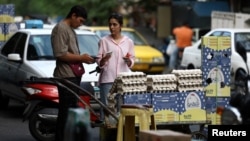
Every week, the shopping lists of Iranians become shorter as inflation soars and purchasing power plunges.
“As things disappear from the dining table, fruit goes first, then dairy products, then anything considered non-essential,” a woman in the Iranian capital, Tehran, said in an audio message sent to RFE/RL’s Radio Farda.
“Ultimately, everything we buy is only essentials, but even then, nothing is affordable,” added the woman, who spoke on condition of anonymity for security reasons.
She is among the millions of Iranians who are grappling with the economic fallout from Iran’s five-month-long war with the United States and Israel.
Years of international sanctions and government mismanagement had already crippled Iran's economy. But the war has pushed the country of some 90 million people to the verge of economic collapse.
The United States and Israel's bombing campaign has left some of Iran's infrastructure and industries in tatters, fueling runaway inflation and joblessness. Even as unemployment has increased, the prices of basic food items, medication, and utilities have soared.
Another woman in Tehran said the prices of staples are increasing almost daily.
A kilogram of potatoes cost 540,000 rials ($0.39) last week, she said, compared to 720,000 rials ($0.52) today. The price of a tray of 30 eggs, she said, went up from 4,000,000 rials ($2.90) to 5,700,000 rials ($4.15) in just a week. Bread prices, meanwhile, have doubled from a year ago in Tehran.
“Don’t even get me started on fruit -- it’s extremely expensive,” the woman said in an audio message sent to Radio Farda. “We simply can’t afford it. We run out of money before the end of the month.”
In Iran, the minimum monthly salary is around $100. According to Iranian media outlets, an average family of four is now spending around 70 percent of their income on basic food items.
The 48-year-old woman, who spoke on condition of anonymity for security reasons, said many Iranians are “quietly heading toward death.”
“I’ve given up on myself,” she added. “All I worry about is my child’s future, because they have no future.”

The economic crisis was boiling over even before the start of the war on February 28.
Spiraling inflation, a currency freefall, and deteriorating living conditions touched off protests at the end of December, resulting in what many analysts called the gravest threat to Iran's clerical rulers since the Islamic Revolution in 1979.
The threat to authorities led to a deadly crackdown by security forces. Rights groups have documented more than 6,000 deaths during the crackdown, but many say the real toll is much higher.
Economic Pressure
Beyond the damage inflicted by the bombing campaign, Washington has sought to increase the economic pressure on Tehran by targeting its most important sources of revenue.
To disrupt Iran's oil exports, the lifeline of its economy, the United States has imposed a naval blockade on Iranian ports and vessels. The embargo was lifted as part of an interim peace deal signed by Tehran and Washington in June. But it was reimposed after the agreement collapsed within weeks.
The US Treasury has also imposed new sanctions on Iran to further restrict Tehran’s access to foreign currency and international financial markets.
US President Donald Trump appears to be betting that the toll of sanctions and the naval blockade will force Iran to sign a peace deal on US terms, observers said.
“We are low-keying it,” Trump told US media outlet Axios on August 9, suggesting that he was prepared to let economic pressure on Iran to intensify rather than launch another military offensive.
“We're only semi-negotiating with them. We are just watching Iran with its huge inflation and the fact they have no money,” he said.
Experts say it is unclear if the strategy will work. The Islamic republic has refused to budge on its key demands and showed it is willing to absorb high costs -- economically and militarily -- to ensure its survival.
Iran has also been able to impose costs on the United States and its allies. By effectively closing the Strait of Hormuz, a key artery for global oil and gas supplies, Tehran has rattled international energy markets and upended the world economy.
The interim peace deal signed in June sought to end Iran’s nuclear program in exchange for economic relief. But its vague terms quickly sparked disputes over control of the strait. Tehran insists it controls the waterway, its key source of leverage in the war, and has set out extensive demands for reopening it to international shipping.
'Iran's Achilles' Heel’
What is clear is that US measures are deepening the economic crisis in Iran.
Iranian oil imports have ground to a halt. Authorities are rationing fuel and electricity as well as restricting access to foreign currency. Overall inflation will reach nearly 69 percent this year, the highest since the Islamic Revolution in 1979, the International Monetary Fund forecasts.
“Iran’s Achilles’ heel is the economy,” said Masoumeh Taherkhani, a London-based economic analyst. “Even before the war, Iran’s economy was already in serious trouble, heading toward a period of severe stagflation and possibly even hyperinflation.”
Now, the war and naval blockade have pushed the Middle Eastern country into an even deeper crisis, she said.
“Within less than a year, the economy could be approaching a severe collapse, which could mark a major turning point,” Taherkhani told Radio Farda.
Ultimately, it will be ordinary Iranians who will pay the price, she said, as shortages of essential goods worsen and the government slashes subsidies.
“Planning for tomorrow no longer feels possible,” said the first woman in Tehran. “Saving money is like trying to hold water in a sieve: its value keeps slipping away.”
“People are focused on getting through today because no one knows how much more expensive tomorrow will be.”



