

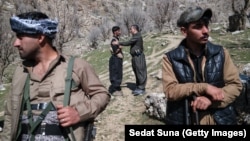

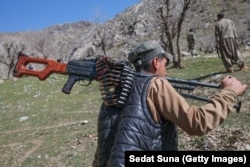
After initially voicing support, US President Donald Trump says he doesn't want Iran's Kurds to enter the military operation against Tehran -- at least for now. Still, one group of exiled Kurds is "preparing for war" just in case, according to a photographer who visited one stronghold of Iranian Kurds.
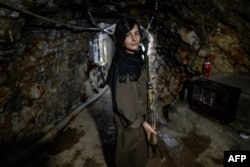
Photojournalist Sedat Suna gained access on March 12 to a mountain base of the Komala -- Reform Faction, an armed political entity of Iranian Kurds based in the northeastern region of Iraq that has recently been targeted by Iranian drone strikes.
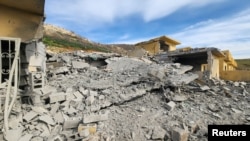
The armed group is part of an alliance of several Iranian Kurdish political parties that was formed shortly before the US-Israeli military operation was launched on February 28. It seeks a self-determining region within Iran that would be similar to the current semiautonomous Kurdistan Region of Iraq.
"They see [the war] as an opportunity," the photographer told RFE/RL, adding that the fighters insisted they are not waiting for a green light from the United States to enter the conflict in Iran. "They say they can make their own decisions."
A spokesman for the Komala party has vowed the fighters would "start the liberation," in the Kurdish region of Iran, provided the United States pledges support.
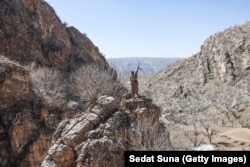
Kurds are an ethnic group of around 30-40 million people living largely across mountainous areas spanning parts of Iran, Iraq, Syria and Turkey. The mostly Sunni Muslim group is one of the world's largest ethnicities without a country of their own.
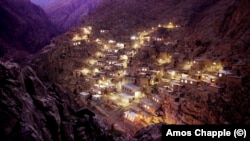
Iranian Kurds live mostly along the western border of the country and make up around 10 percent of Iran's population of some 92 million.
Kurdish relations with Tehran have remained tense since soon after the 1979 Islamic Revolution when the country's new rulers launched mass killings of Kurds, who were viewed as a danger to Iran's territorial integrity.
Today, observers say there are immense complications involved with potential Kurdish involvement in the ongoing war in Iran.
Kamran Matin, an Iran expert at Sussex University, says exiled Iranian Kurdish groups enjoy widespread support inside Iran's Kurdish region, but he believes only a specific set of conditions would open the door to Iranian Kurds -- both inside and outside the country -- openly entering the war against the Islamic republic.
Firstly, Matin says, Iranian regime forces would need to be "significantly degraded in [Iranian] Kurdistan." Additionally, Kurdish groups would require an "explicit commitment from the US for long term military and political support in the form of the establishment of a no-fly zone over Iranian Kurdistan."
And, he says, they would need a US pledge of support for Kurdish rights within a future Iran.
That level of US commitment appears unlikely for now.
Amid reports the CIA was arming Kurdish groups in neighboring Iraq, on March 5 Trump stated he would be "all for it" if Iranian Kurds sparked an uprising. He later walked that back, telling reporters he had ruled out the Kurds getting involved, saying, "We don't want to make the war any more complex than it already is."
Photographer Suna says there is widespread goodwill toward the United States among the fighters he visited, with some bearing US flags on their uniforms.
In Iraqi Kurdistan, the authorities have ruled out the idea of Iraqi Kurds entering the war in Iran.
Qubad Talabani, the deputy prime minister of Iraq's Kurdistan Region, recently told reporters, "We're not guns for hire."
In a message apparently aimed at Iranian Kurdish militant groups in Iraq, the Kurdistan regional government has also stated that "Iraqi territory must not be used as a launching point for attacks against neighboring countries."
For its part, Tehran has threatened that if there is any incursion by Kurdish fighters from Iraqi territory, "all facilities of the Kurdistan Region of Iraq...will be widely targeted."