




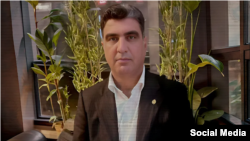
Prominent Iranian human rights lawyer Nasrin Sotoudeh has called for a UN fact-finding committee to investigate the death of Khosrow Alikordi, an attorney known for representing political prisoners and activists.
Alikordi, a former political prisoner and outspoken critic of Iran’s clerical establishment, was found dead on December 5 in his office in the northeastern city of Mashhad. He was 46.
The official cause of death was given as a “heart attack,” with local officials ruling out “unnatural causes.” But some lawyers and activists have described his death as "suspicious" and others called it outright "murder," although they have not provided any proof to back their claims.
Rights groups, including the Norway-based Iran Human Rights and the International Organization to Preserve Human Rights, have called for an independent inquiry into Alikordi's death.
Sotoudeh, speaking to RFE/RL’s Radio Farda from Iran, said Alikordi was “an honorable lawyer who was under extreme legal and security pressure for nearly two decades.”
Sotoudeh said the authorities "had done to him everything you could do to a critic" -- from imprisonment to blocking him from practicing law. She added that Alikordi was acutely aware of the threats against him, which is why he had installed 16 cameras in his office. Those cameras have since been confiscated, she added.
"There are ample grounds to doubt the coroner's report," said Sotoudeh. "A UN fact-finding mission has the legal authority to press Iran for answers."


Alikordi’s funeral in his home city of Sabzevar in northeastern Iran took place under tight security.
Human rights lawyers are often targeted by the authorities. Some of them have been jailed for their activism and taking up politically sensitive legal cases, including Sotoudeh and Alikordi.
The Islamic republic has long shown little tolerance for dissent, and some critics have suffered suspicious deaths.
Last month, the death of an Iranian man who burned a poster of Supreme Leader Ali Khamenei in an online video, sparked protests in the country. Omid Sarlak's death was called a suicide by the authorities, but his father thinks he was murdered. Sarlak's funeral drew an angry crowd, chanting "death to Khamenei!"
Alikordi’s death prompted an outpouring of tributes from fellow lawyers.
Reza Shafakhah, an attorney, wrote on social media that Alikordi defended his clients “to the very end.”
"Injustice only stops when the oppressed refuse to tolerate it anymore,” he added. “Alikordi had long since stopped tolerating injustice; he threw caution aside and went all the way, even at the cost of his life.”
Another lawyer Babak Paknia shared a screenshot of a conversation with Alikordi, noting that even after his release from prison, he "never stopped fighting for people's rights."
Nobel Peace Prize laureates Narges Mohammadi and Shirin Ebadi also paid tribute to Alikordi.
Mohammadi said Alikordi "dreamed of peace and human rights.” Ebadi praised Alikordi for standing alongside families of political prisoners and civil activists, calling him "the voice of forgotten and silenced prisoners whose names were never mentioned in the media."

