




We are now closing the live blog for the day. We'll be back at 7:30 a.m. Central European time to cover the latest events across the Middle East.
Mecca Defense Group Says Pakistani Will Lead Pact For First 3 Years
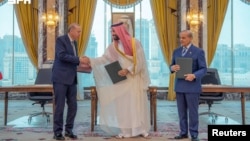
Saudi Arabia, Turkey, and Pakistan -- the three signees of the Mecca Joint Defensive Agreement --agreed to create a secretariat in Saudi Arabia that will be headed by a Pakistani secretary-general for the first three years.
The person to hold that role was not announced after the three country's representatives met in Istanbul on August 31.
Officials said the secretariat will be responsible for managing day-to-day communications, organizing joint maneuvers, sharing intelligence, and monitoring threats to regional security.
Termed the Mecca Accord, the agreement was signed by the three countries on August 7 amid the ongoing conflict in the Middle East involving Iran, Israel, and the United States.
One clause of the agreement explicitly provides for collective defense, stating that “any armed attack against any one of the three states shall be regarded as an attack against them all.”
The members have insisted that the grouping is not aimed at any one country. Sunni Muslim-led Saudi Arabia has been targeted by Iran with retaliatory missile and drone launches following the start of the US-Israeli war with Shi'ite majority Iran.
Masoud Alfak, a Riyadh-based analyst, described the agreement as a "major development in the region's security architecture."
The war in the Middle East has "created a new regional security environment, and I believe this new environment is one of the main reasons for forming this alliance," Alfak told RFE/RL's Radio Farda.
"These countries believe they face common threats, and they think this partnership can serve as a deterrent," said Alfak, adding that he believed the "primary objective is to promote regional security and stability rather than seeking confrontation or joining wars."
Members have said that other countries, including Egypt and Bangladesh, could eventually join the grouping.
Trump Says US Will Hit Iran 'Hard' As Bessent Vows To Intensify Economic 'Pressure'
President Donald Trump said US forces would hit Iran "hard" after the Islamic Revolutionary Guards Corps (IRGC) launched missiles at two US bases in Jordan, while Treasury Secretary Scott Bessent vowed to intensify economic pressure on Tehran.
"We're going to hit them hard," a Fox News reporter quoted Trump as saying on August 31. "There will be a response."
Trump said US air defenses had intercepted all Iranian missiles that could have caused damage after the IRGC claimed it had launched ballistic missiles at the King Hussein and Al Azraq bases in Jordan, causing "heavy damage."
The IRGC often exaggerates claims, and reports of attacks cannot immediately be verified.
The attack on Jordan came after US forces struck missile launchers on the Iranian island of Larak, the first publicly reported direct US attack on Iranian military positions in more than a month.
Fox News also quoted Trump as saying the tough economic measures taken against Tehran were having a major impact on Iran's economy, which is on the verge of collapse following years of Western sanctions and now a US blockade of its ports.
Bessent said the latest exchange of fire between the US and Iran showed that Tehran was "lashing out" because the new sanctions were causing major disruptions to its economy.
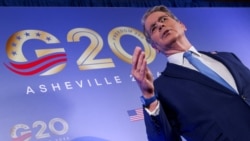
"They're taking it very seriously...they're in shock at the state of their economy," Bessent told reporters at a meeting of 20 finance ministers and central bankers in the US state of North Carolina.
"I would think that they are lashing out kinetically because they are losing economically," he said, using a term referring to military action.
"We are going to continue exerting pressure, and we've had very good discussions here already," Bessent added.
He said the next "weeks or months" could see a turning point in the US pressure campaign, adding that Iran's economy may not need to suffer a total collapse to achieve US goals.
French Finance Minister Roland Lescure told reporters at the meeting that "we all need to work on this."
"The US has a view on how to enhance sanctions. We're going to discuss with them whether we can help on that front," he said.
With reporting by Reuters and AF
US Military Denies Iran's Claim That Oil Tanker Hit A Mine In Strait Of Hormuz
The US military has denied a claim by Iran's Islamic Revolutionary Guards Corps (IRGC) that an oil tanker struck two naval mines, caught fire, and was brought to a halt while attempting to pass through a route in the southern Strait of Hormuz.
"No ships have encountered mines in the Strait of Hormuz," US Central Command (CENTCOM) said on X on August 31.
"This is yet another attempt by the [IRGC] to create fear among commercial vessels in the region through the dissemination of disinformation," CENTCOM said.
The IRGC said earlier on August 31 that a "supertanker" had struck two naval mines while attempting to use what Iran described as an unauthorized route in the south of the strait. It said the vessel caught fire and was brought to a complete stop.
The claim could not be independently verified.
The incident comes amid heightened tensions between the United States and Iran over the Strait of Hormuz, a vital route for global oil shipments. Iran has said the waterway is closed, while the United States has said it is working to secure shipping and maintain freedom of navigation through the strait.
Recent US military operations have included strikes on Iranian assets on Larak Island that Washington said were preparing to deploy sea mines.
For Iranians Seeking A Way Out, Even The English Test Is Becoming A Barrier

Iranians have reacted with a mix of grief, sarcasm, and political recrimination after the US-based Educational Testing Service (ETS) confirmed it has suspended the TOEFL and GRE exams in Iran, cutting off a pathway to foreign study for thousands of students who had spent months, in some cases years, preparing for the tests.
ETS told RFE/RL's Radio Farda in a written statement that it had "paused administration of the TOEFL and GRE tests in Iran effective immediately," citing the US Treasury's Office of Foreign Assets Control (OFAC) and its suspension of General License G, which since 2014 had authorized US educational providers to offer certain services, including standardized testing, to people in Iran despite broader US sanctions.
The suspension is part of a sweeping package of new sanctions the administration of US President Donald Trump rolled out on August 24 under what Treasury Secretary Scott Bessent called an "economic onslaught" against Iran's financial networks worldwide.
To read the full report, click here.
Aviation Safety Agency Renews Gulf Airspace Warning
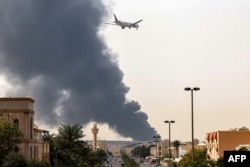
The European Union Aviation Safety Agency (EASA) has renewed its warning against the use of airspace over several Persian Gulf countries, saying the situation remains volatile and poses risks to civilian aircraft.
The warning, which was initially issued on July 14, was revised on August 31, says the US-Iran conflict creates "high risks" for the airspace over the waters of Bahrain, Kuwait, Qatar, the United Arab Emirates and Jordan.
The agency said the regional security situation remains "volatile," creating additional risks in the airspace of the affected countries.
The statement said the presence of major US military facilities in the region increases the likelihood that those states may be directly exposed to Iranian missile and drone attacks. The surrounding maritime airspace may also be affected, it said.
"Unpredictable military developments, combined with the possible use of missiles, drones, combat aircraft and air-defense systems, create a high risk to civil flights at all altitudes and flight levels over the waters within the concerned airspace," the agency said.
Pezeshkian's Son Says Iranians Will Survive Without Enriching Uranium
Commenting on Iran’s pursuit of becoming nuclear power, the son of Iranian President Masud Pezeshkian, Yousef Pezeshkian, has said Iranians will not die without enriching uranium.
“Our lives do not depend on enrichment. If we do not enrich, we will not die,” the younger Pezeshkian, who is also said to be his father’s media adviser, posted on his Instagram channel on August 27.
Explaining that his viewpoint was not against uranium enrichment, Yousef Pezeshkian said there are other technologies to focus on, which are pivotal for the security and governance of the country.
RFE/RL's Radio Farda reports that comments by the younger Pezeshkian would not go unnoticed by opponents of the Iranian president as well as in the pro-regime media.
Previously, such comments by Yousef Pezeshkian have drawn criticism from the media. In a reference to his position as media adviser to his father, the pro-regime Tabnak news website had earlier reported that “a media assistant must understand the consequences of the words, writings, and messages he publishes or conveys.”
In the August 27 Instagram post, Yousef Pezeshkian also stressed the need for informed decisions by the leadership. While referring to Iran’s quest for uranium enrichment, he said “a wise person weighs the benefits and harms of something and then makes a decision.”
Iran’s uranium enrichment program is at the center of its current conflict with the United States. The lingering tension has caused significant harm to the global economy due to the closure of the Strait of Hormuz, the narrow waterway through which approximately 20 percent of the world’s oil supplies pass.
The conflict has also caused severe damage to Iran’s own economy, which is heavily dependent on oil exports. In recent months, various reports have pointed to skyrocketing prices of basic commodities in the country, driven in part by the depreciation of the Iranian currency, which hit a record low in August.
In an apparent reference to the country’s economic situation, President Pezeshkian told an Iranian state television on August 28 that the country’s exports had fallen by 25 to 35 percent in recent months.
UAE Denies Iran’s Claim Of Targeting Al Menhad Air Base
The United Arab Emirates has denied Iranian claims that its Al Menhad Air Base was attacked by drones.
In a social media post on August 31, the UAE’s Defense Ministry said that reports about the targeting of Al Menhad Air Base are “false” adding that its armed forces remain on a “high state of readiness” to respond to any threat and safeguard the country’s security and stability.
Al Menhad Air Base, also known as Menhad Air Base, is operated by the UAE Air Force and located approximately 24 kilometers south of Dubai.
In a separate post on X, the UAE’s Defense Ministry said that its air forces “dealt with a drone over the state’s territorial waters coming from Iran.” It did not provide further details.
Earlier, the Iranian army claimed attacking the Al Menhad Air Base with “dozens of destructive drones” on August 31.
Iran’s semi-official ISNA news agency, quoting the Iranian military, said that Al Menhad Air Base was targeted in response to the killing of “Iranian military personnel and civilians” on Larak Island in the Strait of Hormuz.
The Iranian military claimed that it had targeted the “locations of helicopters and forces” of the US military at the Al Menhad Air Base.
The United Arab Emirates has been one of the Gulf countries frequently targeted by Iran with missiles and drones since the beginning of the US-Israel-Iran conflict in late February.
Mecca Accord Signatories Hold First Meeting In Istanbul
Pakistan, Turkey, and Saudi Arabia, signatories to the Mecca Joint Defense Agreement, are holding their first plenary meeting in Istanbul today, August 31.
The meeting is expected to be attended by senior military and security officials, including the defense and foreign ministers and army chiefs of the three countries, according to statements issued by participant states.
Termed the Mecca Accord, the agreement was signed by the three countries on August 7 amid the ongoing conflict in the Middle East involving Iran, Israel, and the United States.
One clause of the agreement explicitly provides for collective defense, stating that “any armed attack against any one of the three states shall be regarded as an attack against them all.”
Pakistani Foreign Affairs Ministry says that the meeting will be attended by foreign and defense ministers, as well as army chiefs from the three countries.
Iran Revolutionary Guards Claim Attack On US Military Assets In Jordan
Iran's hard-line Islamic Revolutionary Guards Corps (IRGC) said it launched ballistic missiles at two bases housing American forces in Jordan.
A statement published through Iranian state media on August 31 said the IRGC had attacked the King Hussein and Al Azraq bases in Jordan, a close US ally.
The IRGC said it fired ballistic missiles to "target technical infrastructure, maintenance facilities, and enemy fighter jet positions at the US-operated King Hussein and Al-Azraq air bases in Jordan." It claimed "heavy damage."
The IRGC often exaggerates claims, and the details could not immediately be verified. Jordan's military later said it intercepted eight missiles that entered its airspace early on August 31.
"Air defense systems intercepted eight missiles that breached the kingdom's airspace at dawn today," a statement quoting the army's spokesperson said.
The August 30 American strike on Larak Island was the first known attack by US forces on Iranian assets in more than month.
A US official confirmed to RFE/RL that the IRGC had been observed "preparing to launch rockets with sea mines into the Strait of Hormuz" from the Larak Island site.
Last week, US Central Command said American forces had completed clearing sea mines from the strait's international shipping routes and were monitoring the area closely.
Following the latest US strike, the IRGC Iran's vowed retaliation. In a statement carried by Iranian state media, it acknowledged “the martyrdom and injury of several of our fighters and compatriots” and said the attack would “result in the punishment of the aggressor.”
It did not say how many people had been killed or injured in the attack and reports by the IRGC cannot be independently verified.
UPDATE: US Central Command said that "US forces took limited, precise action against IRGC mine-laying forces posing an imminent threat in the Strait of Hormuz. In essence, Iran created the threat and the US military eliminated it to protect civilian mariners, commercial shipping, and the free flow of global commerce."