




We are now closing the live blog for the day. We'll be back at 7:30 a.m. Central European time to cover the latest events across the Middle East.
Iranian Military Vows Retaliation For US Strikes
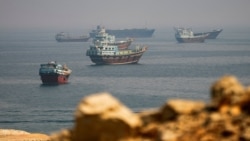
Iran has vowed to retaliate after US strikes hit targets in the country on September 1, following what Washington says were attempts by Tehran to attack commercial shipping and US forces in the region.
According to Iran's state broadcaster, IRIB, the country's military warned that it would “deliver crushing and devastating blows” against the United States.
It added that “the more the US military persists in its aggression in the region, the greater and heavier the losses it will have to endure.”
The statement came after a social media post by US President Donald Trump, in which he said the US military had launched the strikes in response to an attempt by Iran to lay mines in the Strait of Hormuz and target a US military base in Jordan.
Trump threatened Iran with much heavier attacks if it retaliated.
Meanwhile, air-raid sirens have been activated in Jordan and Kuwait, the countries' militaries reported. The Jordanian military said that its air defenses engaged the missiles and shot down 10 of the 13 that were launched. It added that the other three fell in remote areas.
With reporting by Reuters and CNN
Report: Iran Still Denying US Atomic Agency Access To Nuclear Sites
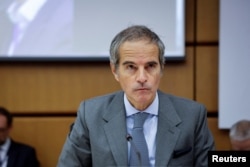
Iran has continued to deny UN nuclear inspectors information about its stockpile of highly enriched uranium and access to more than 20 nuclear sites, according to a confidential quarterly report by International Atomic Energy Agency chief Rafael Grossi circulated to IAEA member states and seen by the AFP and dpa news agencuies.
The report said Tehran had again failed to cooperate with the IAEA in recent months, including by providing no information on around 440 kilograms of near-weapons-grade uranium.
Experts say the stockpile could provide enough material for several nuclear weapons if enriched further. Iran denies seeking nuclear arms.
Iran suspended cooperation with the IAEA after Israeli and US attacks damaged several of its nuclear facilities during a 12-day war in June 2025. After a new conflict erupted in February, Iran and Israel again struck Iranian nuclear facilities.
A US-Iran framework agreement reached in June envisaged diluting the highly enriched uranium under IAEA supervision, but that has yet to happen. Washington and Tehran have since accused each other of violating the deal.
Based on reporting by AFP and dpa
Trump Says US Striking Iran, Threatens Heavier Attacks If Tehran Retaliates
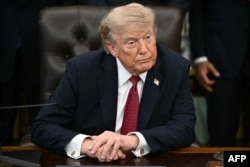
President Donald Trump says that the United States is striking Iranian targets near the Strait of Hormuz, warning of much heavier attacks if Tehran retaliates.
Trump said on his Truth Social platform that renewed US strikes on September 1 were in response to what he described was a "failed attempt" by Iran to place mines in the waterway and target a US military base in Jordan.
He added that the Strait of Hormuz "currently has no mines" because they "have been completely removed or detonated," and said that all eight missiles fired by Iran at the US base were successfully shot down.
Trump warned that if Iran retaliated for what he called a “very justified attack,” it would be hit again “at a much harder and higher level.” He added that an even larger attack was “waiting in the wings” and threatened that, when it was over, “there will be very little left of the Islamic Republic of Iran.”
Earlier in the day, the US military said it had launched strikes on targets in Iran, while Iranian media reported that explosions had been heard in two of its port cities.
Putin, Pezeshkian Reaffirm Moscow-Tehran Alliance Amid US-Iran War
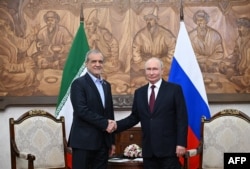
Iranian President Masud Pezeshkian thanked Russian President Vladimir Putin for Moscow’s position on the war in the Middle East, in their first meeting since the conflict broke out in February.
Russia has supplied Iran with satellite images and other intelligence, helping Tehran target US facilities in the Persian Gulf in recent months, according to reports. The two allies have also expanded military and economic ties in recent years.
“We appreciate and thank you for your positions at every stage, both during the period when the fighting and acts of aggression were taking place and under normal circumstances, when the United States was imposing sanctions on us, both at the United Nations and in international forums,” Pezeshkian told Putin at a meeting on the sidelines of the Shanghai Cooperation Organization (SCO) summit in Kyrgyzstan on September 1.
Pezeshkian described Iran’s relationship with Russia as “strategic” and said Tehran and Moscow can work together to resist what he called US “unilateralism.”
The meeting came after a new flareup in the six-month war. The United States said it attacked Iranian rocket launchers on a small island in the Strait of Hormuz on August 30, prompting Tehran to retaliate by hitting US military targets in Jordan.
Read more here
US Launches Fresh Strikes On Iran After Attempted Attacks, Military Says
The United States has launched strikes on targets in Iran, the US military said, following what it described as attempted Iranian attacks on commercial shipping and American forces in the region.
"Today at 12 p.m. ET, US forces began striking Islamic Revolutionary Guard Corps (IRGC) targets in Iran," US Central Command (CENTCOM) said in a post on X on September 1.
CENTCOM said the strikes followed recent attempted attacks by the IRGC against commercial shipping in the Strait of Hormuz and US service members.
The US military did not immediately provide details on the targets struck or the scale of the operation.
Shortly before CENTCOM's announcement, Iranian media reported that explosions had been heard in the port cities of Bandar Abbas and Sirik as well as on Qeshm Island.
EU Backs US Pressure on Iran, Drawing Sharp Rebuke From Tehran
The European Union said on August 31 that it would continue to work closely with the United States, other G7 partners, and international allies to maintain pressure on Iran and contribute to de-escalation and regional stability.
The statement was issued in connection with the G20 meeting of finance ministers and central bankers being held in Asheville, North Carolina, on August 31 and September 1.
"The EU welcomes efforts at ensuring that Iran ceases its destabilizing activities and engages in peace negotiations with good faith, also through additional economic pressure, including through the US-led Operation Economic Outcast,” the EU said. It added that it remained ready to take further measures, where necessary, to safeguard its security and interests.
The statement drew a sharp response from Iranian Foreign Ministry spokesman Esmail Baqaei, who criticized the EU's support for additional economic pressure on Iran.
In a statement posted on X later on August 31, Baqaei accused the European Union of surrendering its sovereignty, laws, regulations, values and ethics to US pressure. He questioned how the EU could support what he described as "the most predatory and unlawful unilateral coercive measures" against Iran.
Baqaei said the EU's endorsement of what he called "America's unlawful economic war" constituted a "grave violation of international law and said EU member states should be held accountable for the consequences of their contribution to what he described as a wrongful act.
He did not specify what consequences he had in mind.
Baqaei also argued that the EU's position was inconsistent with its own rules. He pointed to the EU's Blocking Statute, under which the bloc does not recognize the extraterritorial application of laws adopted by third countries and regards such effects as contrary to international law.
He contrasted the EU's current position with its 1996 adoption of the Blocking Statute, which was designed to protect European operators from the extraterritorial effects of certain US sanctions.
Baqaei concluded by accusing the EU of taking contradictory positions by supporting US economic pressure on Iran while simultaneously calling for de-escalation and regional stability.
Pezeshkian Says Iran Would Reciprocate If US Returns To MOU
Iranian President Masud Pezeshkian said on September 1 that Tehran would "immediately reciprocate" if the United States returns to its commitments under the Islamabad Memorandum of Understanding (MOU).
Speaking at the Shanghai Cooperation Organization summit in Bishkek, Pezeshkian accused Washington of violating its commitments under the agreement.
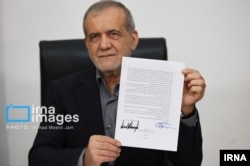
"But I am stating clearly that if the US returns to its commitments in the aforementioned memorandum of understanding, the Islamic republic of Iran will immediately reciprocate," he said, according to Iranian state media.
Pezeshkian's remarks came after Iran's Supreme National Security Council outlined six conditions for reopening the Strait of Hormuz earlier this month. The conditions, announced by council secretary Mohammad Baqer Zolqadr, include an end to the war and attacks against Iran and its regional allies, the lifting of the US naval blockade and withdrawal of US forces from around Iran, full compensation for war damages, the lifting of sanctions, and the unconditional release of frozen Iranian assets.
The remarks also come amid renewed military tensions between Iran and the United States. On August 30, US forces struck two Iranian missile launchers on Larak Island in the Strait of Hormuz, while Iran subsequently launched missiles at US forces in Jordan.
The MOU, signed by US President Donald Trump and Pezeshkian on June 18 with Pakistan acting as mediator, called for an immediate and permanent end to military operations and established a framework for further negotiations. It also included provisions concerning the reopening of the Strait of Hormuz, sanctions, Iranian assets, and US military forces in the region.
Trump Says 30 Ships Pass Through Strait Of Hormuz Every Night
US President Donald Trump said the Strait of Hormuz is in "extremely good shape" and claimed an average of 30 ships a night are passing through the waterway with the assistance of the US Navy.
"We have the Strait of Hormuz in extremely good shape. You know, we're taking over," Trump told reporters in the Oval Office on August 31.
"Many, many ships got through last night, as you know, with the Navy's assistance, and we've been averaging 30 ships a night," he said.
"That's a lot, and a lot of oil is coming out. That's why you haven’t seen the price of oil go like they thought it might have to go," he added.
Trump also described Iran as a "failed nation" and claimed that its inflation rate had reached 350 percent, that its currency was no longer functioning and that the government was struggling to pay its soldiers.
"They're a failed nation. They've got 350 percent inflation. They have no currency. They're not paying their soldiers. Their leaders are largely dead. Their navy is gone. Their air force is gone. Their surveillance equipment is almost entirely gone," Trump said.
He added that Iran’s leadership structure was unclear, saying: "I don't really think they know who their leader is."
Trump nevertheless warned that further US military action against Iran remained possible.
"That doesn't mean we won't smack them. We'll see what happens," he said.
Trump's comments came amid a renewed escalation between the United States and Iran. On August 30, US forces struck two Iranian rocket launchers on Larak Island in the Strait of Hormuz, according to US officials.
Iran subsequently said it had launched missiles and drones at US military bases in Jordan in retaliation. US officials said most of the incoming missiles were intercepted and that there was no significant impact.
The exchange marked the first known direct US-Iranian military confrontation in several weeks and came amid continuing tensions over the Strait of Hormuz, a major global oil transit route.
Oil Tanker Struck By Projectiles In Strait Of Hormuz, Says UKMTO
The UK Maritime Trade Operations center (UKMTO) reported that a tanker was struck by three unknown projectiles while completing an outbound transit of the Strait of Hormuz.
According to UKMTO Warning 124-26, the incident occurred approximately 17 nautical miles (31 km) east of Khasab, Oman, on August 31.
UKMTO said the tanker reported being struck by three unknown projectiles. The agency reported no casualties or environmental impact and said authorities were investigating. It advised vessels operating in the area to transit with caution and report suspicious activity.
Separately, UKMTO said on August 31 that it had received a report of an incident involving a tanker and military forces in the Indian Ocean. The agency provided no further details and said relevant investigations were ongoing.
The incidents come amid a renewed escalation between the United States and Iran and heightened security concerns around the Strait of Hormuz.