




Iranian Currency Hits New Low As US Pressure Intensifies
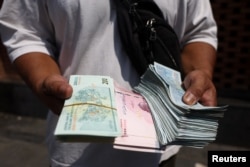
Iran's rial fell to a new low against major foreign currencies on September 8 as the United States intensified military and economic pressure on Tehran.
Currency-market websites reported the dollar trading at up to 2.4 million rials later in the day, while the euro exceeded 2.7 million rials and the British pound reached about 3.1 million rials. The Emami gold coin also reportedly rose to 2.4 billion rials.
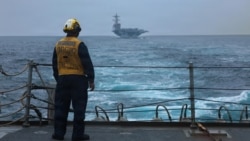
The latest depreciation came as US forces said they destroyed five Iranian oil tankers in the Gulf and Gulf of Oman after Iran's Islamic Revolutionary Guards Corps twice targeted a US warship with ballistic missiles.
Washington also announced sweeping new sanctions against Iran's aviation sector on September 8, designating 36 targets and sanctioning all remaining Iranian airlines under its Operation Economic Outcast campaign. Treasury Secretary Scott Bessent warned companies doing business with Iran's airlines that they risk being cut off from the global financial system.
The currency crisis comes amid severe inflation. Iran's Statistical Center reported annual inflation of 89 percent in August, while food and beverage prices rose 127.5 percent year-on-year. Iranian lawmakers warned on August 31 that volatility in currency, gold, and coin markets was increasing economic uncertainty.
Iran Steps Up Work At Pickaxe Mountain, Satellite Images Show
New satellite imagery shows a surge in construction at Iran's deeply buried Pickaxe Mountain complex near the Natanz nuclear facility, but the activity does not appear to indicate that Iran is currently enriching uranium there, according to a new analysis by the Center for Strategic and International Studies (CSIS).
CSIS said its analysis of six years of satellite imagery showed more road activity at Pickaxe Mountain in 2026 than at any previous point in the site's history.
Recent work included hardening tunnel entrances, paving internal roads, reinforcing access areas, and removing excavation spoil, suggesting the project has shifted from excavation toward probable construction inside the underground complex.
The researchers said the imagery could neither confirm nor refute reports that Iran moved centrifuges and centrifuge components into Pickaxe Mountain last year. But continued construction, the lack of increased internal security, and the absence of non-construction vehicles and equipment suggested the facility was "not yet capable of enrichment work," if that is its intended purpose.
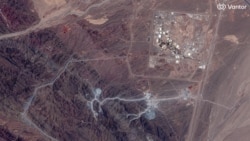

Pickaxe Mountain lies about 2 kilometers south of the Natanz uranium-enrichment facility in Iran's central Isfahan Province and is buried deep inside granite, making it extremely difficult to destroy with conventional weapons.
CSIS said even the heaviest US bunker-buster bombs might not be sufficient to destroy the facility, arguing that military strikes could at best degrade or temporarily disable it.
UKMTO Reports Merchant Vessels Hit In Gulf And Gulf Of Oman
The United Kingdom Maritime Trade Operations (UKMTO) said on September 9 that several merchant vessels in the northern Gulf and Gulf of Oman were hit by disabling fire during military activity in the region overnight.
UKMTO, which is affiliated with the British Navy, said it could not confirm any casualties or environmental impact from the incidents.
Separately, UKMTO reported that a vessel was seen listing while anchored 24 nautical miles northwest of Port Rashid in the United Arab Emirates. The vessel may have taken on water after being struck by an unidentified projectile, the agency said. The incident was reported by a third party.
The reports came a day after US Central Command said its forces destroyed five Iranian crude-oil tankers following attempted missile attacks on a US Navy warship over the previous two days.
Reuters also reported on September 8 that a Panama-flagged tanker carrying 2 million barrels of Iraqi fuel oil was struck by a drone in Iraqi territorial waters.
Two port officials told Reuters that Iraqi rescue boats extinguished a fire aboard the tanker, New Andros, and that there were no reports of casualties.
Tehran Targets US Base In Jordan After Iranian Oil Tankers Sunk
Iran launched fresh missile attacks on Jordan, saying it was targeting a US military base in retaliation for strikes on Iranian oil tankers.
Jordan says it intercepted 18 ballistic missiles, while the US military says it destroyed five Iranian crude carriers after Iran's failed attempted attacks on a US warship.
The latest exchanges mark a sharp escalation in the conflict around the Strait of Hormuz and the Gulf of Oman.

Global Oil Prices Rise Above $100 per Barrel
Global oil prices rose above $100 per barrel on September 9, as tensions in the Middle East escalated and Iran and the United States continued to exchange attacks.
Brent crude futures rose 2.2 percent to $100.07 per barrel in early European trading, while US West Texas Intermediate crude futures rose 1.8 percent to $94.73 per barrel, according to Reuters.
Brent's price was its highest since July 24, when it last crossed the $100 mark.
Oil prices have risen sharply in recent days amid escalating regional tensions and concerns about disruptions to oil supplies. On September 8, Iran-backed Houthi forces in Yemen launched attacks on several cities and energy facilities in southern Saudi Arabia, setting oil installations ablaze and temporarily disrupting some operations.
The attacks have raised concerns about further disruption to oil shipments through the Red Sea, while oil flows through the Strait of Hormuz have already been severely curtailed by the US-Iran conflict.
Iranian Activist Ahmad Reza Haeri Released After More Than 3 Years in Prison
Ahmad Reza Haeri, a civil rights activist and member of the "No To Execution Tuesdays" campaign, was released from prison on Tuesday, September 8, after completing his sentence.
He had spent more than three years in Evin Prison in Tehran and Ghezel Hesar Prison in Karaj.

Haeri began serving his sentence at Evin Prison in May 2023. In September 2023, he was transferred to Ghezel Hesar, along with a number of other political prisoners.
Haeri was denied prison leave during his incarceration. Despite this, he continued his social and political activities, including sending letters and public messages with other prisoners. In June 2024, for example, he called on people not to participate in Iran's presidential election.
The "No To Execution Tuesdays" campaign, launched by prisoners in Iran, calls for an end to executions and holds weekly protests against the death penalty, with participating prisoners refusing food on Tuesdays.
US Says It Destroys 5 Iranian Tankers As Tehran Strikes Back Across Gulf
The United States and Iran have sharply escalated their confrontation, with Washington destroying five Iranian oil tankers and Tehran responding with missile attacks on US forces in Jordan and claims of strikes against American warships and other vessels.
US Central Command (CENTCOM) said on September 9 that its forces destroyed the Kaviz, Charminar, Horizon 1, and Riesco in the Gulf of Oman and the Derya near Iran's Kharg Island.
CENTCOM said the tankers were part of a multibillion-dollar Iranian oil network allegedly financing the Islamic Revolutionary Guards Corps (IRGC) and its regional allies. Crews were ordered to abandon the vessels before they were struck, and no US personnel were injured.
The strikes followed two failed Iranian ballistic-missile attacks on a US Navy warship, according to CENTCOM. They came just days after the United States said it had destroyed three other Iranian oil tankers following attempted attacks on an American aircraft carrier and destroyer.
Iran retaliated overnight by firing 20 ballistic missiles toward Jordan, according to Jordanian authorities. Jordan's air defenses intercepted 18, while two landed in unpopulated areas. No casualties were reported.
The IRGC also claimed it attacked two US warships and eight other tankers, causing significant damage. Those claims have not been independently verified.
The IRGC separately warned tanker crews in Kuwaiti and Bahraini ports to evacuate, raising fears of further disruption around the strategically vital Strait of Hormuz.
The escalation has already affected shipping: Kpler data show only six commercial vessels crossed Hormuz on September 8, well below the recent average.
Rubio: Iran Will 'Lose Tankers' for Every Attempt to Hit US Ships
The United States has struck additional Iranian oil tankers linked to the Islamic Revolutionary Guard Corps (IRGC), US officials told reporters on September 8, as tensions between Washington and Tehran escalated following further attempted Iranian missile attacks on US Navy ships.
One US official said American forces struck targets near Iran's strategic Kharg island oil terminal and the port of Jask, including Iranian oil tankers. The strikes are part of a broader US effort to put economic pressure on Tehran by targeting oil revenues linked to the IRGC.
Iranian media, meanwhile, reported explosions near Kharg island and Jask. Iran's Tasnim news agency said a US missile struck an Iranian tanker near Kharg island, while Iranian state media reported a second tanker was attacked near Jask. The reports could not be immediately independently verified.
The latest strikes follow US attacks on several Iranian crude tankers. US Central Command said on September 8 it disabled five Iranian vessels after "IRGC targeted a US Navy warship with ballistic missiles twice over the past two days." In the statement, CENTCOM said no American servicemen have been harmed and no damage has been sustained.
The strikes came after Iran launched ballistic missiles toward US Navy ships, according to the US military.

Speaking to reporters in Colombia on September 8, Secretary of State Marco Rubio was asked about the back-and-forth between the two sides over the past 24 hours and the US strikes on Iranian tankers.
“The back and forth is pretty straightforward,” Rubio said. “Iran continues to try to hit US naval ships, and for every time they do that or try to do that, they're going to lose tankers, and I think you'll see that again today.”
Rubio's remarks came as Washington intensified its campaign to restrict Iran's oil revenues. The US also announced new sanctions on September 8 targeting Iran's aviation sector and companies accused of helping Tehran obtain aircraft and sensitive technology.
Separately, a US official said an American military underwater drone malfunctioned more than a day earlier in the Middle East. The official said the drone was not carrying classified sonar or radar equipment, after Iran claimed to have seized a US underwater drone.
Iranian Media Report US Strike On Tanker
Iranian media reported that a US strike hit a tanker near Kharg Island, the country’s main oil export hub.
The Tasnim news agency, which is affiliated with Iran’s Islamic Revolutionary Guards Corps, said a “small” tanker was targeted by a US “projectile” on September 8.
Tasnim added that there were no casualties and the crew of the tanker was being evacuated.
Iranian media also reported explosions in the southern port city of Jask near the Strait of Hormuz.
There was no immediate comment from the United States.
On September 7, Iran threatened to retaliate against any new US attacks on its oil tankers, warning that American oil and gas interests in the Persian Gulf could be targeted.
US forces hit three Iranian oil tankers on September 5, including one near Kharg Island, according to US Central Command. The strikes came after Iran attacked US warships operating in the region.
Basij Commander Killed In Southeastern Iran
Iranian media have reported the killing of a local commander of the Basij militia in the southeastern province of Sistan-Baluchistan, which borders Afghanistan and Pakistan.
Abdolrauf Eshaqi, a commander in the Parud district, was “martyred” in a “terrorist attack,” the Tasnim news agency reported on September 8, without providing details.
It was not clear who was behind the attack.
The volunteer Basij paramilitary force, which is estimated to have around 1 million members, is commanded by the Islamic Revolutionary Guards Corps (IRGC).
One of Iran’s poorest provinces, Sistan-Baluchistan has been the scene of a decades-long insurgency.
It is home to Baluch, an ethnic minority that has long faced discrimination and violence at the hands of the authorities.
On September 7, Iran's official news agency, IRNA, reported that two Iranian security personnel were killed in an armed attack near the city of Zahedan in Sistan-Baluchistan.
IRNA reported that the men came under attack on September 6 while carrying food and equipment for the Basij.
No group has yet claimed responsibility for the attack.