



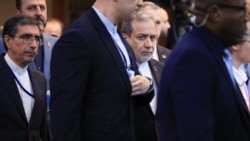

Pezeshkian Says Khamenei Authorized Government To Negotiate With US
Iranian President Masud Pezeshkian said on November 2 that Supreme Leader Mojtaba Khamenei had given his government the authority to pursue negotiations with the United States, amid renewed diplomatic efforts to end the war.
Speaking at a meeting with provincial governors, Pezeshkian stressed the importance of overcoming what he described as challenges and crises created by Iran's enemies.
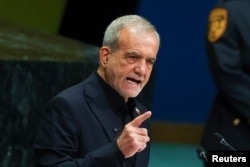
"We are trying to solve the problem through dialogue," he said.
Pezeshkian also said Khamenei had authorized the government to advance the negotiations, but did not elaborate on the scope of that authority.
The statement comes amid renewed questions over Khamenei's position on negotiations with Washington.
On June 18, following the signing of the Islamabad Memorandum of Understanding between Iran and the United States, Khamenei issued a message saying he had initially held a different view of the agreement but had authorized it after receiving assurances from Pezeshkian and other members of the Supreme National Security Council.
"I had a different opinion," Khamenei said in the message, adding that he had given permission based on their commitment to protect the rights of the Iranian nation and the Resistance Front.
The wording of the message subsequently became a subject of dispute among Iranian media outlets. Some outlets close to the supreme leader's office claimed that the phrase "in principle" in the published version did not appear in the original written text.

The 14-point Islamabad MoU established a framework for ending military operations, reopening the Strait of Hormuz and beginning a 60-day period of negotiations toward a broader agreement. The arrangement subsequently collapsed.
Khamenei, who succeeded his father, Ali Khamenei, after the latter was killed in US-Israeli strikes in February, has not appeared publicly since taking office, although Pezeshkian has previously said he met him privately.
The latest statement comes amid intensified diplomatic contacts involving Qatar and other regional mediators, as Tehran and Washington explore the possibility of renewed negotiations.
Iran Negotiators Leave Qatar As Draft Proposal To End War Circulates
Iranian officials have departed Qatar following discussions with mediators seeking an end to the war with the United States, while a draft agreement is being circulated and another meeting remains possible, an official familiar with the negotiations said on November 2.
The Iranian delegation left Doha on November 1, but the official emphasized that their departure was not prompted by a breakdown in discussions. No further details about the proposed agreement were offered.
Iranian Foreign Ministry spokesman Esmaeil Baqaei said the negotiations are based on a seven-point plan Tehran prepared in September that calls for reopening the Strait of Hormuz and ending the US naval blockade of Iranian ports. Iran has indicated the measures could be fast-tracked as part of an agreement.
Baqaei confirmed that Deputy Foreign Minister Kazem Gharibabadi had traveled to Doha to coordinate the exchange of messages with Washington through Qatari intermediaries. He said Iran would not agree to a final settlement or restore security and access through the strait unless the US blockade was lifted and Tehran's demands were addressed.
Foreign Minister Abbas Araqchi said on October 31 that an agreement could allow the Strait of Hormuz to reopen within two days, rather than the seven days envisaged in the original proposal.
US President Donald Trump previously rejected Iran's initial plan.
The diplomatic efforts come amid fears that hostilities could resume after the US midterm elections on November 3. Baqaei dismissed the prospect of a change in Washington's approach following the vote, saying Tehran did not expect the elections to produce "a new US."
Trump has said Washington will not attack Iran before the elections and described negotiations as productive, while leaving open the possibility of further military action.
Pezeshkian Says Khamenei Authorized Government To Negotiate With US
Iranian President Masud Pezeshkian said on November 2 that Supreme Leader Mojtaba Khamenei had given his government the authority to pursue negotiations with the United States, amid renewed diplomatic efforts to end the war.
Speaking at a meeting with provincial governors, Pezeshkian stressed the importance of overcoming what he described as challenges and crises created by Iran's enemies.
"We are trying to solve the problem through dialogue," he said.
Pezeshkian also said Khamenei had authorized the government to advance the negotiations, but did not elaborate on the scope of that authority.
The statement comes amid renewed questions over Khamenei's position on negotiations with Washington.
On June 18, following the signing of the Islamabad Memorandum of Understanding between Iran and the United States, Khamenei issued a message saying he had initially held a different view of the agreement but had authorized it after receiving assurances from Pezeshkian and other members of the Supreme National Security Council.
"I had a different opinion," Khamenei said in the message, adding that he had given permission based on their commitment to protect the rights of the Iranian nation and the Resistance Front.
The wording of the message subsequently became a subject of dispute among Iranian media outlets. Some outlets close to the supreme leader's office claimed that the phrase "in principle" in the published version did not appear in the original written text.
The 14-point Islamabad MoU established a framework for ending military operations, reopening the Strait of Hormuz and beginning a 60-day period of negotiations toward a broader agreement. The arrangement subsequently collapsed.
Khamenei, who succeeded his father, Ali Khamenei, after the latter was killed in US-Israeli strikes in February, has not appeared publicly since taking office, although Pezeshkian has previously said he met him privately.
The latest statement comes amid intensified diplomatic contacts involving Qatar and other regional mediators, as Tehran and Washington explore the possibility of renewed negotiations.
China Says Persian Gulf At 'Critical Crossroads Between War and Peace'
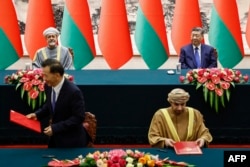
Chinese Foreign Minister Wang Yi said on November 2 that the Persian Gulf region had once again reached a "critical crossroads between war and peace," calling on all parties to end hostilities through negotiations.
Wang made the remarks during a meeting in Beijing with Saudi Arabia's national-security adviser, Musaed bin Mohammed Al-Aiban.
He said China hoped all parties would prioritize political solutions over further military action and work to protect regional energy security and the safety of shipping routes.
According to a summary of the meeting released by China's Foreign Ministry, Wang also said Beijing was ready to work with Riyadh to make further progress in bilateral relations.
Wang also met with Iranian security official Ali Bagheri Kani in Beijing on November 2, as China held discussions with representatives of both sides of the conflict amid efforts to end the war. Chinese President Xi Jinping also met Oman's Sultan Haitham bin Tariq, with Beijing announcing that its Middle East special envoy would visit Iran, Oman, and Saudi Arabia this month.
Tanker Struck By Projectiles Near Saudi Arabia, Says Maritime Monitor
A tanker was struck by two unidentified projectiles in the Persian Gulf, about 72 nautical miles east of Ras al-Khafji, Saudi Arabia, the United Kingdom Maritime Trade Operations Center (UKMTO) reported on November 2.
The tanker was traveling southeast when it was hit on its port side. The incident occurred late on November 1, at 23:47 UTC, according to reports citing the UKMTO advisory.
All crew members were accounted for, and no environmental impact had been reported, the maritime security agency said. Authorities were investigating the incident, and vessels were advised to transit the area with caution.
The attack came amid a series of incidents involving commercial shipping in the Persian Gulf.
On November 1, Qatar's state-owned shipping company Nakilat confirmed that its liquefied natural gas (LNG) carrier, Al Mayeda, had been struck by unidentified objects while sailing in the Gulf on October 30. The vessel remained operational, and none of its crew members were injured.
Gulf Cooperation Council Secretary-General Jasem Mohamed Albudaiwi condemned the attack, describing the targeting of energy tankers as a "dangerous escalation" that threatens regional security and global energy supplies.
Is Europe In Iran's Crosshairs? Tehran Hints At Wider Military Reach
- By Kian Sharifi
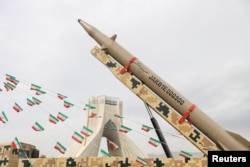
Iran and the United States have traded threats for weeks even as they pursue diplomacy, with the possibility of military escalation after the US midterm elections still looming.
A statement attributed to Supreme Leader Mojtaba Khamenei on October 31 directed the armed forces to be ready to respond to an attack "immediately, effectively, and with no geographical restriction."
That last point has fueled speculation in Iran about what it could entail and whether Tehran has the capability to deliver on its threat.
When the United States and Israel first attacked Iran on February 28, Tehran responded by striking military and civilian sites in Arab states across the Persian Gulf, insisting it was targeting US interests in the region.
Analysts say the Islamic republic hoped that regionalizing the conflict and striking the territory of US allies would pressure Washington into halting its attacks.
To read the full report, click here.
UAE Seeks To Shield Energy Exports From Renewed Iran War
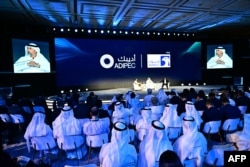
The United Arab Emirates says it will be better prepared for a possible resumption of US attacks on Iran and retaliatory strikes by Tehran, the country's energy minister said on November 2, adding that Abu Dhabi plans to strengthen its energy infrastructure and diversify export routes.
Suhail al-Mazrouei told reporters on the sidelines of the Abu Dhabi International Petroleum Exhibition & Conference that the course of the US-Israeli war on Iran could not be predicted, but the UAE would be more resilient if hostilities resumed.
The country plans to invest in additional storage capacity overseas, shipping fleets, and alternative export routes to protect its energy supplies from disruption.
The UAE has continued exporting crude through Fujairah, a port outside the Strait of Hormuz, which has been severely disrupted by the conflict. It is also building a new pipeline to Fujairah that is expected to double its crude transportation capacity by next year.
"After this crisis, many companies are going to look, think again, and design, redesign their facilities to be more resilient in the future," Mazrouei said.
He described resilience as extending across the entire energy supply chain, from production to transportation and delivery to customers.
Mazrouei also told the conference that UAE exports had at times exceeded prewar levels.
His comments come amid growing fears of renewed US military action against Iran and possible Iranian retaliation across the Gulf. US President Donald Trump has indicated that Washington could launch another military operation, although he has said he would not attack Iran before the US midterm elections on November 3.
With reporting by Reuters and Al Jazeera
CENTCOM Rejects Araqchi's Denial Of Attacks On Civilians
The US military's Central Command (CENTCOM) on November 2 rejected a claim by Iranian Foreign Minister Abbas Araqchi that Iran had not targeted civilians in neighboring countries, accusing Tehran of deliberately attacking civilian infrastructure and commercial vessels.
In an interview with Al Jazeera on November 1, Araqchi said Iran's attacks in the region had targeted US military bases and interests, not neighboring countries. He denied Iran had deliberately targeted civilians.
In a post on X, CENTCOM called the minister's claim "false" and said Iran had deliberately attacked civilian infrastructure, residential areas, and other facilities in neighboring Persian Gulf countries.
The command also accused Iran of deliberately targeting civilian mariners at sea, saying the attacks had killed more than 20 people in recent months.
CENTCOM did not identify the vessels involved or provide a breakdown of the reported deaths. The figure was not independently verified.
The statement comes amid ongoing maritime tensions in the Strait of Hormuz, where commercial shipping has faced repeated attacks during the US-Israeli war with Iran.
CENTCOM described Iran's actions as "indiscriminate aggression," adding that they were "clearly evident and inexcusable."
The command's statement did not address civilian casualties from US and Israeli attacks inside Iran.
Somali Pirates Hijack Iranian Fishing Boat
Somali pirates hijacked an Iranian fishing vessel off the northeastern coast of Somalia, raising concerns that the pirates could use it to launch further attacks on commercial shipping.
The European Union's Maritime Security Center Indian Ocean (MSCIO) said it had received information about the reported hijacking of the vessel, named Azini, on October 29.
The vessel was carrying 23 people, including 21 Iranian crew members and two Somali security guards, according to the Associated Press. Their whereabouts and condition were not immediately known.
The boat was seized between the coastal towns of Bandar Bayla and Hafun in Puntland, a semi-autonomous region of northeastern Somalia.
Puntland security officials told AFP that eight armed pirates initially carried out the attack. A subsequent report said four more pirates boarded the vessel, bringing the total number of attackers to 12.
The MSCIO warned that the hijacked vessel could potentially be used as a "mothership" to support further piracy attacks. It said the boat was approaching a maritime traffic lane and urged vessels in the area to remain vigilant.
The EU's Operation Atalanta naval force is investigating the reported hijacking.
The incident comes amid a resurgence of Somali piracy after years of relative inactivity. International naval patrols and improved security measures helped reduce attacks after 2013, but piracy has increased again in recent years.
Pirate groups have used hijacked fishing vessels as floating bases to launch attacks on larger commercial ships farther from the Somali coast.
The latest incident adds to concerns about maritime security in the western Indian Ocean, where commercial shipping has also faced threats from Iran-allied Houthis in the Red Sea and surrounding waters.
Trump Tells Rally That US May Have To Give Iran 'The Hammer'
US President Donald Trump again threatened to resume air strikes against Iran, saying during a campaign rally that he may have to give Tehran "the hammer" at some point, without being specific.
"And the only reason why I'm not finished with Iran is I want to be nice," he told supporters on November 1 during a rally in Iowa, just ahead of the November 3 midterm elections.
"I want to try and save all those lives if I can...But at some point we're going to have to give them the hammer," he added.
Trump earlier said he had spoken by phone with Israeli Prime Minister Benjamin Netanyahu over the weekend, with Iran being discussed. He was not more specific.
US news outlet Axios, citing US and Israeli sources, reported that Netanyahu pressed Trump to launch strikes on Iran immediately following the November 3 US midterm elections.
Trump was leaning toward allowing current negotiations to play out, the report said.
With reporting by AFP
Trump Talks To Netanyahu On Iran, While Mediators Bid To Head Off New Fighting
US President Donald Trump said he spoke with Israeli Prime Minister Benjamin Netanyahu amid speculation of possible new strikes against Iran, while Qatari mediators met with leaders of the Islamic republic in an effort to prevent a war of words from becoming a renewed deadly conflict.
"Just had a very good talk with him," Trump on November 1 said of the conversation he held the day earlier with the Israeli leader after US media, citing sources, reported on the call.
One of the key topics, Trump, said was Iran, although he did not offer details.
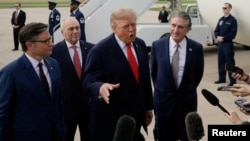
Axios quoted one source from the US and one from Israel as saying Trump and Netanyahu discussed the state of talks with Tehran, with Netanyahu pressing Trump to launch strikes on Iran immediately following the November 3 US midterm elections.
Trump was leaning toward allowing current negotiations to play out, the report said.
The Israeli source told Axios that the call was "tough." The US source said it was "direct."
Trump on October 31 insisted to reporters that talks with Tehran were "going fine," but he also said the US needed to "take care of" one or two Iranian targets.
"We still have to take care of, I would say one or two sites, but we can do that in 10 minutes," Trump told reporters.
Trump claimed Washington was not in a hurry to take offensive action because it had already wiped out Iran's military and its nuclear program.
Meanwhile, Qatari mediators arrived in Tehran over the weekend for talks with Iranian officials, state media reported.
Iranian Foreign Minister Abbas Araqchi said the purpose of the "ongoing and progressing" talks was to continue consultations with the Qatari mediators. He added that Iran was prepared for "both defense and diplomacy."
Iranian military spokesman Mohammad Akraminia told state TV that any "potential future war could last longer than previous conflict, and the American president would not be in a position to dictate the timing or the conditions of its conclusion."