



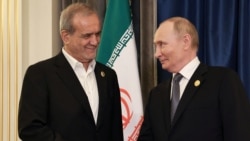

Bessent Warns Iran Will Be Economically Isolated 'Like The World Has Never Seen Before'
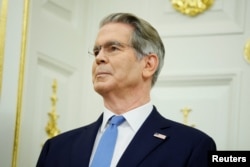
US Treasury Secretary Scott Bessent has said that the United States is going to apply measures that have "never been seen" against Iran.
"Watch this space for more announcements coming next week because we are going to apply measures like [those] that have never been seen in the history of economic isolation of a country," Bessent said in an interview with the US cable news channel Newsmax on August 13.
"It will be a combination of economic isolation like the world has never seen before and the continued blockade of the Strait of Hormuz that will keep anything from going in or out of Iranian ports," Bessent added.
Asked about Bessent's comments later in the day, White House Press Secretary Karoline Leavitt, without providing details, said the United States had "more tools" to continue pressuring the Iranian regime and "crippling its economy," which she said was already in a "very weak spot."
Earlier, US President Donald Trump suggested that he was willing to let economic pressure force the Islamic republic to reach a long-elusive peace deal, appearing to back off threats of immediate military action against Iran, despite ongoing disputes with Tehran over the Strait of Hormuz,.
"We are low-keying it," Trump told the Axios news outlet in a brief phone conversation on August 9.
"We are only semi-negotiating with them. We are just watching Iran with its huge inflation and the fact that they have no money," he was quoted as saying.
This blog post was updated.
US Central Command Announces 'First-Ever' Multinational Drone Force
US Central Command (CENTCOM) announced on August 13 that it was in the process of establishing what it described as "the first-ever multi-domain, multinational attack drone task force."
"The unit, called Task Force Falcon Strike, will employ one-way attack drones consisting of unmanned systems from above, on, and below the sea operated by military support staff from the United States and regional partners," CENTCOM said in a statement.
As Washington began consultations with its partners in the Middle East, US Navy Admiral Brad Cooper said that jointly deploying these new capabilities "will help us rapidly realize the new possibilities that are on the horizon."
"The United States military has a lot of strong partnerships and friends in the region," Cooper said. "We are collectively stronger when we integrate and deploy new capabilities together."
Iranians Wait In Long Lines For Gas Amid Fuel Shortage
- By RFE/RL
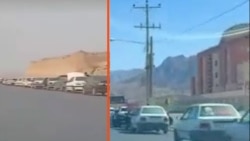
Long lines are forming at gas stations in Iran as the ongoing war with the United States disrupts fuel supplies. Iranian authorities have rationed fuel and considered other measures that would raise prices in an effort to curb consumption. Previous price hikes on gas have sparked social unrest in the country.

Hegseth: US Can Maintain Naval Blockade Against Iran 'Indefinitely'

US forces have the resources to maintain the naval blockade of Iranian ports for as long as necessary, Defense Secretary Pete Hegseth said on August 13, as Washington and Tehran remain at odds over control of the Strait of Hormuz.
"Indefinitely the United States Navy can maintain a blockade," Hegseth told reporters after addressing the crew of the guided-missile destroyer USS Gridley during the PANAMAX 2026 multinational military exercises in Panama. The Gridley had previously been deployed to the Middle East.
Hegseth added that the United States could sustain the blockade because it was able to "rotate ships in and out" of the area and would continue to redeploy its forces as needed.
His comments came after Washington and Tehran clashed over who had full control over the Strait of Hormuz, a key waterway that accounted for around one-fifth of the global oil and gas supplies before the war.
President Donald Trump has insisted that the United States controls the strait, while Iranian military officials have disputed that assertion, saying that Tehran remains in control and continues to manage traffic through the waterway.
Iran Lurching Toward 'Severe Economic Collapse' As War Takes Its Toll
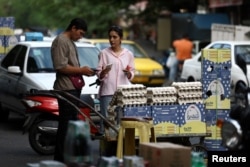
Every week, the shopping lists of Iranians become shorter as inflation soars and purchasing power plunges.
“As things disappear from the dining table, fruit goes first, then dairy products, then anything considered non-essential,” a woman in the Iranian capital, Tehran, said in an audio message sent to RFE/RL’s Radio Farda.
“Ultimately, everything we buy is only essentials, but even then, nothing is affordable,” added the woman, who spoke on condition of anonymity for security reasons.
She is among the millions of Iranians who are grappling with the economic fallout from Iran’s five-month-long war with the United States and Israel.
Read the full article by Roya Maleki and Frud Bezhan here
US Says 59 Ships Redirected In Iran Blockade
The US military's Central Command (CENTCOM) says that as of August 12 its forces had diverted 59 commercial ships as part of Washington's naval blockade of Iran.
In an X post on August 13, CENTCOM that it had disabled three vessels and boarded two others "to ensure full compliance with the blockade."
US President Donald Trump reiterated on August 12 that the United States had "total control" of the Strait of Hormuz and intended to "keep it."
Iran, however, claims it has de facto control of a large part of the strategic waterway and that the United States must accept all of Tehran's conditions for it to open, including receiving compensation from the US for war damages.
Iran, Trump Clash Over Who Controls The Strait Of Hormuz
- By Kian Sharifi
Iran’s new Basij Paramilitary chief says the Strait of Hormuz is under Iran’s control, disputing the United States’ assertion that its forces control the chokepoint.
The crisis in Hormuz has led to dwindling oil stockpiles and higher global energy prices as traffic through the narrow strait has come to a standstill after almost six months of war between the United States and Iran.
US President Donald Trump has insisted that America controls the strait. On August 12, he told reporters that the Iranian’s “don’t have control.”
“We have total control. We own it,” he said.
Hossein Taeb, the notorious former head of the intelligence organization of the Islamic Revolutionary Guards Corps (IRGC) whose return to the center of Iranian politics last week saw him named as the head of the IRGC Basij Organization, challenged Trump's statement.
“The Strait of Hormuz is under the control and management of the Islamic Republic of Iran, and the country continues on its path in absolute security,” he said on August 13 during a meeting with religious leaders in the holy city of Qom.
Iran has shut down the critical waterway, using it as an essential card in its negotiations with Washington to end their war.
Although Trump initially said the elimination of Tehran's nuclear threat was the major aim of the US-Israeli war with Iran, which began on February 28, in recent weeks he has focused on the free flow of traffic through the important Strait of Hormuz, through which some 20 percent of the world's oil and natural gas supplies transited prewar.
Concern Grows Over Spread Of Spill From Grounded Tanker Carrying Russian Oil Off Oman
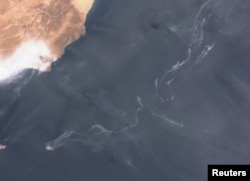
A large oil spill from a sanctioned tanker that was carrying Russian crude and ran aground off Oman’s coast six weeks ago is spreading and causing increasing concern amid the war in the Persian Gulf region.
The Caroline Bezengi, which held an estimated 800,000 barrels of Russian oil, ran aground on June 30 at an Omani island that is part of a marine nature reserve after reporting difficulties earlier in June off Yemen. Reports said there were explosions on board.
Oman said on August 10 that the slick covered almost 400 square kilometers, and that it was working to contain the spill.
On August 12, Reuters cited John Amos, an oil spill specialist who reviewed satellite imagery obtained by the news agency, as saying it now covers more than 2,000 square kilometers.
"Oil is drifting offshore to the northeast of Al-Qibliyyah Island with some oil reported to be reaching the mainland," the AFP news agency quoted a spokesperson for the International Maritime Organization (IMO) as saying. The spokesperson said that seasonal monsoon weather “has limited access to the vessel and delayed salvage operations."
Nobody has claimed an attack on the vessel, which sailed from the Russian Black Sea port of Novorossiisk in April, headed for India.
It passed through the Suez Canal in late May and later sailed past Yemen, where Iran-backed Houthi militants have joined the war pitting Iran against the United States and Israel.
Amos, CEO of SkyTruth, a nonprofit environmental advocacy group that uses satellite images to further its cause, warned that if “there's no adequate response to keep the worst from happening," the ship could lose its entire cargo, creating a spill whose size would rival the 1989 Exxon Valdez disaster off Alaska.
The Caroline Bezengi is under sanctions as a suspected part of a “shadow fleet” that Russia uses to circumvent Western punitive measures aimed to curtail its oil exports, a crucial source of funding for Moscow's war against Ukraine.
With reporting by Reuters and AFP
EU, Western States Condemn Iranian Executions In 'Strongest Terms'
The European Union and 26 Western countries condemned Iran’s ongoing executions of protesters “in the strongest terms” on August 12, saying the country’s citizens must be permitted to gather and voice their views without risking their lives.
“The use of capital punishment to silence dissent, intimidate communities, and punish individuals exercising their human rights can never be justified,” the EU and nations from Canada to Romania said in a statement.
“The people of Iran must be free to exercise their rights to freedom of expression and peaceful assembly without fear,” they said, urging Iran to “immediately end the use of the death penalty and release all those arbitrarily detained.”
“We further call on Iran to listen to the voice of its people as they demand change, and to take meaningful steps toward ensuring respect for human rights,” the statement said.
The Iranian state has used the death frequently in a crackdown on political dissent during and after mass protests in January.

Since the start of the war with the United States and Israel on February 28, there has been a surge in executions of people human rights groups consider political prisoners, from protesters to alleged members of banned groups and those convicted of spying.
“Seven months after the mass crimes committed against the Iranian people who rose up to demand justice and dignity, the regime continues to shed blood by multiplying executions,” French Foreign Minister Jean-Noel Barrot said in a post on X.
Some rights groups say more than 50 people hit with security and political charges have been executed since the beginning of the war, though others put the number much higher.
According to data verified by the Iran Human Rights group, 463 people have been executed in Iran so far this year, many of whom were sentenced to death in connection with the January protests where thousands were killed by security forces and tens of thousands more detained. Again, some estimates are much higher.
In addition to the EU, the statement was issued by Albania, Austria, Australia, Belgium, Canada, Croatia, Cyprus, the Czech Republic, Denmark, Estonia, Finland, France, Germany, Hungary, Iceland, Ireland, Italy, Latvia, Lithuania, Luxembourg, Montenegro, the Netherlands, New Zealand, North Macedonia, Norway, Portugal, Romania, Slovakia, Slovenia, Spain, Sweden, and the United Kingdom. The United States was not listed.
World Burning Through Oil Stockpiles, Says International Energy Agency
The International Energy Agency (IEA) warned on August 12 that global oil stockpiles are being rapidly depleted as diplomatic efforts to reopen the key Strait of Hormuz drag on.
The agency reported that oil inventories fell last month by 2.2 million barrels per day, pushing total global stocks below 7.9 billion barrels for the first time since early 2025.
The global oil balance is now projected to face a deficit of 1.8 million barrels a day in the coming months -- more than double the estimate made in July.
"Although the market is projected to return to surplus towards the end of this year, risks remain substantial and the urgency of reopening the Strait has increased," the IEA wrote.
The report comes as Iran and Oman have been negotiating the establishment of a safe route through the Strait of Hormuz, with Tehran saying it will not fully reopen the waterway unless the United States meets its conditions, a demand rejected by President Donald Trump.