


Grossi: No Iran-US Agreement Can Succeed Without IAEA Role
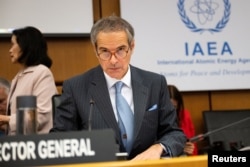
The director-general of the International Atomic Energy Agency (IAEA), Rafael Grossi, said any potential agreement signed by Iran and the United States will not be successful without the involvement of the UN nuclear watchdog.
"Without verification, any agreement is not an agreement, but rather an illusion of agreement or a promise that you don't know whether it will be kept," Grossi said in an interview with the British newspaper The Telegraph.
Stating that the IAEA knows Iran's nuclear facilities "very well," he added: "We are the only ones who can guarantee absolute impartiality in our work."
Regarding a possible US–Iran agreement, Grossi said it could involve "diluting some of Iran's enriched uranium and sending the rest to a third country."
He also described any potential US operation to enter Iran and collect remaining uranium as highly complex.
"I don't doubt for a moment that the United States has the military capabilities to do this, but I'm just saying that it's a very delicate thing to manage, to master, to maneuver," he said.
US President Donald Trump has recently spoken about US forces removing "nuclear dust" from Iran, saying such an operation could be carried out in cooperation with the Iranian government.
Since the bombing of nuclear facilities during the 12-day war between in Israel and Iran in July 2025, Iran has restricted full access for IAEA inspectors and reduced cooperation with the watchdog.
Grossi also warned that ongoing conflicts in Ukraine and the Middle East could spark a broader nuclear arms race involving up to 20 countries, including Saudi Arabia, Poland, Turkey, South Korea, and Japan.
"There's talk of friendly proliferation," he said. "All of this worries me because I believe a world with 20 nuclear-armed states would be very dangerous."
Seized Iranian Ship May Have Had Dual-Use Cargo
The Iranian-flagged container ship Touska, which was seized by US forces on April 19, was likely carrying items Washington considers dual-use, meaning goods with possible civilian and military applications, maritime security sources told Reuters on April 20.
The vessel, part of the sanctioned company Islamic Republic of Iran Shipping Lines (IRISL), was boarded off Iran's Chabahar port in the Gulf of Oman.
US Central Command said the crew failed to comply with repeated warnings over six hours and that the vessel was violating a US maritime blockade.
Sources said initial assessments suggested the ship was carrying dual-use cargo after a voyage from Asia. They did not specify the items involved. One source said the vessel had previously transported similar goods.
Qalibaf Says Iran Has 'New Cards' In War With US, Israel
Iranian parliamentary speaker Mohammad Baqer Qalibaf, who is also Iran's lead negotiator, said that Iran is "prepared to reveal new cards" in the war with the United States and Israel.
"[US President Donald] Trump, by imposing a siege and violating the ceasefire, seeks to turn this negotiating table -- in his own imagination -- into a table of surrender or to justify renewed warmongering," Qalibaf wrote on X late on April 20.
"We do not accept negotiations under the shadow of threats, and in the past two weeks, we have prepared to reveal new cards on the battlefield," he added.
Amnesty International Condemns New 'Predatory' World Order
The leaders of the United States, Israel and Russia are seeking to impose a new "predatory" world order while most countries are too cowardly to stop them, rights group Amnesty International said April 21.
Launching the global group's annual report in London, Amnesty International Secretary-General Agnes Callamard condemned Trump, Putin and Netanyahu as "predators."
The report on "reflections on human rights in 2025/26," and features a statement by Callamard on "voracious predators stalked through our global commons, hulking hunters plundering unjust trophies. Political leaders like Trump, Putin and Netanyahu, among many others, carried out their conquests for economic and political domination through destruction, suppression and violence on a massive scale."
"The 1948 adoptions of the Universal Declaration of Human Rights and the Genocide Convention, and the many other normative instruments debated and adopted over the subsequent 80 years, are no illusion," Callamard said. "They are tangible manifestations of a post-world war order founded on a multilateral system of equal states, rooted in universal human rights, and dedicated to non-recurrence of atrocities."
"We all know that the system’s promise remains unfulfilled, but it is not for the promise-breaker to declare that promise a fantasy," she added.
To read the full Amnesty International statement, click here.
We are now closing the live blog for the day. We'll be back tomorrow at 7:30 a.m. Central European time to cover the latest events across the Middle East.
Why Is Iran Parading Pink Weapons? To Coerce Women Into Militancy, Says Rights Expert
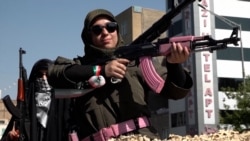
Speaking with RFE/RL's Radio Farda, Mansoureh Shojaee, an Iranian women's rights activist based in the Netherlands, says the regime is coercing women into "revenge-driven" militancy amid war with the United States and Israel.
In videos shown by pro-government media outlets, crowds of Iranian women were filmed holding guns, flags, and children at the recent rally titled Self-Sacrificing Daughters Of Iran, where pink weapons were on display.


Trump Says Deal US Is Seeking With Iran 'Far Better' Than JCPOA
US President Donald Trump is asserting that a deal the United States is negotiating with Iran will be much better than the Joint Comprehensive Plan of Action (JCPOA), the 2015 international agreement on Iran's nuclear program from which he withdrew the United States during his first term.
In a series of Truth Social posts on April 20 in which he vehemently criticized the US Democratic Party, former presidents Barack Obama and Joe Biden, and prominent US media outlets, Trump said he does not feel pressure to make a deal with Iran but predicted one will be reached fairly soon.
"The DEAL that we are making with Iran will be FAR BETTER than the JCPOA," which he claimed, without providing details, "was a guaranteed Road to a Nuclear Weapon [for Iran]." Trump pulled the United States out of the JCPOA, which restricted Iran's nuclear activity in return for an easing of economic sanctions, in 2018.
"If a Deal happens under 'TRUMP,' it will guarantee Peace, Security, and Safety, not only for Israel and the Middle East, but for Europe, America, and everywhere else," he added.
Trump wrote, "I am under no pressure whatsoever [to reach a new deal with Iran], although, it will all happen, relatively quickly!”
Trump also repeated earlier arguments that the United States is prevailing in the war with Iran, which began with US and Israeli air strikes on February 28. A cease-fire is in place until April 22 amid efforts to hold a second round of face-to-face US-Iran talks in Islamabad after an April 11-12 meeting ended without an agreement.
He repeated what he has said in recent days: that a US naval blockade on Iranians ports will remain in place until "until there is a 'DEAL.'" Tehran has said it will not participate in talks if the US blockade of Iranian ports is in effect.
China's Xi Urges Reopening Of Hormuz
In the most high-profile statement from Beijing on the US blockade of Iranian ports so far, Chinese leader Xi Jinping told Saudi Crown Prince Mohammed bin Salman on April 20 that "the Strait of Hormuz should remain open to traffic."
Speaking by phone with the Saudi leader as China continues to increase its diplomatic efforts during the US-Israeli war with Iran, Xi said reopening the crucial waterway would be in the "common interest of countries in the region and the international community."
Xi's comments come as the US Navy intercepted and seized the Touska, an Iranian cargo ship traveling from China on April 20. According to the nonprofit group Global Fishing Watch, the ship had remained in Chinese waters until the end of March before returning to Iran via an extended stay in Port Klang in Malaysia.
Asked to comment on the ship's seizure at a press conference on April 20, Foreign Ministry spokesman Guo Jiakun expressed "concern about the forced interception of the relevant vessel" and reiterated Beijing's official position of promoting de-escalation.
Xi's phone call with the Saudi crown prince follows a series of international engagements between Beijing and its allies in the conflict. On April 15, Chinese Foreign Minister Wang Yi met with his Russian counterpart, Sergei Lavrov, to discuss the wars in Iran and Ukraine, as well as Beijing and Moscow’s closer cooperation.
Since the United States announced its blockade on Iranian ports on April 12, Wang has also spoken with his counterparts from Iran and Pakistan, as well as the United Arab Emirates' special envoy to China.
Internet Shutdown Adds To The Costs Of War For Iranians
- By Kian Sharifi
Iran's Internet shutdown has now surpassed 1,248 hours or 52 days, making it the longest national-level blackout since Libya's outage of nearly six months during the Arab Spring in 2011.
But the comparison understates the scale: Iran's population over 90 million is roughly 15 times larger than Libya's was at the time, making this arguably the largest government-directed communications outage in recorded history, with Internet monitoring watchdog NetBlocks describing it as "unsurpassed in scale and severity in a connected society."
The shutdown began on February 28 in the immediate aftermath of US and Israeli air strikes against Iran. Since then, publicly available network data shows that cross-border Internet traffic has remained below 1 percent of the country's pre-shutdown average for nearly the entire period.
In other words, for the overwhelming majority of Iranians, access to any website or application outside the country has been effectively impossible.
To read the full report, click here.
Trump Says Vance, US Delegation To Arrive In Pakistan 'Tonight' For Iran Talks
US President Donald Trump told the New York Post that a delegation led by Vice President JD Vance was due to arrive in Pakistan "tonight," but there was no immediate confirmation that Vance had left the United States and Tehran has not said it will take part in a new round of peace talks.
"We're supposed to have the talks…. So I would assume at this point nobody's playing games," the Post quoted Trump as saying in a brief interview it said was held shortly after 9 a.m. Eastern time on April 20.
"They're heading over now," Trump was quoted as saying. While he did not specify whether that meant the delegation was already in the air, he said, "They'll be there tonight, [Islamabad] time."
However, sources told RFE/RL on condition of anonymity that the plane Vance normally uses, Air Force Two, remained on the ground at Joint Base Andrews outside Washington. Reuters, citing two unnamed sources, reported that Vance had not yet departed, and several media reports cited sources as saying he would do so soon.
Trump had said a day earlier that US negotiators would travel to Islamabad for talks and would arrive on April 20.
But neither Iran nor mediator Pakistan confirmed it at the time, and Iranian Foreign Ministry spokesman Esmail Baqaei said earlier on April 20 that "We have no plans for the next round of negotiation, and no decision has been made in this regard."
Around the time the Post published its story, Reuters cited an unnamed senior Iranian official as saying Tehran was positively reviewing its participation in potential peace talks with the United States but that no final decision had been made.