




Axios: Witkoff 'Secretly' Met Iran's Prince Reza Pahlavi
Axios reporter Barack Ravid said on January 13 that Steve Witkoff, Donald Trump’s special envoy, "secretly" met with Reza Pahlavi, the former crown prince of Iran who has become an opposition figure.
He quoted an unnamed "senior American official" as saying the focus of the meeting and talks was the widespread protests in Iran.
US officials have not yet officially confirmed the news.
Axios says this is the first high-level meeting between the Iranian opposition and the Trump administration since the protests began in Iran on December 28.
According to the site, Pahlavi is trying to position himself as a "transitional" leader if the regime falls.
Witkoff previously served as Trump's representative in nuclear negotiations with representatives of the Islamic republic.
Meanwhile, Canada is now advising any of its citizens in Iran to leave the country.
The NetBlocks digital rights watchdog now says that Iran's Internet blackout has passed the 120-hour mark.
'Thousands Of Bodies': Death Toll Soars Amid Iran's Brutal Crackdown
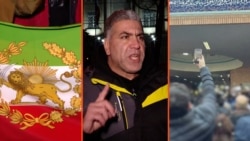
At least 2,000 people have been killed in the protests in Iran, according to a US-based human rights group, HRANA, amid the deadly crackdown on anti-government demonstrations. One Iranian exile in Germany told RFE/RL she heard from a trusted source able to get past Iran's communication blackout that her uncle had been killed and that the number of deaths could be much higher.

Will The EU Add The IRGC To Its Terror List Now?
For years the European Union has failed to achieve unanimity from its 27 member states to put Iran's Islamic Revolutionary Guards Corps (IRGC) on its terrorist list. Tehran's deadly crackdown on anti-government protesters over the past two weeks, however, may have finally changed that.
The bloc is now weighing more asset freezes and visa bans against individuals responsible for the crackdown on Iranian protesters, and the measures could potentially be ready by the time the bloc's foreign ministers meet in Brussels on January 29.
No sectoral sanctions are expected, but there has been talk that the decision to add the IRGC to the terrorist list -- meaning certain IRGC officials could be arrested if they set foot in an EU member state -- would be largely symbolic.
To read the rest of the analysis by RFE/RL Europe Editor Rikard Jozwiak, click here.
Iran Port Closures, Internet Blackout Also Hurting Afghan Traders
Afghan traders who regularly import goods from neighboring Iran say the current wave of protests has severely affected business. Iran, which is one of Afghanistan's largest trading partners, has seen closures at ports as infrastructure nationwide has been paralyzed by the mass demonstrations and the government's violent crackdown.
Traders who spoke with RFE/RL's Radio Azadi on January 12 said that each passing day represents more financial losses as their goods remain stuck in Iran.
Naqibullah Qalandari, who imports tires, mobile phones, and raw materials for factories from Iran, says "hundreds of containers" of his firm's goods are currently in limbo at multiple Iranian ports.
"Due to the protests in Iran, our loads of tires and mobile phones are stuck in Bandar Abbas. Hundreds of containers of these raw materials are stuck at Imam Khomeini port. Undoubtedly, the losses are high, because the goods are sitting there and incurring fines. About 200 of our containers are stuck and we are extremely worried."
Haji Abdul Ghafoor, an Afghan trader who exports Afghan apples and pomegranates to India via Iran, voiced a similar complaint.
"This may be a domestic issue for Iran, but it has also caused us problems. My 13 commercial vehicles are stuck, and each vehicle costs $20,000. There are many other traders like me whose goods are stuck, and if these fruit spoil, we will suffer considerable financial losses. Our trucks loaded with goods have been stopped by Iran, and therefore we have to pay for cold storage, transportation, and parking of the vehicles."
As part of its crackdown on the protests, the Iran government has restricted telephone lines and enforced a nationwide Internet blackout, which also negatively affects Afghan traders.
Haji Bashir, who imports fresh vegetables from Iran, told Radio Azadi he has received no information about his shipment of goods for several days due to telephone and Internet outages.
Officials from the Afghanistan Chamber of Commerce and Investment did not respond to Radio Azadi's inquiries on the matter.
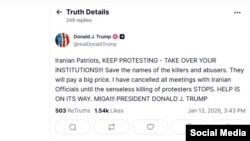
US President Donald Trump has issued another post on social media expressing support for protesters in Iran, saying that "help is on its way."
Iranian Doctor Says Security Forces 'Shooting Inside' Hospitals
A doctor inside Iran has told RFE/RL’s Radio Farda that security forces have stormed hospitals and executed wounded protesters amid a brutal state crackdown on nationwide antiestablishment protests.
The doctor, who said she works in a hospital in southern Iran, said members of Iran’s security forces had “finished off” protesters who had been admitted to hospital for treatment.
“They killed many [demonstrators], arrested many, and many are on the run,” said the doctor, who spoke to Radio Farda on condition of anonymity for fear of retribution. “The situation is very bad.”
RFE/RL could not independently verify the doctor’s claims.

The authorities have shut down the Internet and blocked phone lines, but eyewitness accounts have emerged that suggest the state is waging one of its deadliest-ever crackdowns on street protesters.
At least 648 people, mostly protesters, have been killed since protests erupted on December 28, according to human rights groups, which fear the real death toll could be in the thousands.


Iranian security forces have used brute force, including firing live ammunition at protesters, according to videos verified by RFE/RL and testimony from eyewitnesses.
'They're Killing Everyone'
Hospitals across Iran have been flooded with the dead and wounded, according to doctors and nurses inside the country of some 92 million people.
“It's a horrible situation, almost everywhere is closed,” a nurse living in the capital, Tehran, told Radio Farda. “There are many people with eye injuries. People say they don't want this establishment. They're killing everyone."
Human rights organizations have documented the use of metal pellets fired from shotguns, with security forces deliberately targeting the eyes and heads of protesters.
The doctor in southern Iran said the protests have “died down” after the authorities launched a large-scale crackdown in major cities, including in Tehran, on January 8 and 9.
The protests were sparked by spiraling inflation and a freefall of the national currency but have since snowballed into the biggest threat to Iran’s clerical rulers since the Islamic Revolution in 1979.
A man in the city of Karaj, near Tehran, said he witnessed security forces directly firing at protesters.
“I saw everyone who was [running], they were falling on the ground, [security forces] were shooting,” said the man, who spoke to Radio Farda on condition of anonymity. “I don’t know what kind of ammunition they were using but it sounded like live ammunition.”
He said security forces piled dead protesters in trucks and drove away.
“They didn’t care who these people were,” he added. “I came home and my wife asked me if I was crying because of tear gas. I told her that I was crying because of the young people [killed].”
Iran Port Closures, Internet Blackout Also Hurting Afghan Traders
Afghan traders who regularly import goods from neighboring Iran say the current wave of protests has severely affected business. Iran, which is one of Afghanistan's largest trading partners, has seen closures at ports as infrastructure nationwide has been paralyzed by the mass demonstrations and the government's violent crackdown.
Traders who spoke with RFE/RL's Radio Azadi on January 12 said that each passing day represents more financial losses as their goods remain stuck in Iran.
Naqibullah Qalandari, who imports tires, mobile phones, and raw materials for factories from Iran, says "hundreds of containers" of his firm's goods are currently in limbo at multiple Iranian ports.
“Due to the protests in Iran, our loads of tires and mobile phones are stuck in Bandar Abbas. Hundreds of containers of these raw materials are stuck at Imam Khomeini port. Undoubtedly, the losses are high, because the goods are sitting there and incurring fines. About 200 of our containers are stuck and we are extremely worried.”
Haji Abdul Ghafoor, an Afghan trader who exports Afghan apples and pomegranates to India via Iran, voiced a similar complaint.
"This may be a domestic issue for Iran, but it has also caused us problems. My 13 commercial vehicles are stuck, and each vehicle costs $20,000. There are many other traders like me whose goods are stuck, and if these fruit spoil, we will suffer considerable financial losses. Our trucks loaded with goods have been stopped by Iran, and therefore we have to pay for cold storage, transportation, and parking of the vehicles."
As part of its crackdown on the protests, the Iran government has restricted telephone lines and enforced a nationwide Internet blackout, which also negatively affects Afghan traders.
Haji Bashir, who imports fresh vegetables from Iran, told Radio Azadi he has received no information about his shipment of goods for several days due to telephone and Internet outages.
Officials from the Afghanistan Chamber of Commerce and Investment did not respond to Radio Azadi's inquiries on the matter.
'He Deeply Cared About Bread, Inequality': Iranian Exile Mourns Uncle Lost in Tehran Protests
With the Internet blackout, it is incredibly hard to get information from inside Iran. And for Iranians living abroad, desperate for news of their loved ones inside the country, that can mean a tortuous wait.
For Maedeh Soltani, the daughter of a well-known human rights lawyer Abdolfatah Soltani and civil rights activist Masoumeh Dehghan, the news, when it finally came, was not good.
In an interview with RFE/RL's Radio Farda, Soltani, who lives in Germany, confirmed the killing of her uncle, Ali Dehghan Joghan. She said that there were so many bodies in Tehran that it took her relatives four to five days to find her 55-year-old uncle.
“My uncle was a resident of Shahr-e Rey, in the south of Tehran, but it is not clear to me where he was shot or where his body was found," Soltani said. "I believe my family searched for his body in places such as Behesht-e Zahra, Tehran’s main cemetery, as well as other locations in the south of the city."
“I cannot say with certainty exactly what happened. However, relatives who contacted us from Iran said that the body of my uncle (her mother’s brother), who was killed on Thursday [January 8] or Friday [January 9], was not found until the morning of January 13," the exiled Iranian said.
'Thousands Of Bodies'
Soltani said that she had heard from a "trusted source, someone reliable to both me and my family" that the number of people killed and being kept in Tehran’s morgues and cemeteries is extremely high. "This person spoke of thousands of bodies," she said.
At least 648 protesters have been killed and thousands injured amid the ongoing protests, according to the Norway-based NGO Iran Human Rights. Rights groups warn the true death toll could be significantly higher, potentially reaching into the thousands.
“My uncle was around 55 years old. He had two daughters, approximately 20 and 15 years old. He was not necessarily politically active, but he deeply cared about bread, inequality, and the catastrophe we are witnessing in social justice.
"This is what brought him to the streets. I am certain that his grieving daughters and his family will not remain silent at home. They will rise and make their voices heard."