



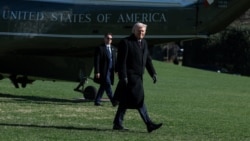
Reuters: Some US Military Base Staff In Qatar Advised To Leave
Citing three diplomats, Reuters is reporting that certain staff at the US military base in Qatar have been advised to leave.
The agency did not identify the diplomats, but quoted them as saying: "Some staff have been advised to leave Al-Udeid Air Base, a US military base in Qatar, on Wednesday evening."
The US Embassy in Doha did not comment on the matter, according to Reuters.
Al-Udeid is the largest US base in the Middle East and houses approximately 10,000 troops. Previously, some troops had left US bases in the Middle East before the United States carried out air strikes on Iran during the 12-day Iran-Israel war last June.
Officials in the Islamic republic had threatened to consider US bases and interests in the region as legitimate targets for attack if US President Donald Trump takes military action in support of the protesters.
Iran's Top Sunni Cleric Condemns Killings Of Protesters
Molavi Abdolhamid, Iran's top Sunni cleric and Friday Prayer leader in Zahedan, issued a statement describing the recent killing of thousands of protesters in Tehran and other Iranian cities as a horrific and unprecedented catastrophe and saying those responsible await "divine punishment."
In a message published on January 13, Abdolhamid wrote: "This bitter event has plunged the Iranian nation into grief and anger, profoundly wounding the collective conscience of free-spirited people worldwide."
He also emphasized at the end of his message that "those who ordered and carried out this crime will undoubtedly be held accountable in this world and will also deserve divine punishment in the hereafter."
The US-based human rights monitor HRANA reported that as of January 13 -- the 17th day of the protests -- 2,403 protesters, including 12 children, had been confirmed killed.
Rights groups and observers warn that due to the nationwide Internet blackout, the death toll may be even higher.
US State Department Renews Call For Release Of Political Prisoners
The US State Department's Persian account on X called for the release of political prisoners in Iran. Addressing the Iranian government, it wrote: "While we expose your violence against protesters, do not think that we have forgotten the political prisoners who were imprisoned even before these protests."
The message, which was published on January 14, mentions the political prisoners Narges Mohammadi, Sepideh Gholian, Javad Alikordi, Pouran Nazemi, Reza Khandan, Majid Tavakoli, Sharifeh Mohammadi, Hossein Ronaghi, "and many others" and emphasizes that "their continued detention remains a serious concern."
A number of the political prisoners in question were arrested on December 12, when a ceremony marking the seventh day after the death of Khosrow Alikurdi, a lawyer and human rights activist, in Mashhad turned into a clash with government forces.
Mohammadi, a prominent Iran human rights activist and Nobel Peace Prize laureate, later said through her foundation that she had endured significant physical abuse during her arrest and detention. Mohammadi said she "was attacked with severe and continuous blows to the head and neck with a baton and then violently arrested."
Iran's Justice Chief Reiterates Speedy Trials For Detained Protesters
The head of the Islamic judiciary once has again emphasized that the trials of those detained in the recent protests will be expedited.
Iranian media also quoted Gholamhossein Mohseni-Ejei as saying the trials will be held in public. According to these reports, Mohseni-Ejei visited a Tehran prison for five hours and personally processed a number of cases.
The head of the judiciary did not provide an explanation about the legal process of these cases.
Human rights groups say tens of thousands of people have been arrested in recent days and have expressed concern that the judiciary may be carrying out mass executions.
This comes as US President Donald Trump warned Iran's authorities in a message on January 13 that they would face "very strong action" from the United States if they executed detained protesters.
US State Department Slams Iran's Description Of Protesters As 'Terrorists'
The US State Department's Persian-language account on X responded to the Iranian government's attempt to portray protesters as "terrorists."
The account wrote in a post: "The fact that the Islamic Republic regime calls protesters 'rioters' and 'terrorists' is not deceiving the world."
The post states that "these are labels used to justify violence, nothing more."
As the protests escalate, Iranian officials have increased their confrontations with protesters, calling them "terrorists."
In recent days, the Iranian Foreign Ministry has also attempted to justify the unprecedented violence against protesters by inviting ambassadors and representatives of foreign countries to Iran, using a speech by Foreign Minister Abbas Araqchi and a film screening.
However, shortly after this move, German Chancellor Friedrich Mertz described Iran's resort to violence to remain in power as a sign of the end of the Islamic republic's "work."
Trump Threatens 'Serious Action' If Iran Executes Prisoners
US President Donald Trump says the United States will "take very serious action" if Iran begins executing protesters.
Trump made the statement on the sidelines of a trip to Detroit in a brief interview on January 13 with CBS, without giving details.
In response to a CBS reporter who asked about the US response to reports that some detainees in Iran could be hanged early Wednesday morning, Trump emphasized that he had not heard anything about hanging protesters yet, but added that "if they do such a thing, we will take very strong action."
When asked what his endgame is in Iran, the president said: "The endgame is to win. I like winning." He cited the fate of Abu Bakr al-Baghdadi and Nicolas Maduro and strikes on Iran's nuclear facilities.
"We don't want to see what's happening in Iran happen," he said. "And you know, if they want to have protests, that's one thing, when they start killing thousands of people, and now you're telling me about hanging -- we'll see how that works out for them. It's not going to work out good."
More Than 2,400 Protesters Killed, Says HRANA Rights Group
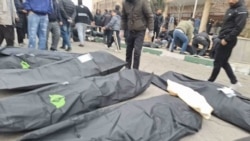
More than 2,400 protesters have been killed during Iran's brutal crackdown against the regime, according to the US human rights monitor HRANA.
The rights group reported late on January 13 that the total death toll had reached 2,571 in the wave of unrest that represents the biggest challenge to the Islamic republic in years. HRANA said it had verified the deaths of 2,403 protesters, 147 government-affiliated individuals, 12 children, and nine bystanders. It also confirmed the detention of 18,434 individuals, 97 cases of forced confessions that have been broadcast, and 1,134 reports of severe injuries.
The protests have been met with a violent crackdown by security forces and a widespread Internet blackout, raising fears that the actual death toll may be even higher.
In the first time the Iranian government has acknowledged the climbing death toll, an official said on January 13 that about 2,000 people had been killed.

Starlink Internet Service Provided Free For Iran
Following a conversation between US President Donald Trump and SpaceX's Elon Musk, the Starlink satellite Internet service has been made free of charge for those in Iran.
In recent days, following the complete Internet blackout in Iran by the authorities in response to mass protests, Starlink has been one of the few ways for Iranians to communicate with the outside world.
Despite the presence of tens of thousands of Starlink terminals and dishes across Iran, users have faced difficulties in methods for paying the subscription fee. There have also been reports of serious disruptions in Starlink signals.

Live Blog Closing For The Day
We are closing the live blog for now, but we'll be back again tomorrow at 7:30 a.m. Central European time.
Goldberg: 'Nothing Is Off The Table' For Trump's Response In Iran
During Trump’s presidency, between 2019 and 2020, when the United States pressure campaign against the Islamic republic was at its peak, Richard Goldberg was director of the White House’s National Security Council’s Office of Countering Iran’s Weapons of Mass Destruction.
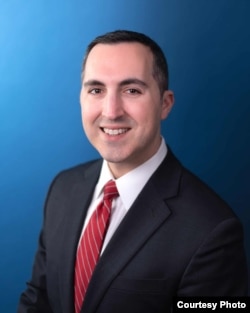
Hannah Kaviani of RFE/RL’s Radio Farda spoke with Richard Goldberg, now a senior adviser at the Foundation for Defense of Democracies, on January 13 about what Trump’s next move might be against Iran.
Click here to read the interview.