


Good morning from all of us at RFE/RL. While the news from Iran is slowing down, we're here for another day of live blogging.
We are now closing the live blog for today. We'll be back again tomorrow morning to follow all the ongoing developments in Iran at 9:00 a.m. Central European time.
Trump: Khamenei Responsible For 'Violence At Levels Never Seen Before'
US President Donald Trump said that Supreme Leader Ayatollah Ali Khamenei is responsible for the "complete destruction" of Iran, hours after Khamenei called nationwide protests an "American sedition" and said that "America must be held accountable."
"What he is guilty of, as the leader of a country, is the complete destruction of the country and the use of violence at levels never seen before," Trump told Politico on January 17.
"In order to keep the country functioning -- even though that function is a very low level -- the leadership should focus on running his country properly, like I do with the United States, and not killing people by the thousands in order to keep control," he said. "Leadership is about respect, not fear and death."
Trump's latest comments came after he said he decided not to launch military strikes against Iran, crediting Tehran's alleged cancellation of hundreds of scheduled executions as the decisive factor in his decision to hold back from military action.
"The best decision he ever made was not hanging more than 800 people two days ago," Trump said.
Earlier, Trump warned that Iran would face "very serious action" from the United States if it carried out its threats to execute detained protesters.
In Hospitals Across Iran, High Number Of Eye And Head Injuries
More reporting from Radio Farda on the huge number of injuries after the authorities violently cracked down on the protesters.
Shahram Kordasti, director of research at King’s College London’s Faculty of Oncology and Pharmaceutical Sciences, said colleagues in Iran reported an unusually high number of eye and head injuries.
“The volume was so large that specialized eye hospitals could no longer cope,” he said, adding that shortages of medical supplies and difficulties reaching hospitals had worsened the crisis.
Read more here.
Eyewitness: Armed Security Forces Still Out On The Streets
An Iranian citizen who recently traveled to Tajikistan told a correspondent for RFE/RL's Tajik Service that security forces are still out on the streets with "combat weapons" following the widespread protests.
According to this Iranian traveler, shops are closed from the evening onwards, and many are mourning their dead relatives.
Khamenei Says He Will Not Spare 'Criminals' For Role In Protests
In a public speech on January 17, Iranian Supreme Leader Ayatollah Ali Khamenei says he has no intention of leading the country to war, but he will not spare "domestic criminals."
The leader of the Islamic republic also acknowledged that “several thousand people” have been killed during widespread protests across Iran.
Khamenei also called the widespread protests in Iran an "American sedition" and said that "America must be held accountable."
US President Donald Trump recently warned that Iran would face “very serious action” from the United States if it carried out its threats to execute detained protesters.
After the expected executions of some protesters did not go ahead, the US president on January 16 thanked Iran's leadership, writing: "I greatly respect the fact that all scheduled hangings, which were to take place yesterday (over 800 of them), have been cancelled by the leadership of Iran. Thank you!"
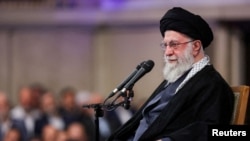
In his remarks on January 17, Khamenei also referred to a group of protesters who he said had no connection to Israel or the intelligence services but were "excited by lies," adding that "this group also killed several thousand people."
This is the first time the Iranian government has acknowledged the deaths of “several thousand” people, although it has made no mention of the role of the authorities in the killing of protesters. Previously, Iranian Foreign Minister Abbas Araqchi had put the death toll at “only a few hundred” and blamed “armed terrorists.”
In another part of his speech, the supreme leader warned political groups in Iran that he would not allow "the heads of state, the president, and others to be insulted in such important international and domestic circumstances."
EU Planes Warned To Steer Clear Of Iranian Airspace
The European Union's civil aviation safety body has advised air operators in the political bloc to avoid Iranian airspace entirely.
The European Union Aviation Safety Agency wrote in a January 16 statement that:
"The presence and possible use of a wide range of weapons and air-defence systems, combined with unpredictable state responses and the potential activation of SAM systems, creates a high risk to civil flights operating at all altitudes and flight levels."
The statement added that "Given the ongoing situation and the potential for U.S. military action, which has placed Iranian air defence forces on a heightened state of alert, there is currently an increased likelihood of misidentification."
Iran reopened its airspace on January 15, after it was closed for around 5 hours, causing many flights to be canceled or diverted. Despite this reopening, many European airlines, including Lufthansa, British Airways, and Wizz Air, avoided entering Iranian and Iraqi airspace on January 16.
On January 8, 2020, a Ukrainian passenger plane was shot down by a surface-to-air missile belonging to the Islamic Revolutionary Guards Corps Aerospace Force. The plane was targeted just minutes after it took off from Tehran Airport and all 176 passengers and crew lost their lives.
Iranian officials ultimately claimed that the incident occurred due to human error resulting from rising tensions between Iran and the United States.
Iranian Filmmaker Jafar Panahi: Fall Of The Regime Is 'Inevitable'

Renowned Iranian filmmaker Jafar Panahi has said that after the bloody suppression of protests in Iran, the regime will no longer be able to control society.
In an interview with the British newspaper The Guardian on January 16, the director, whose work includes Palme d’Or winner It Was Just an Accident, Taxi, and The Circle, said:
"It is impossible for this government to sustain itself in this situation. They know it too. They know that it will be impossible to rule over people. Perhaps their only goal right now is to bring the country to the verge of complete collapse and try to destroy it."
According to Panahi, the fall of the Iranian regime is "inevitable," but its timing cannot be predicted.
“The regime will collapse, 100 percent. It is what has happened to dictatorship governments throughout history. When it will collapse, no one knows. We want it to be as soon as possible, in the next few minutes, but there are many factors that have to come together for it to happen."
The 65-year-old filmmaker warned Western governments about treating the clerical regime as rational actors. "Unfortunately in this system there is no rationality," the director said. "All they can think of is crackdown and how they can stay in power even just one more day. The last thing they’re thinking about is the people.”
Panahi, who has been promoting It Was Just an Accident abroad, has been persecuted by the Iranian regime for years due to his films dealing with issues of social injustice, gender oppression, and state repression. He has spent time in prison and has been prevented by the Iranian authorities from traveling abroad.
The filmmaker recognized that some people in Iran were supporting Reza Pahlavi, the son of the former shah, saying:
"As Reza Pahlavi as said himself, after the transition there must be a referendum in Iran, and that is when people will decide what type of government they want and whom they want to rule over them. During this period of transition, we should all be united.”
Asked whether Pahlavi could be trusted to oversee a transition, Panahi said:
“Whether we agree with Pahlavi or not, we know that the overwhelming majority of the population of Iran want the current regime to go.”
The Internet In Iran Seems To Be Slowly Coming Back

Good morning from our teams in RFE/RL's Radio Farda and in the Central Newsroom. Starting the morning with the news that Iranians are slowly getting back online.
Internet monitoring data from NetBlocks shows that on the morning of January 17, after more than 200 hours of internet shutdown in Iran, the number of connected users has increased, albeit by a small amount.
According to NetBlocks, despite the slight uptick, nationwide internet connectivity in Iran remains at just 2 percent of normal levels, with no indication of a broad or sustained restoration.
Some experts say this limited improvement is due mainly to parts of government infrastructure and some specific networks getting back online -- with general access for ordinary users still incredibly limited.
Meanwhile, reports and user anecdotes indicate that some Iranian users are getting back on social networks but in a limited and scattered manner. A few unstable calls have been made through messenger apps, but widespread access is still not available to the public.
The internet shutdown in Iran, which began on the evening of January 8, is one of the longest nationwide internet shutdowns in the world, in terms of its duration and scale. It is thought that the only complete and nationwide internet shutdown in the world that lasted longer was related to the October 2021 coup in Sudan.
The Fars news agency, which is affiliated with the Islamic Revolutionary Guards Corps, announced on January 14 that "it seems that the final decision on greater access to the internet will be made in the next week or two by the relevant institutions."
However, more pessimistic assessments suggest that the Iranian people may not have access to the global internet for months -- or even that the internet will be nationalized.
We are now closing the live blog for today. We'll be back again tomorrow morning to follow all the ongoing developments in Iran at 9:00 a.m. Central European time.