



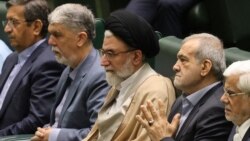
'Kidnapped From Hospitals': An Iranian Doctor Describes Brutal Crackdown
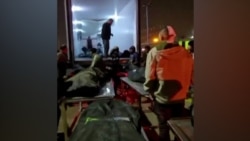
An Iranian ophthalmologist who spoke to RFE/RL's Radio Farda from Europe said hospitals are struggling to treat all the wounded as authorities try to crush anti-government protests.
Doctors have been overwhelmed by the number of eye injuries in particular, she said, adding that there have also been reports of security forces taking injured patients from hospitals and bodies from morgues.

Trump Thanks Iran For Canceling 'Over 800 Executions'
US President Donald Trump thanked the "Iranian leadership" for what he called the cancellation of "over 800 executions."
Trump posted on social media on January 16, writing: "I greatly respect the fact that all scheduled hangings, which were to take place yesterday (Over 800 of them), have been cancelled by the leadership of Iran. Thank you!"
On January 15, a White House spokeswoman announced that Iran had halted the executions of 800 death sentences under pressure from Trump.
At the same time, White House Press Secretary Karoline Levitt announced that all options remain open for dealing with Iran if repression and killings continue.
Pahlavi Confident Protests Will Succeed In Toppling Regime
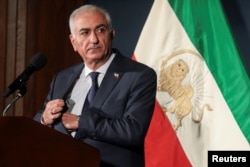
On January 16, Reza Pahlavi, the son of the late shah of Iran, who was ousted from power in 1979, said he was still confident the Islamic republic and its regime will fall in the face of mass protests.
"The Islamic republic will fall -- not if, but when," he told a news conference in Washington. "I will return to Iran."
The former crown prince has emerged as a leading opposition figure during the current unrest, with the broader opposition as a whole fragmented and unorganized.
In recent weeks, Pahlavi has repeatedly called for intervention by US President Donald Trump. At the news conference, he once again appealed for greater international pressure to aid protesters and ratchet up pressure on Tehran.
"Iranian people are taking decisive actions on the ground. It is now time for the international community to join them fully," he said.
Witkoff: US Wants Diplomacy Over Military Action In Iran
US President Donald Trump's special envoy, Steve Witkoff, says Washington would prefer a diplomatic solution to a military one in dealing with Iran and its multiple crises.
Speaking at the Israel-America Council in Florida on January 15, he said a potential diplomatic deal with the Islamic republic would cover four issues: uranium enrichment, ballistic missiles, Iran's stockpile of enriched uranium, and Tehran's support for its proxies.
Citing Iran's dire economic situation, Witkoff said the Islamic republic could be willing to compromise on the issues.
“If they want to come back to the league of nations, we can solve those four problems diplomatically, then that would be a great resolution. The alternative is a bad one,” he said.
Witkoff also said, in response to a question about what message he had for Iranians who want the current regime to fall: "They're incredibly courageous people, and we stand with you."
US astronaut Jasmin Moghbeli, whose parents left Tehran in 1980 after the Islamic Revolution, has posted a message of support for protesters in Iran.
Putin Talks With Pezeshkian
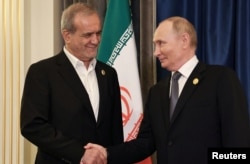
Russian Vladimir Putin has been talking by phone with his Iranian counterpart, Masud Pezeshkian. The Kremlin said on January 16 that during the call the Iranian president briefed Putin on Tehran's "sustained efforts to normalize the situation" in Iran amid a violent and deadly state crackdown on widespread anti-government protests that has left thousands dead, according to human rights groups,
The Kremlin said the two leaders also "confirmed their mutual commitment to further strengthening the strategic partnership between Russia and Iran and implementing joint economic projects in various fields."
And on that point, here are a couple of recent articles on the impact recent events in Iran might have on Moscow's complicated relationship with Tehran:
A little bit of background and context now: RFE/RL's graphics department has produced an interactive timeline of anti-regime demonstrations in Iran since deadly student protests in 1999.
Rights Watchdog Says 'Growing Evidence Of A Countrywide Massacre'

Human Rights Watch says there is growing evidence of mass killings of protesters by Iran’s security forces after nationwide demonstrations escalated on January 8.
The group reported that “security forces scaled up their deadly crackdown in a coordinated manner … resulting in large-scale killings and injuries of protesters and bystanders across the country.” It also said severe restrictions on communications have limited independent verification of the full scale of the atrocities.
HRW said it reviewed multiple forms of evidence, including verified photographs and videos, interviews with witnesses and relatives of victims, and analyses by forensic experts. The organization found many protesters were killed or injured by gunshot wounds to their heads and torsos and noted that Iranian officials cited by media outlets have acknowledged that the number of deaths has reached the “thousands.”
Lama Fakih, program director at Human Rights Watch, said the mass killings “are unprecedented in the country and a stark reminder that rulers who massacre their own people will keep committing atrocities until they are held to account.” She urged United Nations member states to convene a special session of the UN Human Rights Council to put human rights and accountability in Iran “front and center of the international response.”
Read HRW's full report here.
US Slams South Africa Over Iran's Role In Naval Drills
In other news, the United States has been taking South Africa to task for allowing Iran to take part in naval drills, saying it was "particularly unconscionable" that Pretoria has "welcomed Iranian security forces as they were shooting, jailing, and torturing Iranian citizens engaging in peaceful political activity South Africans fought so hard to gain for themselves."
Bloomberg later reported that While local news media said South Africa had persuaded Iran to withdraw from exercises, even though, the country's National Defense Force’s had posted images of captains of participating vessels docked at a South African naval base with Iranian officials present.
The Will for Peace 2026 war games, which included the participation of Russia and China alongside Iran and South Africa, started on January 9 and were due to end on January 16, bringing together warships from several BRICS Plus countries in South African waters.
Filterbaan, an Iran-focused digital rights group tracking online censorship and communications restrictions in the country, says the current Internet shutdown in the country reflects a policy that has not been adopted solely to contain protests, but "is designed structurally to eliminate the ability to record, document, and disseminate violence."