



Iran Is Still Offline. Will Access To The Global Internet Ever Be Restored?

Iranians are living through one of the longest Internet shutdowns in history, with the authorities imposing a digital blackout since launching a bloody crackdown on antiestablishment protesters on January 8.
While the authorities have quelled the weekslong demonstrations against Iran's clerical rulers with the use of unprecedented brute force, it remains unclear when they will restore access to the Internet.
Even when services resume, Iranians could be permanently cut off from the global Internet as the authorities force its citizens to use a domestically designed "intranet," which works independently from the world's Internet, digital experts warn.
To read the rest of the report by RFE/RL's Kian Sharifi, click here.
Russia Says Will Not Stop Trade With Iran
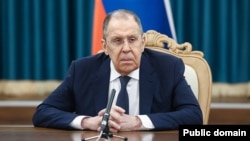
Russian Foreign Minister Sergei Lavrov said on January 20 that Moscow sees no reason to stop trading with Iran, despite the threat of US sanctions.
On January 12, US President Donald Trump announced that any country doing business with Iran would face 25 percent tariffs on its trade with the United States.
The United States already imposes extensive trade sanctions on Russia, particularly since Moscow's full-scale invasion of Ukraine in February 2022.
Last week, Lavrov said relations between Moscow and Tehran are based on agreements between the presidents of the two countries and "the United States cannot influence it."
Lavrov pointed to projects such as the Bushehr Nuclear Power Plant and the North-South Transport Corridor as examples of its cooperation with Iran and emphasized that Russia will continue to implement these agreements.
In recent years, Iran and Russia have expanded their economic and military ties, including Tehran providing Moscow with military drones for its war in Ukraine.
Hillel Neuer Challenges Iranian FM's Claim That Davos Invitation Canceled Due To Israeli Pressure
Hillel Neuer, an international lawyer and executive director of UN Watch, told Iranian Foreign Minister Abbas Araqhchi on X that the organizers of the World Economic Forum in Davos canceled his appearance because he is "directly implicated in crimes against humanity against your own people."
On January 19, the World Economic Forum (WEF) announced it had canceled Araqhchi's invitation to the summit, saying, "The tragic loss of lives of civilians in Iran over the past few weeks means that it is not right for the Iranian government to be represented at Davos this year."
Araqhchi hit back at the WEF, saying his invitation was withdrawn "on the basis of lies and political pressure from Israel."
Neuer attempted to put the record straight, telling Araqhchi on X that if he did come to Davos this week "a criminal complaint will be filed with Swiss prosecutors" due to what he claimed was Araqhchi's role in the "mass murder of thousands of protesters" in Iran.
Neuer and UN Watch regularly highlight abuses by regimes that often dominate UN forums.
On January 16, the Munich Security Conference (MSC) -- scheduled for February 13-15 -- withdrew its invitation to Araqhchi and other Iranian government representatives.
NetBlocks: Iranian Government Might Be Testing Selective Internet Access
According to NetBlocks, an internet monitoring organization, "the nationwide internet shutdown in Iran has passed the 280-hour mark, and the country, with a population of over 90 million people, remains cut off from global communications for the 13th consecutive day."
In its latest report, NetBlocks also said on January 20 that a review of traffic from some restricted services and platforms suggests that the government may be experimentally moving toward "whitelist-based connectivity." Whitelisting is a type of internet censorship where authorities block access to the vast majority of the global internet, while selectively allowing a very limited number of approved websites, apps, and services.
The ongoing internet shutdown has caused widespread damage to Iran's digital economy. Reza Olfatsefat, secretary of the country's Internet Business Association, said the shutdown has already caused more than 400 trillion rials ($286 million) in financial losses to small and large businesses.
These developments come as Iranian President Masud Pezeshkian said in a cabinet meeting on January 18 that, given the need to support online businesses and ease restrictions on communication, he has recommended to Ali Larijani, the secretary of the Supreme National Security Council, that internet restrictions be lifted as soon as possible.
However, Pezeshkian, who himself heads the Supreme National Security Council, has not said why he made recommendations instead of issuing direct orders to the responsible institutions.
European Parliament To Discuss Iran Crisis
Hanna Neumann, a German politician and head of an Iran delegation in the European Parliament, has announced that MEPs will discuss Iran on January 20 and, two days later, will vote on a resolution.
Neumann wrote on X that she will try to get the parliament to adopt clear demands on Iran that show "full solidarity with the protesters, condemn the regime's violent crackdown, [and] punish those responsible."
Neumann has also advocated for putting the Islamic Revolutionary Guards Corps on the EU's terror list, freezing the assets of Iranian banks, providing Iranians at risk with emergency visas, and expelling diplomats.
The debate is expected to begin at 16:00 CET and can be streamed here.
Shirin Ebadi: Islamic Republic Is 'Fundamentally Irreparable'

Nobel Peace Prize winner Shirin Ebadi emphasized in a recent interview with the French newspaper Liberation that Iran's political system is "fundamentally irreparable" and structured in such a way that any effort to enact meaningful reforms from within is destined to fail.
In the interview, Ebadi says that the main obstacle to democracy and progress in Iran is the “position of the leadership.” In order to achieve real change, she said, Supreme Leader Ayatollah Ali Khamenei must be “removed” from power.
The human rights activist and lawyer was the first Muslim woman and the first Iranian to receive the Nobel Peace Prize in 2003.She has lived in the United Kingdom since 2009.
Ebadi criticized Western countries' approach to Iran, saying that "self-serving" policies and attempts to "compromise" with the regime have only served to perpetuate the status quo. Ebadi also called on the international community to stand with the Iranian people and increase pressure on the country's senior leadership.
Referring to the recent protests, Ebadi said that the Iranian people have outgrown the system and are now seeking to establish a secular government free from religion.
Rights Group: Death Toll Likely Tops Even Highest Media Estimates
Mahmood Amiry-Moghaddam, director of the Oslo-based Iran Human Rights Organization (IHRNGO) which has been compiling information on the number of deaths during the recent unrest in Iran, says the available evidence "indicates that the number of protesters killed may exceed even the highest media estimates."
"There is no doubt that the Islamic Republic has committed one of the largest mass killings of protesters in our time." he added.
Moghaddam's comments came just hours after IHRNGO said that, given the magnitude of the killings in Iran and severe restrictions on communications, it would for the time being "refrain from issuing daily statistics until sufficient documentation has been obtained."
Pahlavi Says 'No Escape Route' For Khameini Whose Hands Are 'Stained With Blood'
Former Iranian Crown Prince Reza Pahlavi has described Supreme Leader Ayatollah Ali Khamenei as “an anti-Iranian criminal” whose hands are “stained with the blood of tens of thousands of Iranians.”
In a video message addressed to Khamenei, Mr. Pahlavi said: “You, your regime, and all your mercenaries will be held accountable for every drop of blood you have shed -- without exception.”
Referring to the prosecution and punishment of Nazi criminals at Nuremberg, he told Khamenei that he and his accomplices have “no escape route” and “no place to hide,” and that they too will be tried and punished.
Emphasizing that “the killers of the people of Iran will enjoy no immunity,” Pahlavi also addressed the Iranian people, saying: “You are not alone. Your resistance has changed history. You are standing on the front line of freedom.”
“Believe in yourselves; in your unity; in your courage; in your greatness…" he added. "This regime fears you and your power. We will not allow our grief to turn into despair.”
At the same time, he called on the people to “be ready,” because “the moment to return to the streets will come."
Pahlavi, who lives abroad, also issued a message of support on social media for the protesters, telling them that they have “won the admiration of the world with your courage and steadfastness” while announcing that he was planning to return to Iran in the near future.
Protesters came out in force on January 8 and January 9 night following calls by Reza Pahlavi for sustained street demonstrations.
Iranian authorities have responded to the unrest with a brutal crackdown in which thousands have been killed.
European Parliament Applauds Iranian Protesters
Members of the European Parliament have held a minute's applause in honor of the Iranian protests.
"I know many of you want to remember the thousands murdered on Iran's streets, but the people of Iran do not need silence," European Parliament President Roberta Metsola told members of the assembly in a public session on January 19. "They have been kept forcefully silent for 47 years. So today I'll ask you to do something a little bit different. I ask that we pay tribute to those killed by joining me in filling this chamber with a moment of applause as we honor their bravery and their courage."
Good morning. We'll start the live blog today with the news that the US-based rights group HRANA now says its confirmed death toll in the Iranian protests has now climbed past 4,000 and there are more than 9,000 cases under review. The death toll from the crackdown on the protests is substantially higher than those of previous bouts of unrest put down by the authorities in 2022 and 2009, but an Internet blackout has made it difficult to verify information and ascertain a precise tally.