




Christiaan Triebert from The New York Times, who specializes in open-source verification and geolocation analysis, has posted a picture on X showing a satellite picture of the official residence of Iranian Supreme Leader Ayatollah Ali Khamenei in Tehran, showing several buildings razed to the ground.
It was reported earlier that the first wave of US and Israeli attacks on February 28 targeted several Islamic republic government officials, including Khamenei and President Masud Pezeshkian.
State media say that the two were not harmed in the attacks.
Blasts Reported Across Gulf As Iran Confirms Strikes On US Bases
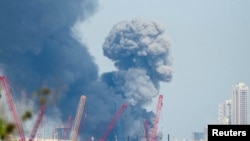
Amid reports of strikes across the Middle East, Persian Gulf states have reacted to expanding Iranian missile and drone attacks targeting US military facilities and regional capitals.
A new wave of explosions was reported in Abu Dhabi, with Reuters and AFP citing local witnesses.
Qatar closed its airspace after earlier missile attacks and said it reserves the right to respond.
Saudi Arabia condemned what it called “brutal Iranian aggression” and a “blatant violation” of the sovereignty of the UAE, Bahrain, Qatar, Kuwait and Jordan, though it did not confirm being targeted despite reported explosions in Riyadh.
Iran’s Islamic Revolutionary Guards Corps claimed it had struck US bases in Bahrain, Qatar and the United Arab Emirates, including the US Fifth Fleet headquarters, and said operations would continue.
Earlier, sirens and explosions were reported in the Bahraini capital, Manama, Abu Dhabi, Dubai, Riyadh and Kuwait.
Bahrain confirmed that there had been a missile strike on the Fifth Fleet service center.
The UAE said it intercepted several missiles but reported one fatality. Qatar said all incoming missiles were destroyed. Reuters also reported an airstrike on Iraq’s Popular Mobilization Forces headquarters in Baghdad.
Meanwhile, the US Department of War has issued a brief post on X, giving the name of the latest US operation.
Iran Plunged Into Digital Darkness as Internet Blocked Amid US, Israeli Air Strikes
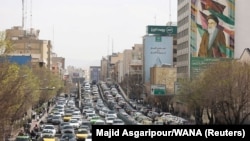
Iran has been plunged into a "near-total" Internet blackout as the United States and Israel carry out a massive, coordinated aerial bombing campaign across the country.
According to the Internet watchdog NetBlocks, connectivity in the country plummeted to just 4 percent of ordinary levels on February 28, severely limiting the flow of information as military operations intensify.
The digital shutdown began shortly after several Iranian news websites, including the official IRNA news agency, reported they had been targeted by sophisticated cyberattacks.
NetBlocks noted that the current disruption "matches measures" taken by the Iranian government during the 12-day conflict with Israel last June, suggesting the blackout is a state-enforced effort.
The military operation, which US President Donald Trump described as "major combat operations," was launched jointly with Israel to dismantle Iran’s missile and nuclear infrastructure.
In a video address, the president stated that the objective is to eliminate "imminent threats" to the American people and allies. Directly addressing the Iranian public, he declared that "the hour of your freedom is at hand," urging citizens to "take over your government" once the military phase concludes—a move signaling that the operation's ultimate goal is the collapse of the Islamic republic.
In Tehran, the strikes have targeted the highest levels of the Islamic republic’s leadership. Missiles reportedly struck the residential compounds of Supreme Leader Ayatollah Ali Khamenei and President Masud Pezeshkian in the city’s downtown district. News wires quoting informed sources say both leaders were moved to secure locations and remain safe.
The escalation comes amid a state of emergency in Israel and a retaliatory wave of Iranian missile strikes targeting regional bases.
Meanwhile, Barak Ravid, global affairs correspondent for Axios, a US political news website known for its insider reporting on Washington and foreign policy, says that President Donald Trump is expected to discuss the strikes in an address to the nation later today.
Britain Not Part Of Strikes, Local Media Report
British media are quoting government sources as saying the UK did not participate in strikes on Iran carried out earlier on February 28 by the United States and Israel.
A UK government spokesman did not comment on the reports in a statement, but did say that "Iran must never be allowed to develop a nuclear weapon and that is why we have continually supported efforts to reach a negotiated solution."
Lindsey Graham Backs Strikes On Iran

Senior Republican Senator Lindsey Graham, an influential voice on US national security policy and a longstanding advocate of a tough stance on Iran, has strongly endorsed the latest strikes against the Islamic republic.
“My mind is racing with the thought that the murderous ayatollah’s regime in Iran will soon be no more,” Graham said.
“This operation has been well-planned. It will be violent, extensive and I believe, at the end of the day, successful," he added.
Arguing that Tehran bears responsibility for American deaths, Graham said, “the demise of the ayatollah’s regime with American blood on its hands is necessary and more than justified.”
Australian PM Says Australia 'Stands With' Iranians
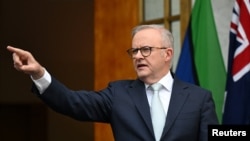
Australian Prime Minister Anthony Albanese has been responding to developments in the Middle East, saying his country "stands with the brave people of Iran in their struggle against oppression."
In a post on X, he said Australia supported the United States "acting to prevent Iran from obtaining a nuclear weapon and to prevent Iran continuing to threaten international peace and security."
He described the Iranian regime as a long-standing “destabilizing force” and that it “can never be allowed to develop a nuclear weapon.”
Albanese said international calls for Tehran to respect “the human rights and fundamental freedoms of Iran’s citizens” had “gone unheeded,” pointing to a “brutal crackdown” that left “thousands of Iranian civilians dead,” and arguing that “a regime that relies on the repression and murder of its own people to retain power is without legitimacy.”
He also pointed out that Iran had directed “at least two attacks on Australian soil in 2024,” prompting diplomatic expulsions and sanctions. Australia has upgraded travel warnings for Iran, Israel, and Lebanon and activated its Crisis Centre to assist citizens.
EU Foreign Policy Chief Says Latest Developments In Middle East 'Perilous'

EU foreign policy chief Kaja Kallas says the initiation of US and Israeli air strikes against Iran, and Tehran's retaliation at targets around the Middle East, are "perilous."
In a post on X, she said the bloc is "coordinating closely with Arab partners to explore diplomatic paths."
"Protection of civilians and international humanitarian law is a priority," she said. "Our consular network is fully engaged in facilitating departures for EU citizens. Non-essential EU personnel are being withdrawn from the region."
Meanwhile, the president of the European Commission, Ursula von der Leyen, has said the latest developments are "greatly concerning" amid fears of further escalation.
Reports: First Wave of Strikes Targeted Iranian Officials
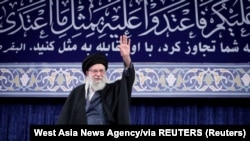
Its being reported by a number of media outlets that the first wave of strikes in today's joint US-Israeli operation targeted officials of the Islamic republic.
There have been no reliable reports from inside Iran regarding the status of these officials or whether they are alive or dead.
The first report of an attack said a missile struck near Pasteur Square in Tehran, where the residence of Supreme Leader Ayatollah Ali Khamenei is located. A source told Reuters that Khamenei was not in Tehran and had been transferred to a secure location.
At the same time, a video has circulated on social media claiming to show the aftermath of a missile strike on the residence of former Iranian hardline president Mahmud Ahmadinejad.