



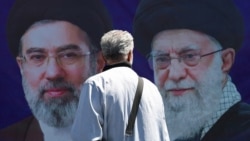
RFE/RL's Radio Farda has also been talking to a number of analysts about the developments in Iran.
Here's a selection of some of the things they've been saying:
Leyla Morovati, political analyst with expertise in Iranian domestic and foreign affairs,
“The responses Iran has carried out up to this stage may lead many regional powers and countries beyond the region powers -- even if they do not enter the war directly -- to indirectly demand that Iran's missile program be limited and controlled.
If we consider the experience of several years of negotiations, including the most recent round, it has shown that the Islamic republic will not retreat from its positions. This stance, in practice, causes other countries to feel threatened. Specifically, the Islamic republic’s missile program can pose significant risks.
Ultimately, some of these nations may feel compelled to align with these attacks -- even if not directly -- to see the Islamic republic severely weakened and its missile program dismantled or restricted. In other words, they will be moving in alignment with US and Israeli interests.”
Damon Golriz, lecturer and researcher at The Hague University of Applied Sciences specializing in Middle East politics, geopolitics, and security studies
"In light of the recent strikes and the Islamic republic’s retaliation, we’re likely looking at an escalation in the coming days and weeks. [...] the Omani Foreign Minister’s 11th-hour trip was a collective effort by the Gulf states and Saudi Arabia to pull the region back from the brink. That effort clearly fell through. We are now in the midst of a regional war, and Tehran is bound to hit back. The ball is now firmly in the court of the United States and Israel; the question is whether they have the technical capability and the sufficient political will to, so to speak, 'finish the job.'
But what if they don't?
If the United States and Israel lack the military and political resolve to see through a regime… then all these countries allied with the United States will pay a very heavy price. For a regime whose only priority is survival at any cost -- even its own people’s blood -- this is just the price of doing business. But for the UAE and Qatar, the cost will be far steeper given Iran's missile reach. Unless, of course, the United States and Israel can neutralize that threat, which I doubt is possible without boots on the ground."
And, speaking of Iran's missile reach, here's a graphic showing the range of its armaments.

Analysis: Trump's Endgame In Iran: Strategic Submission Or Systemic Collapse?
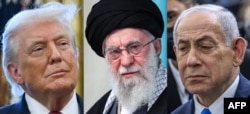
Weeks of tension with Iran and a rapid US military buildup have erupted into joint US-Israeli strikes on high-profile targets, including Iranian military sites and the residences of the country’s top brass.
As the first wave of strikes shook major locations across the country, a central question looms amid the clouds of smoke billowing into Iranian skies: What is the ultimate objective of the Trump administration?
While Donald Trump’s rhetoric has swung between calls for a “better deal” and hints of regime change, his February 28 address -- combined with the nature of the current strikes -- suggests a radical policy shift.
No longer content with “maximum pressure,” the United States now appears to be pursuing the total neutralization of Iran as a regional power.
For months, Trump maintained that his goal was a new, more restrictive nuclear agreement. But as Michael Horowitz, an independent defense expert based in Israel, observes, the diplomatic path had effectively hit a dead end.
“The negotiations between Washington and Tehran clearly weren't working in the way Trump would have liked,” Horowitz told RFE/RL. “The gap is simply too wide to bridge through talks.”
Read more here.
Canadian PM Carney Says Ottawa Supports US Acting To 'Prevent' Iran From Obtaining Nuclear Weapons
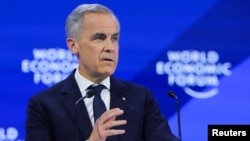
Prime Minister Mark Carney said Canada supports the US military operations against Tehran that he hopes will "prevent Iran from obtaining a nuclear weapon and to prevent its regime from further threatening international peace and security."
Carney added in a statement that Canada's position remains clear: "Iran is the principal source of instability and terror throughout the Middle East, has one of the world's worst human rights records, and must never be allowed to obtain or develop nuclear weapons."
Global airlines canceled flights across the Middle East after the United States and Israel launched strikes on Iran.
Time-lapse imagery from flight-tracking service Flightradar24 showed an increasingly empty sky over the country as flights were rerouted around the region.
Red Crescent Spokesperson Says At Least 20 Provinces Affected By Strikes
A spokesperson for the Iranian Red Crescent Society says that more than 20 provinces across the country have been affected by today’s Israeli and US attacks.
Mojtaba Khaledi also reported that rescue workers are working to clear debris and transfer the injured and the dead following the attack on a school in Minab County.
He strongly urged citizens to maintain a “100-meter distance” from impact sites and to avoid gathering at these locations in order to protect their lives.
Earlier, the special governor of Minab, in Iran's southern Hormozgan Province, said “40 students” were killed in US and Israeli attacks.
RFE/RL's Radio Farda was unable to independently verify the claim.
Some unverified footage purportedly showing the aftermath of the strike in Minab has also been widely shared on social media.
Images captured on February 28 and compiled by RFE/RL show blasts in Iran, Israel, and several other Middle Eastern countries amid US President Donald Trump's announcement that "major combat operations" are underway.
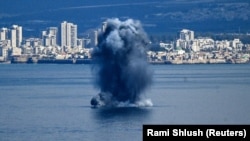
Explosions Seen In Multiple Middle East Cities As US, Israel Launch Strikes On Iran
UN Special Rapporteur Criticizes US-Israeli Strikes
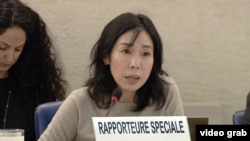
The United Nations special rapporteur on the human rights situation in Iran, Mai Sato, has criticized the US-Israeli strikes, saying they were launched “in violation of the UN Charter and without authorisation from the Security Council.”
“We cannot pick and choose when international law applies,” she said in a post on X, adding that “unlawful military intervention is not a solution to the nuclear issue or to the human rights situation in Iran.”
She added that she is “closely monitoring the human rights impact of this escalation,” particularly on civilians and infrastructure.
Macron Calls Escalation 'Dangerous for All,' Seeks UN Meeting
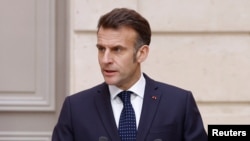
French President Emanuel Macron has also weighed in on this morning's developments, warning that the “outbreak of war between the United States, Israel, and Iran carries grave consequences for international peace and security.”
Describing the escalation as "dangerous for all," he said the Iranian regime "must understand that it now has no other option but to engage in good faith in negotiations to end its nuclear and ballistic programs, as well as its regional destabilization activities."
“The Iranian people must also be able to freely build their future,” he said in a post on X, and announced that he was seeking an urgent UN Security Council meeting while consulting European and regional allies.
He added that "every measure is being taken to ensure the security of our national territory, our citizens, and our interests in the Middle East."
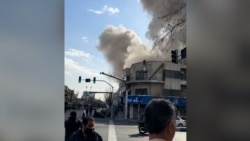
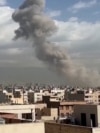
Here is some video footage of the explosions witnessed in Tehran on February 28, which were shortly followed by sirens sounding in Israel in the wake of US President Donald Trump's announcement of attacks on Iran. He called for Iranian citizens to keep off the streets, telling them "the hour of your freedom is at hand."

Mediator In Iran–US Talks Expresses Disappointment Over Attack On Iranian Soil
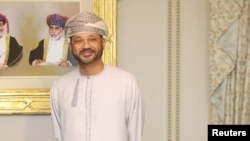
Omani Foreign Minister Badr Albusaidi, who has been mediating in recent Iran–US negotiations and is currently in the United States, has posted on X, expressing disappointment over the outbreak of hostilities.
"I am dismayed. Active and serious negotiations have yet again been undermined," he said. "Neither the interests of the United States nor the cause of global peace are well served by this."
The senior Omani official was in the midst of negotiations between the two countries over Iran's nuclear program and cited "significant progress." Less than 24 hours earlier he had told reporters that “peace is within reach.”