



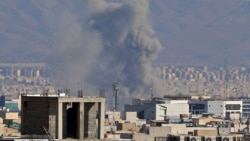
New Reported Wave Of Attacks
RFE/RL's Radio Farda has received reports of explosions being heard in the cities of Tehran, Karaj, and Garmdareh.
News agencies inside Iran have reported that a loud explosion was heard in the capital, Tehran, on the evening of February 28.
Similar reports of explosions or blasts have emerged from multiple other cities across Iran, according to independent news sources.
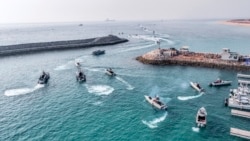
Reuters: Strait Of Hormuz Reportedly Closed
Reuters is reporting that the Strait of Hormuz, through which an estimated 20 percent of the world's oil transits, has been closed.
The UK Maritime Trade Operations agency said on Saturday that it received multiple reports from vessels operating in the Gulf saying they had received messages on the closure of the Strait of Hormuz.
There was no immediate confirmation from Iran.
With its extensive and powerful naval forces, Iran has substantial practical influence over access to the strait enabling it to disrupt or threaten shipping. Here is an explainer from June last year on just why the strait matters so much:

Trump Spoke With Netanyahu
US President Donald Trump spoke with Israeli Prime Minister Benjamin Netanyahu by phone today and will continue to closely monitor the Iranian situation with his national-security team, White House spokeswoman Karoline Leavitt said.
Reports: Iranian Defense Minister, Revolutionary Guards Commander Killed In Strikes
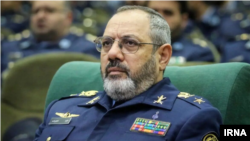
Iranian Defense Minister Amir Nasirzadeh and Islamic Revolutionary Guards Corps commander Mohammed Pakpur are though to have died in Israeli attacks, two sources familiar with Israel's military operations and one regional source said, according to Reuters.
Earlier, The Times of Israel said Israeli officials assessed that Pakpur, Nasirzadeh, and Iran’s intelligence chief were likely killed in the strikes.
Zelenskyy Says Iranians Have A Chance To Oust 'Terrorist Regime' In Tehran
- By RFE/RL
Ukrainian President Volodymyr Zelenskyy says the Iranian people have an opportunity "to get rid of the terrorist regime" in Tehran after joint US-Israeli strikes on Iran.
"It is only fair to give the Iranian people a chance to get rid of the terrorist regime, to remove it and guarantee the safety of all nations that have suffered from terror originating in Iran," Zelenskyy said in a video address published on February 28.

He added that it was "important that the United States is determined," adding that "whenever America is determined, global criminals weaken."
Tehran has long been an ally of Russia, supplying it with military equipment and technology and fueling Moscow’s war effort. According to Zelenskyy, Russia's military used at least 57,000 Iranian-made Shahed drones in attacks on his country, including against its civilian and energy infrastructure.
Earlier on February 28, a statement published by Ukraine's Foreign Ministry said "the reason for the current events is precisely the violence and arbitrariness of the Iranian regime."
UN Security Council To Hold Emergency Meeting
The United Nations Security Council will hold an emergency meeting today following US and Israeli attacks on Iran and Tehran’s retaliatory strikes on countries in the region.
The UN said the session, scheduled to begin at 4 p.m. New York time, will address the “situation in the Middle East.”
France and Bahrain had called for the meeting, and RFE/RL's Radio Farda says Iranian Foreign Minister Abbas Araqchi, had also made a separate request for a similar session.
Images captured on February 28 show fires burning in streets across Tehran following joint US-Israeli strikes on Iran. Iranian state TV said a school in the city of Minab was also damaged, and there have been unconfirmed reports of multiple fatalities.
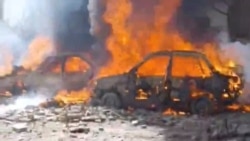
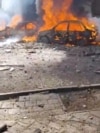
Images from Tehran after US and Israeli strikes on February 28 show people waiting in lines at gas stations. They also depict some protests and heavy traffic on the streets of the Iranian capital, as well as people looking for shelter.
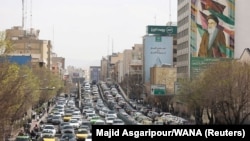
Gas Lines, Protests, And Heavy Traffic In Tehran After US And Israeli Strikes
Iranian Foreign Minister Claims Khamenei and Pezeshkian Are Still Alive
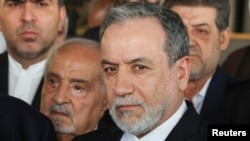
Iranian Foreign Minister Abbas Araqchi says senior Iranian leaders remain in place following the US and Israeli strikes on February 28, telling NBC that “almost all officials are safe and sound and alive.”
He acknowledged possible losses among military officers, saying, “We may have lost one or two commanders, but that is not a big problem. We are actually managing it. We are handling the situation.”
In launching strikes on other countries across the Middle East, Araqchi claimed Iran was not seeking to widen the conflict, adding: “We have no intention of attacking them, but we are attacking the American bases in self-defense.”
He also criticized the strikes for coming in the middle of negotiations on Iran’s nuclear program.
When asked directly about the status of Iranian Supreme Leader Ayatollah Ali Khamenei and President Masud Pezeshkian he said: “As far as I know, yes, they are alive -- and the head of the judiciary [Gholam Hossein Mohseni-Ejei] as well and the speaker of parliament [Mohammad Baqer Qalibaf]. All high-ranking officials are alive. And the secretary of the National Security Council [Ali Larijani]. Everybody is in position and we are handling this situation.”
RFE/RL's Radio Farda has also been talking to a number of analysts about the developments in Iran.
Here's a selection of some of the things they've been saying:
Leyla Morovati, political analyst with expertise in Iranian domestic and foreign affairs,
“The responses Iran has carried out up to this stage may lead many regional powers and countries beyond the region powers -- even if they do not enter the war directly -- to indirectly demand that Iran's missile program be limited and controlled.
If we consider the experience of several years of negotiations, including the most recent round, it has shown that the Islamic republic will not retreat from its positions. This stance, in practice, causes other countries to feel threatened. Specifically, the Islamic republic’s missile program can pose significant risks.
Ultimately, some of these nations may feel compelled to align with these attacks -- even if not directly -- to see the Islamic republic severely weakened and its missile program dismantled or restricted. In other words, they will be moving in alignment with US and Israeli interests.”
Damon Golriz, lecturer and researcher at The Hague University of Applied Sciences specializing in Middle East politics, geopolitics, and security studies
"In light of the recent strikes and the Islamic republic’s retaliation, we’re likely looking at an escalation in the coming days and weeks. [...] the Omani Foreign Minister’s 11th-hour trip was a collective effort by the Gulf states and Saudi Arabia to pull the region back from the brink. That effort clearly fell through. We are now in the midst of a regional war, and Tehran is bound to hit back. The ball is now firmly in the court of the United States and Israel; the question is whether they have the technical capability and the sufficient political will to, so to speak, 'finish the job.'
But what if they don't?
If the United States and Israel lack the military and political resolve to see through a regime… then all these countries allied with the United States will pay a very heavy price. For a regime whose only priority is survival at any cost -- even its own people’s blood -- this is just the price of doing business. But for the UAE and Qatar, the cost will be far steeper given Iran's missile reach. Unless, of course, the United States and Israel can neutralize that threat, which I doubt is possible without boots on the ground."
And, speaking of Iran's missile reach, here's a graphic showing the range of its armaments.
