



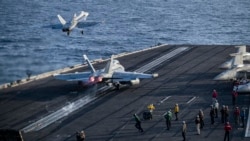
Trump Says Only Iran 'Unconditional Surrender' Acceptable
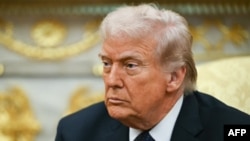
US President Donald Trump says that he will not strike a deal with Tehran other than "unconditional surrender."
"After that, and the selection of a GREAT & ACCEPTABLE Leader(s), we, and many of our wonderful and very brave allies and partners, will work tirelessly to bring Iran back from the brink of destruction, making it economically bigger, better, and stronger than ever before," Trump said in a social media post on March 6.
We are now closing the live blog for the day. We'll be back at 7:30 a.m. Central European time to cover the latest events across the Middle East.
Trump Says He's Paused Planned Iran Strike As Peace Negotiations Continue

US President Donald Trump says he has paused a planned military strike on Iran to allow negotiations over ending the conflict in the Middle East, after Tehran submitted a new peace proposal through Pakistan.
Trump said in a Truth Social post on May 18 that he had told the military that “we will NOT be doing the scheduled attack of Iran tomorrow, but have further instructed them to be prepared to go forward with a full, large scale assault of Iran, on a moment’s notice, in the event that an acceptable Deal is not reached.”
Facing pressure to reopen the Strait of Hormuz and reduce the war’s economic impact, Trump said leaders of Qatar, Saudi Arabia and the United Arab Emirates had urged him to hold off on the attack because “a Deal will be made.”
Iran confirmed its views had been relayed to Washington via Pakistan, though a Pakistani source warned: “We don't have much time.”
Speaking to journalists hours after saying he had postponed a military attack planned for Tuesday, Trump said the United States would be satisfied if it could reach an agreement with Iran that prevents Tehran from obtaining a nuclear weapon.
Trump added that there "seems to be a good chance that a deal can be worked out," while Pakistan described the talks as "difficult."
Iran’s proposal reportedly prioritizes ending the conflict, reopening the Strait of Hormuz, and easing sanctions, while deferring disputes over Tehran’s nuclear program.
Iranian sources also claimed Washington had shown greater flexibility on frozen assets and civilian nuclear activity, though the US has not confirmed any concessions.
With reporting by Reuters
US Extends Russian Oil Waiver As Bessent Urges Tougher Iran Sanctions

WASHINGTON -- The US Treasury Department has extended for another 30 days a sanctions waiver allowing at-risk countries to purchase Russian oil shipments at sea, as supply disruptions linked to the US-Israeli conflict with Iran continue to roil global energy markets.
“US Treasury is issuing a temporary 30-day general license to provide the most vulnerable nations with the ability to temporarily access Russian oil currently stranded at sea,” Treasury Secretary Scott Bessent said in a post on X.
Bessent said the waiver would “help stabilize the physical crude market and ensure oil reaches the most energy-vulnerable countries” while limiting China’s ability to stockpile discounted Russian oil.
The decision highlights the increasingly difficult balancing act facing Washington and its allies as they seek to sustain pressure on Moscow over its war against Ukraine while also trying to prevent a wider energy shock tied to escalating tensions with Iran.
The waiver expired over the weekend before being renewed after several poorer countries requested more time to secure supplies disrupted by the closure of Persian Gulf shipping routes, according to a source familiar with the decision. The countries were not identified.
Oil markets remained volatile despite the extension. Brent crude rose about 1.5 percent on May 18 to roughly $111 a barrel amid continuing concerns over Gulf supplies.
Read more here
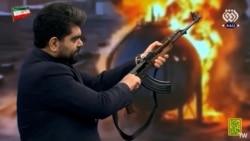
Iranian TV Presenter Fires Gun At UAE Flag Amid Growing Public Militarization
An armed Iranian state TV presenter fired at a United Arab Emirates flag during a broadcast amid signs of growing public militarization in Iran. It came as US President Donald Trump issued threats of renewed attacks on Iran if it didn't reach a deal to end the nearly three-month-long conflict.

With reporting by RFE/RL's Radio Farda
Iranian Official Downplays Seriousness Of Mojtaba Khamenei’s Injuries
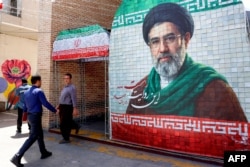
An Iranian Health Ministry official has dismissed reports that Supreme Leader Mojtaba Khamenei suffered debilitating injuries during an Israeli strike on the Tehran residence of his father, Ali Khamenei, insisting that “nothing significant” happened to him.
The attack on February 28 killed Ali Khamenei and dozens of senior officials, while Mojtaba -- later named his father’s successor as supreme leader of the Islamic Republic -- was said to have survived with severe injuries.
Hossein Kermanpour. who heads the ministry's public relations and information center, told the state-run ISNA news agency that Mojtaba sustained only non-disfiguring wounds and did not suffer amputations or permanent disability.

His comments contrast with earlier remarks by regime figures and Iranian state media referring to Mojtaba as a “disabled veteran.”
International outlets including CNN, Reuters,and The New York Times have reported that Mojtaba remains under medical treatment for serious injuries to his face, arm, torso and leg, and has avoided public appearances to avoid seeming weak.
With reporting by RFE/RL's Radio Farda
Qalibaf's New Post
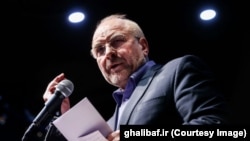
Iran has appointed influential parliament speaker Mohammad Baqer Qalibaf as its special representative for China affairs.
Kian Sharifi and Radio Farda take a look at the appointment, which carries a message that extends well beyond bilateral ties -- and may be as much about Washington as it is about Beijing.
Iran Internet Blackout Hits 80 Days
May 18 marks the 80th day of Iran’s Internet blackout, with the shutdown now exceeding 1,896 hours, Internet monitoring group NetBlocks reports.
"Pro-regime content floods social media, as Iranians seeking to get pro/whitelist access say they are being asked to meet a quota of daily propaganda posts, policed by AI," NetBlocks said in a post on X on May 18.
The shutdown began on February 28 in the immediate aftermath of US and Israeli air strikes against Iran.
Since then, publicly available network data shows that cross-border Internet traffic has remained below 1 percent of the country's pre-shutdown average for nearly the entire period.
In other words, for the overwhelming majority of Iranians, access to any website or application outside the country has been effectively impossible.
Background reading on Iran's Internet shutdown here.
German Chancellor Condemns Iran Strike On UAE Nuclear Power Plant

German Chancellor Friedrich Merz has condemned Iran's strike against the United Arab Emirates (UAE) and other Gulf countries.
"Attacks on nuclear facilities pose a threat to the safety of people throughout the entire region. There must be no further escalation of violence," Merz wrote on X on May 18.
"Iran must enter into serious negotiations with the United States, stop threatening its neighbors, and open the Strait of Hormuz without restrictions," he added.
Earlier, the UAE reported that a fire had broken out at the Barakah Nuclear Power Plant (NPP) after a drone attack.
The International Atomic Energy Agency (IAEA) responded to the attack with a statement condemning "military activity that threatens nuclear safety is unacceptable."
Iranian Nobel Laureate Narges Mohammadi ‘Sent Home’ From Hospital
- By RFE/RL
Nobel Peace Prize Winner Narges Mohammadi has been discharged from a Coronary Care Unit (CCU) in Tehran and sent home, according to a statement by her foundation.
Mohammadi was taken to a hospital from a prison in Zanjan, some 330 kilometers west of the capital, Tehran, at the beginning of May. At the time, her brother, Hamidreza Mohammadi, told RFE/RL’s Radio Farda that she was "on the brink of death." The family subsequently moved her, at their own expense, to a hospital in Tehran.
Awarded the Nobel Prize in 2024 for her fight for women's rights in Iran, Mohammadi has spent much of the last decade behind bars as a result of her work and in, December 2025, was arrested again during a memorial ceremony in the northeastern city of Mashhad.
This was followed by a 7-1/2-year prison sentence. The family say she was denied medical care in prison and that conditions there were directly linked to her health problems, which included heart and blood pressure issues.
“While my mother has been discharged from the CCU at Tehran Pars Hospital, her recovery demands strict medical supervision outside prison walls,” Mohammadi’s daughter, Kiana Rahmani, said in a statement.
“Returning her to detention is a death sentence. We must ensure she remains free, all baseless charges against her are permanently dropped, and the persecution ends. Human rights activism is not a crime, and no advocate should ever be imprisoned for it,” Rahmani added.
Iranian Police Chief Says '6,500' Arrested Since Start Of War
The commander of Iran's police force says that, since the beginning of the war, around "6,500" people have been arrested on charges he called "treason and espionage."
Ahmad Reza Radan claimed that 567 of these people were associated with "hypocrisy, evildoers, and counterrevolutionary groups."
Radan also said that the "arrest of enemy soldiers and traitors," which he said began during country-wide protests in January, was still ongoing.
Amnesty International and other human rights groups say Tehran has sharply increased its use of the death penalty in the wake of the January protests and the outbreak of war with Israel and the United States on February 28.
Iran is thought to have executed at least five people on espionage charges so far this year. Given that the regime often carries out executions in secret, it is possible the number is higher.