


Qalibaf's New Post
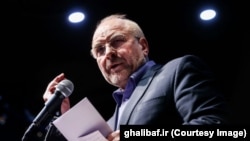
Iran has appointed influential parliament speaker Mohammad Baqer Qalibaf as its special representative for China affairs.
Kian Sharifi and Radio Farda take a look at the appointment, which carries a message that extends well beyond bilateral ties -- and may be as much about Washington as it is about Beijing.
Iran Internet Blackout Hits 80 Days
May 18 marks the 80th day of Iran’s Internet blackout, with the shutdown now exceeding 1,896 hours, Internet monitoring group NetBlocks reports.
"Pro-regime content floods social media, as Iranians seeking to get pro/whitelist access say they are being asked to meet a quota of daily propaganda posts, policed by AI," NetBlocks said in a post on X on May 18.
The shutdown began on February 28 in the immediate aftermath of US and Israeli air strikes against Iran.
Since then, publicly available network data shows that cross-border Internet traffic has remained below 1 percent of the country's pre-shutdown average for nearly the entire period.
In other words, for the overwhelming majority of Iranians, access to any website or application outside the country has been effectively impossible.
Background reading on Iran's Internet shutdown here.
German Chancellor Condemns Iran Strike On UAE Nuclear Power Plant
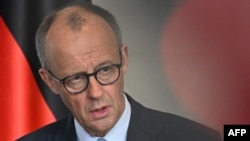
German Chancellor Friedrich Merz has condemned Iran's strike against the United Arab Emirates (UAE) and other Gulf countries.
"Attacks on nuclear facilities pose a threat to the safety of people throughout the entire region. There must be no further escalation of violence," Merz wrote on X on May 18.
"Iran must enter into serious negotiations with the United States, stop threatening its neighbors, and open the Strait of Hormuz without restrictions," he added.
Earlier, the UAE reported that a fire had broken out at the Barakah Nuclear Power Plant (NPP) after a drone attack.
The International Atomic Energy Agency (IAEA) responded to the attack with a statement condemning "military activity that threatens nuclear safety is unacceptable."
Iranian Nobel Laureate Narges Mohammadi ‘Sent Home’ From Hospital
- By RFE/RL
Nobel Peace Prize Winner Narges Mohammadi has been discharged from a Coronary Care Unit (CCU) in Tehran and sent home, according to a statement by her foundation.
Mohammadi was taken to a hospital from a prison in Zanjan, some 330 kilometers west of the capital, Tehran, at the beginning of May. At the time, her brother, Hamidreza Mohammadi, told RFE/RL’s Radio Farda that she was "on the brink of death." The family subsequently moved her, at their own expense, to a hospital in Tehran.
Awarded the Nobel Prize in 2024 for her fight for women's rights in Iran, Mohammadi has spent much of the last decade behind bars as a result of her work and in, December 2025, was arrested again during a memorial ceremony in the northeastern city of Mashhad.
This was followed by a 7-1/2-year prison sentence. The family say she was denied medical care in prison and that conditions there were directly linked to her health problems, which included heart and blood pressure issues.
“While my mother has been discharged from the CCU at Tehran Pars Hospital, her recovery demands strict medical supervision outside prison walls,” Mohammadi’s daughter, Kiana Rahmani, said in a statement.
“Returning her to detention is a death sentence. We must ensure she remains free, all baseless charges against her are permanently dropped, and the persecution ends. Human rights activism is not a crime, and no advocate should ever be imprisoned for it,” Rahmani added.
Iranian Police Chief Says '6,500' Arrested Since Start Of War
The commander of Iran's police force says that, since the beginning of the war, around "6,500" people have been arrested on charges he called "treason and espionage."
Ahmad Reza Radan claimed that 567 of these people were associated with "hypocrisy, evildoers, and counterrevolutionary groups."
Radan also said that the "arrest of enemy soldiers and traitors," which he said began during country-wide protests in January, was still ongoing.
Amnesty International and other human rights groups say Tehran has sharply increased its use of the death penalty in the wake of the January protests and the outbreak of war with Israel and the United States on February 28.
Iran is thought to have executed at least five people on espionage charges so far this year. Given that the regime often carries out executions in secret, it is possible the number is higher.
We are now closing the live blog for the day. We'll be back at 7:30 a.m. Central European time to cover the latest events across the Middle East.
Iran Executed 'Staggering' Number Of People In 2025, Amnesty Says
Iran executed a "staggering" 2,159 people in 2025, Amnesty International reported on May 18, helping to push the global figure to the highest level since 1981.
London-based Amnesty said at least 2,707 people were executed globally last year, although death sentences carried out in China were not included in the figure.
Amnesty said that "thousands of executions" were carried out in China, the world's most prolific user of the death penalty, although details are uncertain due to "the state secrecy" over data in the communist nation.
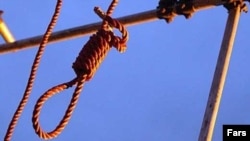
Amnesty said the 2025 global figure -- including executions in Saudi Arabia, Kuwait, Egypt, Yemen, Singapore, and the United States -- represented an increase of more than two-thirds from the 2024 total.
"This trend was strongest in countries where the authorities have tightened their grip on power by restricting civic space, silencing dissent and displaying disregard for protections established under international human rights law and standards," it said.
In particular, the "staggering increase in recorded executions in Iran" came as authorities "intensified their use of the death penalty as a tool of political repression and control," particularly after the June 2025 war with Israel.
Amnesty and other rights groups have said Tehran is intensifying its use of the death penalty after mass antigovernment street protests in January and following the outbreak of war against Israel and the United States.
Amnesty said the known total of 2,159 executions carried out in Iran in 2025 "constituted the highest figure on record since 1981" in the country. It was also the highest one-nation figure since that year.
Because of the difficulty in obtaining concrete information, other groups have provided differing figures on the number of executions in Iran.
The Norway-based Iran Human Rights NGO earlier this year said at least 1,639 people were executed in Iran last year.
Tehran has acknowledged executing 30 people so far in 2026.
Saudi Arabia last year carried out at least 356 executions, above its record-high figure of at least 345 in 2024, Amnesty said.
Executions in Kuwait rose from six in 2024 to 17. In Egypt, they went from 13 to 23. In Yemen, the yearly figure rose from at least 38 to at least 51, it added.
In the US, Amnesty said an "unprecedented rise" of executions in Florida -- to 19 -- brought the national total to 47, highest since 2009.
With reporting by AFP
Saudis Intercept 3 Drones Fired From Iraqi Territory, Origin Unknown
The Saudi Defense Ministry said three drones were intercepted and destroyed after they entered its territory airspace from Iraqi airspace.
Major General Turki Al-Maliki on May 17 said the country "reserves the right to respond at the appropriate time and place, and will take and implement all necessary operational measures to respond to any attempt to infringe on the Kingdom's sovereignty, security, and the safety of its citizens and residents on its territory."
It was not immediately clear who may have launched the drones, but many Iran-allied militias operate within the territory of Iraq.
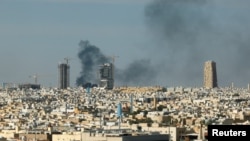
With both pro- and anti-Iranian militias based in the country, Iraq has often been drawn unwillingly into the US-Israeli war with Iran.
The latest incident comes after the United Arab Emirates said a fire had broken out at the Barakah nuclear power plant following a drone attack.
The International Atomic Energy Agency (IAEA) responded to the attack with a statement condemning "military activity that threatens nuclear safety is unacceptable."
Saudi Arabia and UAE have been frequent targets of Iranian missiles and drones launched in retaliation for US-Israeli air strikes that began on February 28, even amid the current cease-fire announced in early April.
Unconfirmed press reports have suggested that both nations launched their own attacks against Iranian sites, although the reports have not been confirmed by the Saudis or the UAE.
Trump: 'Clock Is Ticking' For Iran

US President Donald Trump on May 17 urged Iran to "get moving," threatening severe consequences in a post on Truth Social.
"For Iran, the Clock is Ticking, and they better get moving, FAST, or there won't be anything left of them," he wrote. "TIME IS OF THE ESSENCE!"
Trump's comments came after Iranian media reported that the United States had not offered any concessions in its latest response to a proposal Tehran had transferred to Washington through Pakistan to end the war.
While there were no official comments from Iranian authorities, the state-affiliated Mehr news agency said the United States wanted "to obtain concessions that it failed to obtain during the war," adding that it might be an obstacle to a negotiated agreement.
Earlier on May 17, citing Israeli officials, Axios reported that Trump had spoken to Israeli Prime Minister Benjamin Netanyahu, who has been vocal about refusing any compromise with Tehran until key issues in the conflict are resolved.
In a separate report, Axios said the US president was expected to hold a meeting with the country’s top security officials next week to weigh military action options.
The United States and Israel launched a joint military campaign against Iran on February 28, seeking, among other goals, to limit the country's nuclear and ballistic capabilities.
In response, Iran has effectively closed the Strait of Hormuz, a vital waterway that previously accounted for one-fifth of global oil trade, sending markets soaring. The issue has since become central to any resolution of the conflict.
Islamabad has acted as a mediator since the cease-fire between Iran and the United States took effect in early April. A round of talks between senior officials from Washington and Tehran was held in Islamabad but did not yield any results.
Iran Human Rights NGO Condemns 'Sham Trials' Of Protesters Leading To Executions
The Norway-based NGO Iran Human Rights (IHRNGO) issued a statement on May 16 asserting that the execution of protesters arrested during recent nationwide protests was "facilitated and expedited" by state-approved Iranian lawyers.
The demonstrations, which started in late December and lasted through February, were the largest uprising in Iran since the 1979 Islamic revolution. The unrest was triggered by raising inflation and widespread shortages and led to a violent state crackdown that resulted in thousands of casualties and tens of thousands of arrests. An Internet blackout is still ongoing.
IHRNGO has reviewed documentation confirming what they call "sham trials" in which "some state-approved lawyers routinely fail to challenge forced confessions, investigate claims of torture and ill-treatment, or present vital exculpatory evidence."
The organization claims that this results in Iranian courts immediately issuing death sentences based on uncontested evidence that the Supreme Court quickly affirms, denying the defendant a chance for legal scrutiny.
The statement also notes that lawyers in some cases have refused to communicate with the families of the accused, preventing them from following up on how the case is proceeding.
According to IHRNGO, there have been over 200 executions in Iran in 2026.
Iranian authorities, meanwhile, issued a report on May 16 saying 30 people had been executed on political grounds since the beginning of the country's conflict with the United States and Israel on February 28.
Iran's judiciary said that those executed were found guilty of “espionage” and “terrorism” in cases related to large-scale anti-government protests that took place across the country earlier in the year.