




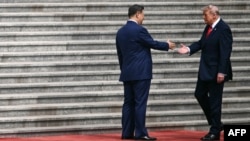
WASHINGTON -- The Trump-Xi summit offered fresh clues about how Beijing is positioning itself on Iran amid growing tensions over sanctions, regional security, and the future of energy flows through the Strait of Hormuz.
While US President Donald Trump said both sides agreed Iran should never obtain a nuclear weapon and supported reopening the Strait of Hormuz, analysts noted that China avoided making concrete public commitments on sanctions enforcement, reducing Iranian oil purchases, or pressuring Tehran directly.
Instead, experts say, Beijing appears focused on protecting its strategic and economic interests while avoiding deeper entanglement in the conflict.
Support For Stability, Without Pressure
Publicly, China has committed itself to the broad principles of de-descalation, freedom of navigation, and opposition to Iranian nuclear weapons.
But analysts noted Beijing stopped short of endorsing tougher measures against Tehran.
Jason Brodsky, policy director at United Against Nuclear Iran, said the gap between China's rhetoric and actions remains significant.
"While readouts from the summit suggested China wants the Strait of Hormuz to be open and for there to be no tolling, China's ambassador is criticizing the US-Bahraini draft UN Security Council resolution demanding Iran reopen the Strait of Hormuz," Brodsky told RFE/RL on May 15.
"China also says it does not want the conflict to continue but is supplying Iran with dual-use components for its missile and drone program," he added.
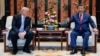
That dual-track approach -- supporting regional stability while maintaining ties with Tehran -- was a recurring theme in expert assessments following the summit.
At Washington's Council on Foreign Relations (CFR), analysts noted that Beijing emphasized keeping the strait open and ensuring oil continued flowing through the Persian Gulf but avoided publicly committing to sanctions enforcement or cuts in Iranian oil imports.
Zongyuan Zoe Liu, Maurice R. Greenberg senior fellow for China studies at CFR, told RFE/RL China's language remained "vague but useful with regard to de-escalation," adding Beijing wanted to show support for stability without assuming responsibility for enforcing it.
"China wanted to show that the message is clear: Keep the oil flowing, keep the strait open," Liu said. "But they haven't really made any commitment to police stability or provide stability."
Oil Flows And Strategic Interests
Much of China's posture appears tied to energy security.
China remains Iran's main oil customer and depends heavily on Gulf shipping routes. Analysts say Beijing's overriding objective is likely to preserve stable access to energy supplies while avoiding a direct confrontation with Washington.
That calculation was also reflected in comments from Brian Mast, a Republican from Florida and chairman of the US House Foreign Affairs Committee.
"They have a substantial relationship with Iran, have bought a significant amount of oil from Iran, and would love to continue to do so, or not have other Gulf oil bottled up from them," Mast told an audience at CFR.
At the same time, in response to an RFE/RL question, Mast argued that China has avoided fully backing Iran militarily.
"They are not coming to Iran's defense," he said. "Did China participate in targeting assistance for the Iranians? Absolutely, yes. Would I say that they dove into this? No, they didn't."
Mast said Beijing appears to be balancing competing strategic interests: whether prolonged instability benefits China by drawing US attention and resources deeper into the region, or whether restoring secure navigation and oil flows better serves Chinese economic priorities.
"They're absolutely trying to balance which one of those is better for them," he said.
The summit also fueled speculation about possible behind-the-scenes discussions involving sanctions relief.
Trump suggested sanctions on Chinese "teapot" refineries processing Iranian crude may have been discussed during talks with Xi. Analysts in Washington say such comments could indicate the US is exploring ways to encourage Chinese cooperation through incentives rather than relying solely on pressure.
Rush Doshi, former deputy senior director for China and Taiwan at the National Security Council during the Biden administration, said Trump's comments raised the possibility of a broader arrangement involving Chinese purchases of US crude oil and flexibility on sanctions enforcement for some refiners handling Iranian crude.
No agreement was publicly announced, however, and Beijing has not confirmed such discussions.
Questions Remain
Another issue hanging over the summit involved reports that Chinese companies may have considered providing weapons or additional support to Iran.
Chris McGuire, a senior fellow for China and emerging technologies at CFR, noted that concerns already exist regarding Chinese transfers of dual-use technologies supporting Iran's military capabilities.
Trump said Xi committed not to sell weapons to Iran, though analysts cautioned such assurances would likely be closely scrutinized over time.
Meanwhile, China has continued pushing back against US sanctions targeting firms linked to the Iranian oil trade.
Liu noted that before the summit, China's Commerce Ministry issued an injunction opposing US sanctions on several Chinese refineries accused of purchasing Iranian crude.
The move highlighted Beijing's broader resistance to what it views as extraterritorial sanctions enforcement and suggested China is unlikely to publicly align itself with Washington's pressure campaign against Tehran.

