



Abu Dhabi Says Nuclear Plant Hit by Drone Attack
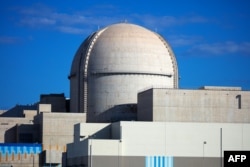
A fire has broken out at the Barakah nuclear power plant in the United Arab Emirates (UAE), according to the Abu Dhabi Media Authority on May 17.
The fire began after a drone attack on the Barakah nuclear power plant in the Al-Dhafra region. No deaths or injuries were reported.
The UAE news agency said that the fire broke out in an electrical generator outside the perimeter of the power plant and did not negatively impact the safety of the site.
The International Atomic Energy Agency (IAEA) responded to the attack with a statement condemning "military activity that threatens nuclear safety is unacceptable."
The IAEA said that it had been assured by the UAE that radiational levels at Barakah remain normal and that emergency diesel generators are currently providing power to the power plants third unit.
"The IAEA is following the situation closely and is in constant contact with the UAE authorities, ready to provide assistance if needed," the agency said on X.
IAEA Director-General Rafael Grossi "expresses grave concern about the incident and says military activity that threatens nuclear safety is unacceptable," the agency continued. "The DG reiterates call for maximum military restraint near any NPP to avoid the danger of a nuclear accident."
Following the launch of US-Israeli strikes on Iran on February 28, the UAE became the biggest target of Tehran's retaliatory attacks.
FIFA Official Says Iranian Team Welcome At World Cup
A senior official of FIFA said on May 17 after talks with Iranian soccer federation officials in Istanbul that it is looking forward to welcoming Iran's team to the World Cup, which kicks off in Canada, Mexico, and the United States next month.
Mattias Grafstrom, FIFA's secretary-general and second in command after President Gianni Infantino, described the meeting held late on May 16 in Turkey as "excellent and constructive," according to Reuters.
"I think we're working closely together and looking very much forward to welcoming them to the World Cup," Grafstrom said.
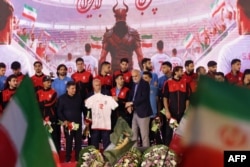
Iran's participation in the world's biggest soccer event has been in question ever since the United States and Israel launched strikes on Iran on February 28, sparking a regional conflict.
Tehran had sought to have Iran's matches moved to Mexico, but Infantino has so far insisted that all games must be played at the originally scheduled venues.
The president of the Iranian Football Federation, Mehdi Taj, described the meeting with FIFA as "positive and constructive" but cautioned earlier this week that no visas had yet been issued for Iran's team members, who are scheduled to play all three of their group games in the United States.
Taj himself was refused entry to Canada for the FIFA Congress in Vancouver earlier in May as Canada has listed Iran's Islamic Revolutionary Guards Corps (IRGC) as a terrorist organisation and indicated Taj had alleged ties with the organization.
The Iranian team will travel to Turkey on May 18 for training camp before heading to the United States. Their first game is against New Zealand in Los Angeles on June 15.
Iran's Top Negotiator Says World On 'Cusp Of New Order' As Trump Reiterates Warning
Mohammad Baqir Qalibaf, Iran's parliamentary speaker and top negotiator in talks aimed at ending the war with the United States, said on May 16 that shifting geopolitics mean that the "the world stands at the cusp of a new order."
Citing comments by Chinese President Xi Jinping, who hosted US President Donald Trump this week for a closely watched summit, Qalibaf wrote on X: "As President Xi said 'The transformation unseen in a century is accelerating across the globe.'"
"I emphasize that the Iranian nation’s 70-day resistance has accelerated this transformation," Qalibaf said, adding: "The future belongs to the Global South."
Trump, meanwhile, reiterated his warning to Iran to "make a deal" in ending the war and reopening the Strait of Hormuz, a crucial waterway that Tehran has effectively closed since US-Israeli strikes began on February 28.
"I have no idea" whether Iran will sign an agreement, Trump said in comments to French broadcaster BFMTV on May 16. "If they don't, they’re going to have a bad time. A very bad time. They had better make a deal."
Report: Black Market Thriving For Iran's 'Internet Pro'
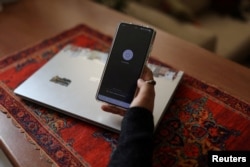
The transformation of free Internet access into a luxury and underground commodity has allowed Iran's distribution network to become rife with systemic corruption, a report has found.
The Khabar Online website reported that a black market has thrived since Iran's nationwide Internet shutdown -- almost at 80 days as of May 17 -- began.
Rather than a total blackout, authorities have maintained an elaborate whitelisting system of selectively granting connectivity to favored institutions, companies, and individuals while leaving the rest of the population cut off.
That system has been formalized further through a paid scheme called Internet Pro that allows business owners and academics to purchase access at pre-shutdown levels, a development critics have quickly labeled a form of tiered or class-based Internet.
According to the report, which was published on May 16, an informal network of brokers has been formed who, in exchange for millions of dollars, register applicants as employees of companies or members of guilds in order to gain access to the Internet.
These brokers exploit regulatory loopholes to register applicants' names on company lists.
Amnesty International has criticized Iranian authorities for imposing what it calls "digital darkness," describing access to the Internet as "a basic human right and indispensable in times of conflict."
US Lets Russian Oil Waiver Linked To Iran War Expire, Reimposing Sanctions
WASHINGTON -- The Trump administration has allowed a controversial waiver on sanctions targeting Russian seaborne oil to expire, reimposing restrictions that had temporarily enabled countries such as India to continue purchasing Russian crude despite Western efforts to curb Moscow's wartime revenues.
The move, which took effect on May 16 after the Treasury Department declined to renew General License 134B, highlights the increasingly difficult balance Washington faces between tightening pressure on the Kremlin and preventing further disruption to global energy markets already rattled by the Iran conflict and instability around the Strait of Hormuz.
The waiver, first introduced in March and extended in April, permitted transactions involving certain Russian oil cargoes that had already been loaded onto tankers before sanctions deadlines took effect.
Administration officials defended the measure as a temporary safeguard aimed at preventing a deeper global energy shock as fighting in the Middle East pushed oil prices higher and threatened key shipping routes.
To read the full report, click here.
We are now closing the live blog for the day. We'll be back at 7:30 a.m. Central European time to cover the latest events across the Middle East.
Massive US Aircraft Carrier Returns Home After Middle East Deployment
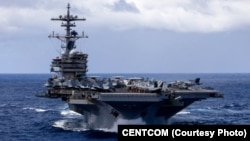
A US aircraft carrier that was deployed to the Middle East before the outbreak of war in Iran has returned to the US after a 326-day mission, the Pentagon said on May 16.
Defense chief Pete Hegseth was in Norfolk, Virginia, to greet the return of the USS Gerald R. Ford, the largest aircraft carrier in the world, the US military said.
It was the longest deployment for a US carrier strike group since the Vietnam War.
The carrier was sent to the Middle East to participate in combat operations against Iran after it took part in US operations in the Caribbean, where US forces have carried out strikes on alleged drug-smuggling boats, intercepted tankers, and captured Venezuelan leader Nicolas Maduro.
Iran Soccer Team Set To Travel To Turkey For World Cup Preparations
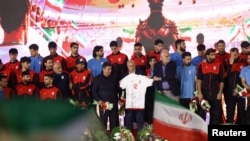
Iran's soccer team is scheduled to travel to Antalya, Turkey, on May 18 to begin its training camp, compete in friendlies, and to finalize formalities ahead of its planned journey to the US for the 2026 World Cup.
A squad of 30 players is traveling for the training camp, but the number will be reduced to a maximum of 26 for the World Cup.
Iran is looking to play two friendlies -- exhibition matches -- in Antalya. A match against Gambia is set for May 29.
Visa formalities will be one of the challenges faced by the Iranian squad. Tehran and Washington cut diplomatic relations in 1980.
"No visas have been issued yet," Mehdi Taj, the Iranian football federation head, told Iranian media on May 14.
The US-Israeli war with Iran has led to uncertainty around the team's participation in the World Cup. FIFA President Gianni Infantino said at the soccer governing body's annual congress in Vancouver last month that: "of course, Iran will play in the United States of America."
Iran's Taj was refused entry into Canada for the conference because of his links to the Iran's Islamic Revolutionary Guards Corps (IRGC).
Iran had requested that its matches scheduled for US sites be moved to Mexico, which is co-hosting the event along with the US and Canada. The request was denied.
The squad is scheduled to begin its World Cup play against New Zealand in Los Angeles on June 15 June, then face Belgium on June 21, also in Los Angeles, and then Egypt in Seattle on June 26.
Iran Plans To Reopen Its Stock Market After Wartime Suspension
Iran plans to reopen its stock market on May 19 after being suspended during the active phase war with the US and Israel, Iran's IRNA news agency reported, cited a senior official.
"The suspension of stock market activities from the start of the war was aimed at protecting shareholders' assets, preventing panic-driven trading and allowing for more transparent pricing conditions," Hamid Yari of Iran's Securities and Exchange Organization said on May 16.
"Now, with the reopening of the stock market, we will see the full resumption of all capital market sectors," he added.
Iranian Authorities Report 30 Executions Since Start of the War
Iranian authorities reported that 30 people have been executed on political grounds since the beginning of the country's conflict with the United States and Israel on February 28.
The report released on May 16 by Iran's judicial system said that those executed were found guilty of “espionage” and “terrorism” in cases related to large-scale anti-government protests that took place across the country earlier in the year.
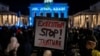
According to the report, 36 more people were sentenced to long prison terms, property belonging to 400 journalists was confiscated, and the bank accounts of dozens of bloggers and activists were frozen.
On May 14, Iran Human Rights (IHRNGO) said that hard-line rulers in Tehran have executed at least 14 participants in the protests in recent weeks, while six more were hanged after being charged with spying for Israel.
Last month, UN Human Rights Chief Volker Turk called on Iran to "establish a moratorium on the use of capital punishment" and release prisoners "arbitrarily detained."
"I am appalled that -- on top of the already severe impacts of the conflict -- the rights of the Iranian people continue to be stripped from them by the authorities, in harsh and brutal ways," he said.
Iran is one of the world's biggest executioners, hanging hundreds of people per year, many for drug-related offenses and homicide.
Two of the latest executions came on May 13 when Ehsan Afrashteh, a cybersecurity and network specialist, was hanged on charges of espionage for Israel, followed hours later by the execution of Mohammad Abbasi, who took part in mass protests in January, on charges of killing a security officer.