


Rights Groups Warn About Danger To Writers, Political Prisoners In Iran
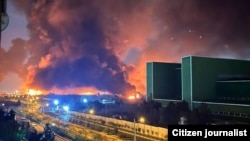
The American and Sydney PEN societies issued a joint statement expressing concern about the safety of writers, journalists, and other political prisoners in Iran following the escalation of military clashes and reports of air strikes near some prisons.
The two organizations -- which advocate for the right to free speech -- said on March 6 that reports of air strikes near detention centers and disruptions in communications had raised concerns about the conditions of detainees, many of whom were imprisoned simply for exercising their right to freedom of expression.
The PEN societies have expressed particular concern about the situation at Evin Prison in Tehran, saying that prisoners in Ward 209, which is run by the Intelligence Ministry, have been transferred to an unknown location. The possibility of political prisoners in Ward 7 being transferred has also been raised. Among those transferred is the name of Ali Asadollahi, a writer and translator who was arrested on February 25.
The statement also raised concerns about the conditions of prisoners in Tehran Greater Prison (Fashafoyeh) and Zanjan Prison, where Nobel Peace Prize laureate Narges Mohammadi is being held.
The American and Sydney PEN societies called on Iranian authorities to guarantee the security of all prisoners and to release those imprisoned solely for peacefully exercising their right to freedom of expression.
IRGC Announces Attack On Oil Tanker In Persian Gulf
Iran's Islamic Revolutionary Guards Corps (IRGC) announced on March 7 that it had attacked a Maltese-flagged oil tanker using an "explosive drone."
A tanker with the trade name Prima was the target of this attack, which took place near the Strait of Hormuz.
No information has yet been released on the extent of the damage to the vessel.
The IRGC-affiliated Tasnim News Agency wrote that the Prima ignored "repeated warnings" from the IRGC Navy about "prohibition of passage through the Strait of Hormuz."
In response to the joint US-Israeli attacks on Iranian territory, the IRGC announced it would close the Strait of Hormuz in the Persian Gulf and would not allow any oil tanker to pass through.
What Does War In Iran Mean For China?
China buys nearly 90 percent of Iranian oil and is a close partner of Tehran. But what happens now as war upends the Middle East and chokes off the Strait of Hormuz, a key global oil route?

Saudi Arabia Intercepts Ballistic Missile, Warns Iran Of 'Miscalculation'
Saudi Arabia said on March 7 that it intercepted two ballistic missiles fired toward an air base hosting US forces.
The Saudi Defense Ministry said in a post on X that "two ballistic missiles fired toward Prince Sultan Air Base, southeast of Riyadh, was intercepted and destroyed."
In a separate incident, the state-run Saudi Press Agency cited a Defense Ministry spokesman saying that Saudi air defenses also thwarted a drone attack on a major oil field near the United Arab Emirates border.
According to the agency, "an attempt to attack the Shaybah oil field was thwarted after six drones were intercepted and destroyed." The Saudi Defense Ministry said the drones were shot down in the Empty Quarter, a vast desert region in the south of the country.
Saudi Arabia, the world's largest oil exporter, reported earlier this week that multiple drone attacks targeting the Ras Tanura oil refinery in the eastern part of the country.
Authorities in neighboring Bahrain also urged residents on March 7 to seek shelter as regional tensions intensified.
The escalating conflict has also rattled energy markets. Global oil prices surged, with Brent crude rising 8.5 percent in a single day to $92.69 a barrel and climbing nearly 30 percent over the past week.
Meanwhile, Saudi Defense Minister Khalid bin Salman warned Iran against what he called further "miscalculations" following the missile and drone attacks.
After meeting Pakistan's army chief, bin Salman said in a post on X on March 7 that the two sides had discussed "Iran’s attacks on Saudi Arabia and the necessary measures to stop them."
Saudi Arabia and Pakistan signed a strategic defense agreement in September 2025 under which an attack on one country would be treated as an attack on both, according to Saudi officials.
The Saudi defense minister added that such actions threaten regional security and stability, expressing hope that Iran would "show wisdom and avoid miscalculations."
With Top Brass Dead, Iran Deploys Decentralized 'Mosaic' Strategy To Boost Defenses
Iran's powerful Islamic Revolutionary Guards Corps (IRGC) has decentralized its command-and-control structure, handing junior ranks more power to respond to the massive US-Israeli aerial bombardment of the Islamic republic.
The joint air campaign that began on February 28 has killed numerous senior military and political leaders, including IRGC chief Mohammad Pakpour and Supreme Leader Ayatollah Ali Khamenei, who had the final say on all matters of the state.
With its leadership decimated, Iran has activated a so-called mosaic defensive strategy, which is designed to empower local IRGC commanders during wartime. While boosting the resilience of Iran's armed forces, the strategy also raises the risks of miscalculation, experts say.
To read the full report, click here.
Azerbaijan Accuses Iran Of Plotting Attack On Major Pipeline, Jewish Sites
Azerbaijan said it uncovered an Iranian plot to sabotage several high-profile targets, including a major oil pipeline that carries crude from the Caspian Sea to Turkey and onward to global markets.
Azerbaijani authorities said the plan was organized by operatives linked to Iran's Islamic Revolutionary Guards Corps and described the alleged scheme as a series of "terrorist" attacks aimed at critical infrastructure and Jewish sites across the South Caucasus country of 10 million.
According to a statement from Azerbaijan's State Security Service, which was cited by the state news agency Azertag late on March 6, the intended targets included the Baku-Tbilisi-Ceyhan pipeline, the Israeli Embassy in Azerbaijan, an Ashkenazi synagogue, and a prominent member of the country's Mountain Jewish community.
To read the full report, click here.
Israeli NGO Head Ksenia Svetlova: Iran Still 'Firing Like Crazy'
TEL AVIV -- Israel has made an impressive start to military operations against Iran, but may be not much closer to its goals than a week ago, former Knesset member Ksenia Svetlova told RFE/RL in an interview at her home in Tel Aviv on March 6.

Svetlova, who is now executive director of an NGO called ROPES (Regional Organization for Peace, Economics, and Security), said there were few examples of "regimes that fall just as a result of air strikes" and was skeptical of the idea that Iraqi Kurdish militia would want to get involved in the fight.
To read the full interview, click here.
After A Week Of War, Israel Sees Progress But Long Road Ahead
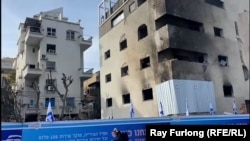
TEL AVIV -- Hidden away on a small street in a central district of town, the ruins of war come as something of a surprise. On nearby streets, hipsters fill outdoor cafes, Lime scooters clutter the sidewalks, and children play in parks. But turn a corner and you'll see blackened walls, smashed windows, and rubble-strewn cars.
This is almost the only site in Tel Aviv that bears the scars of war, following an Iranian strike on the first night of the conflict. As such, it bears witness to the destructive power of Tehran's ballistic missiles. But the lack of other such sites underlines Israel's ability to shoot them down.
It's an aspect of the war so far that is having a profound impact on how Israel approaches what comes next.
For the full report from Tel Aviv by RFE/RL Senior International Correspondent Ray Furlong, click here.
Israel Accuses Iran Of Using Cluster Bombs
The Israeli military announced that Iran has used cluster munitions several times since the start of the war.
Israeli Army spokesman Nadav Shoshani said in a press conference on March 6 that Iran has used this type of munitions "several times" and that if these attacks target civilians, they could be considered a "war crime."
Videos released by AFP show a series of fiery projectiles landing over central Israel on the evening of March 5; the Israeli military says the images are from cluster bombs.
Cluster munitions explode in the air, scattering large numbers of small bombs. Some of these bombs also fail to function and can cause casualties, especially among children, long after they have been dropped.
Neither Iran nor Israel is party to the 2008 Convention on the Prohibition of Cluster Munitions, which prohibits the use, production, transfer and stockpiling of these weapons.
Both countries have been accused of using cluster munitions in the past. Amnesty International said Iran used cluster munitions at least three times during the 12-day war with Israel in June 2025.
Israel Bombs Tehran With 80 Fighter Jets
The Israeli Army announced that it continued its bombardment of Tehran, using 80 fighter jets on the morning of March 7.
In a statement released the night before the strikes, the Israeli Army announced its targets as "Iranian military sites, missile launch pads, and other targets in Tehran and central Iran."
Earlier, news had come from Iran that heavy air strikes were carried out on near the town of Ekbatan and Mehrabad Airport in Tehran, and that the municipality of District 16 in Naziabad was also targeted by an air strike.