


Iran Fires Missiles Toward Israel, Gulf States To Mark Supreme Leader Election
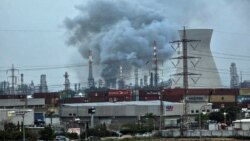
Iran said it fired off a series of missiles toward Israel to mark the election of Mojtaba Khamenei as the country's new supreme leader, according to state media, with additional firings launched toward US Arab allies in the Gulf.
"Iran fires first wave of missiles under the leadership of Ayatollah Seyyed Mojtaba Khamenei toward occupied territories," state broadcaster IRIB said on its Telegram channel on March 9.
The posting carried a photo showing a projectile with the words: "At Your Command, Sayyid Mojtaba."
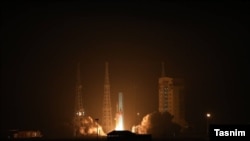
"Massive explosions heard in the center of the occupied territories," it said, although there was no immediate confirmation from Israel.
Iran's Assembly of Experts announced earlier that Khamenei had succeeded his father, Ali Khamenei, as the country's supreme leader. The elder Khamenei had been killed during the first day of US and Israeli air strikes on February 28.
As supreme leader, the 56-year-old Mojtaba Khamenei will have final say in all political and military matters and hold near-dictatorial powers.
Elsewhere, several explosions were heard on March 9 in the Qatari capital, Doha, according to AFP journalists.
The Saudi Defense Ministry, meanwhile, said it had intercepted Iranian drones headed to the massive Shaybah oilfield.
The Kuwaiti Defense Ministry on March 9 also said the country's air defenses were working to intercept a new missile and drone attack on the small Gulf nation.
To read the full story, click here.
US Orders Nonessential Diplomatic Personnel To Leave Saudi Arabia
The US State Department late on March 8 said it ordered nonessential diplomatic personnel and families to leave Saudi Arabia due to safety risks in the face of continued Iranian retaliatory strikes in the Gulf region.
The US Embassy in Riyadh approved voluntary departures for personnel on March 3, the day the facility was struck by Iranian drones, causing a fire that damaged some buildings at the site.
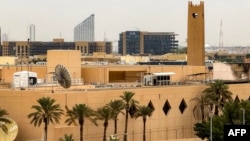
The State Department said in the latest advisory that it had "ordered nonemergency US government employees and US government employee family members to leave Saudi Arabia due to safety risks."
Following the launch of US and Israeli air strikes against Iran on February 28, Tehran has been firing back at Gulf Arab allies of the United States that host US military assets, often hitting airports, diplomatic sites, and commercial buildings.
As the State Department announced the advisory, the Saudi Defense Ministry separately said it intercepted a drone heading to the Shaybah oil field near the border with the United Arab Emirates.
Earlier in the day, the Saudi Civil Defense agency said two people were killed when an Iranian missile struck a residential building in the al-Kharj Governorate southeast of Riyadh.
Trump Says Spike In Oil Prices 'Small Price To Pay' To Remove Iran's Nuclear Threat
US President Donald Trump on March 8 said the surge in oil prices as a result of the war on Iran is "small price to pay" for removing the threat of Tehran's nuclear program.
"Short term oil prices, which will drop rapidly when the destruction of the Iran nuclear threat is over, is a very small price to pay for U.S.A., and World, Safety and Peace. ONLY FOOLS WOULD THINK DIFFERENTLY!" he wrote on his Truth Social platform.

The spike in oil prices threaten to raise the cost of living for throughout the world. A rise in inflationary pressures in the United States could be a political liability for Trump, who had criticized rising prices during the term of predecessor Joe Biden.
The benchmark Brent crude price jumped 17 percent to $108.73 a barrel early on March 9, after already surging 28 percent last week. US crude rose 19 percent to $108.33 a barrel.
Traffic in the Strait of Hormuz -- through which 20 percent of global crude and gas passes -- has been nearly halted since the war began on February 28. Shipping insurance rates have soared, although Trump has vowed to provide assistance to the industry.
"The global economy remains dependent on the concentrated flow of Mideast oil and natural gas through the Strait of Hormuz," Bruce Kasman, chief economist at JPMorgan, was quoted by Reuters as saying.
"The near-term scenario is a near-term spike toward $120 a barrel followed by moderation as the conflict soon subsides. But absent a clear and decisive political resolution, Brent crude oil prices are expected to settle at an elevated $80 barrel through mid-year," he added.
Mojtaba Khamenei Follows In Father's Footsteps As Iran's New Supreme Leader
The March 8 election of Mojtaba Khamenei as the new leader by Iran's Assembly of Experts following the killing of Ayatollah Ali Khamenei in a US-Israeli attack marks the first time the son of a supreme leader is succeeding his father in the Islamic republic.
Mojtaba Khamenei has rarely appeared in public and has never addressed an audience beyond seminary classrooms, yet he is widely seen as a shadowy behind-the-scenes force with influence over those closest to the supreme leader's office and Iran's security institutions.
But who is Mojtaba Khamenei, and how did his name become one of the most controversial options for his father's succession?
To read the full story, click here.
Despite Trump Warning, Iran Names Khamenei's Son As New Supreme Leader
Iran's Islamic republic leaders have named hard-liner Mojtaba Khamenei to replace his father, the late Ayatollah Ali Khamenei, as supreme leader in a decision that comes after President Donald Trump warned anyone chosen won't "last long" without US approval.
Iran's Assembly of Experts, responsible for electing the new ruler, said on March 8 that it has "designated and introduced Ayatollah Seyyed Mojtaba Hosseini Khamenei as the third Supreme Leader of the sacred system of the Islamic Republic of Iran."
As supreme leader, Mojtaba Khamenei will have final say in all matters of state and hold near-dictatorial matters.
Ayatollah Ali Khamenei was killed in a US-Israeli air strike on February 28, the first day of the war that has spread throughout the region over the past week.
Trump had earlier said that Mojtaba Khamenei would be an "unacceptable choice."
The US president, who had previously called on Tehran to stop its resistance and surrender, had also told the American TV network ABC that without US approval, the new Iranian leader "is not going to last long."
In announcing the decision, Iran's Assembly of Experts appeared defiant, saying it made the choice "despite the acute war situation and direct threats from enemies."
To read the full story, click here.
Pezeshkian Denies In Call With Aliyev Iran Responsibility for Nakhchivan Drone Strike
Iranian President Masud Pezeshkian denied in a call with Azerbaijan's leader that his country was responsible for a drone attack that struck a school and airport in Azerbaijan's Nakhchivan autonomous region on March 5.
A statement on March 8 by the office of Azerbaijan's presidential office reported that Pezeshkian said "the incident involving air strike on Nakhchivan had no connection with Iran."
It added that the Iranian president asserted that the incident, which injured two people, would be investigated.

Baku had earlier accused Iran of firing the drones, calling it an "act of terror" and vowing to respond.
Azerbaijani President Ilham Aliyev "underlined the importance" of carrying out an investigation on the incident and also "expressed his condolences over the death of numerous civilians in the recent events in Iran," the statement said.
The drone attack has heightened concerns in Azerbaijan -- which has close military, economic, and energy ties to Israel, Tehran's archenemy -- that it could become a target of the Islamic republic's expanding response to the massive US-Israeli air campaign launched on February 28.
Iran has retaliated by firing missiles and drones at US military and diplomatic facilities and striking key energy infrastructure in the Persian Gulf. Tehran's aim, experts say, is to expand the war and increase the cost of the conflict for Washington and its allies.
Much of the concern in Azerbaijan, an oil-rich country of around 10 million people, is centered around fears that Iran could target its energy infrastructure, including pipelines and production facilities.
Azerbaijan shares an around 700-kilometer border with Iran.
Iran has long been critical of Israel's presence in Azerbaijan. Tehran has accused Baku of cooperating with Israeli intelligence -- allegations Azerbaijan denies.
Seventh US Service Member Dies In The War, US Military Says
Israeli Opposition Leader Tells RFE/RL Iran's Oil 'Lifeline' Must Be Cut
- By Ray Furlong
TEL AVIV -- Yair Lapid, the leader of the opposition in Israel, says air strikes on Iranian oil fields --which have showered Tehran in black rain -- were needed to cut the "lifeline of the regime" in Iran.
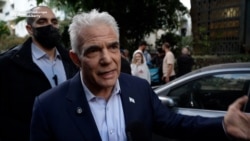

Speaking to RFE/RL at a downtown location hit on March 8 by falling debris from an intercepted Iranian missile, Lapid also indicated that Israel reserves the right to strike any new supreme leader who takes power following the death last weekend of Ayatollah Ali Khamenei.
"It depends who is the leader," he said. "This is our way of protecting ourselves from death and destruction. Because, you know, this is what this regime is."
To read the full report, click here.
2 Killed, 12 Injured By 'Projectile' In Saudi Arabia
Two people were killed and 12 others injured in Saudi Arabia's Al-Kharj city after an unspecified "military projectile" hit a residential area, according to a statement by the Saudi Civil Defense published on March 8.
While the statement didn't specify the origin of the projectile, Al‑Kharj hosts a massive air base and has been targeted repeatedly by Iran over the past week as Tehran launched waves of retaliatory attacks on countries in the Gulf after the initial US–Israeli strikes on the country.
A day earlier, Iranian President Masud Pezeshkian said he wanted to "personally apologize to neighboring countries" hit by Tehran's missiles and drones. Shortly after, his statement was defiantly criticized by powerful national-security chief Ali Larijani and other Iranian officials.
Several of other Gulf states, including the United Arab Emirates, Qatar, Kuwait, and Bahrain, reported new attacks or interceptions of Iranian drones and missiles on March 7 and 8.
Israel Killed Iran's Senior Military Commander, Military Says
The Israel Defense Forces (IDF) said it eliminated a senior commander of the Islamic Revolutionary Guard Corps, Abolqassem Babaeian, in its March 7 strike on Tehran.
In a statement published on March 8, the IDF said Babaeian was newly appointed to head Iran's Supreme Leader's military office, after his predecessor was killed following Tel Aviv's initial air strikes.
The statement added that Babaeian was "responsible for coordinating between the Iranian terror regime's various force employment organizations to execute operations against the State of Israel and emergency operations. "
The report of his death follows a series of other senior figures in the Iranian leadership who were killed by US–Israeli air strikes during their war against Tehran, now in its ninth day.