




Netanyahu Reportedly Wants To Talk With Zelenskyy For Expertise On Iran Drones
Israeli Prime Minister Benjamin Netanyahu has requested talks with Ukrainian President Volodymyr Zelensky as the Israeli side seeks Kyiv's expertise in dealing with incoming drones, the Ynet news site in Israel reported on March 14.
Ukraine has developed defenses against Iran-designed Shahed drones during its battle against Russia's full-scale invasion of February 2022.
Ynet reported that Ukraine's ambassador to Israel, Yevhen Kornychuk, confirmed that a request had been made that he hoped the talks would take place at the beginning of next week.

Iran's envoy to Ukraine, Shahriar Amouzegar, meanwhile, dismissed reports that Kyiv has offered help to the United States and its Gulf allies.
"As for the actions Ukraine is taking in the Middle East against drones, we essentially consider them nothing more than a joke and a showy gesture," Amouzegar told AFP in an interview.
"Unfortunately, Ukraine has now effectively entered a stage of direct confrontation with us; that is, it has placed itself alongside our enemies," he added.
Ukraine stripped the Iranian ambassador of his accreditation in 2022 and scaled down Iran's mission in response to Tehran's supply of Shahed drones to Moscow for use against Ukraine.
Trump Urges Nations To 'Take Care' Of Strait Of Hormuz
President Donald Trump reiterated his call for other governments to assist in securing the Strait of Hormuz and said the United States will coordinate with them as the US-Israeli military campaign enters its third week.
"The Countries of the World that receive Oil through the Hormuz Strait must take care of that passage, and we will help -- A LOT!" Trump wrote on Truth Social on March 14.
"The US will also coordinate with those Countries so that everything goes quickly, smoothly, and well. This should have always been a team effort, and now it will be -- It will bring the World together toward Harmony, Security, and Everlasting Peace!"
Deadly Strike Hits Factory In Isfahan, Iranian Media Reports
At least 15 people were killed in a missile strike on a factory in Iran's central city of Isfahan on March 14, the Fars news agency, which is close to the Islamic Revolutionary Guard Corps (IRGC), reported.
The agency blamed the attack on the United States and Israel and said the factory produced heaters and refrigerators. It added that workers were inside the facility during the strike.
The US and Israeli militaries did not immediately comment on the incident.
Shortly after, both Israel's Defense Forces (IDF) and Iranian state media reported that new missile attacks were launched from Iran toward Israeli territory.
"The public is asked to act responsibly and follow the instructions — they save lives," the IDF said in a statement published on Telegram.
Read more here.
Iranian Foreign Minister Claims Kharg Strike Launched From UAE
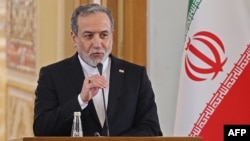
Iranian Foreign Minister Abbas Araqchi has claimed that the US strike on Iran’s Kharg Island was launched from the United Arab Emirates, saying missiles were fired from “Ras al-Khaimah and an area near Dubai,” according to Persian-language media reports.
Araqchi provided no evidence for the allegation and said Tehran would respond to the attack while also seeking to avoid densely populated areas.
The UAE rejected Tehran's claim that the assault was launched from its territory.
"The UAE has the right to self-defense in the face of this terrorist aggression imposed upon it, yet it continues to prioritize reason and logic, maintaining restraint and seeking an exit for Iran and the region," presidential adviser Anwar Gargash wrote on X.
Trump Says 'Many Countries' May Deploy Warships To Protect Strait Of Hormuz

US President Donald Trump says that countries affected by Iran’s attempt to close the Strait of Hormuz may send warships to help keep the key shipping route open alongside American forces.
“Many Countries… will be sending War Ships, in conjunction with the United States… to keep the Strait open and safe,” he wrote on the Truth Social platform on March 14.
Trump claimed the United States had “already destroyed 100% of Iran’s Military capability,” and that the threat posed by Iran had been "totally decapitated." However, he warned Iran could still threaten shipping with drones, mines, or missiles.
He added that the United States would continue striking Iranian coastal targets and vessels, saying Washington would ensure the strait is “OPEN, SAFE, and FREE.”
Inside Israel’s largest hospital, doctors work two stories underground as the war with Iran continues. At the Sheba Medical Center, much of the facility has moved below ground to keep operating despite the threat of Iranian missile strikes. (Video report by RFE/RL's Ray Furlong.)


Iranian Lawmaker Warns Ukraine Is Becoming 'Legitimate Target'
Iranian lawmaker Ebrahim Azizi, who heads the Iranian parliament’s National Security Commission, warned on X that Ukraine is becoming a “legitimate target” for providing “drone support to the Israeli regime.”
Iran itself has been supplying drones to Russia that have been widely used in attacks on Ukrainian cities and energy infrastructure since the start of Moscow’s full-scale invasion in 2022.
Israeli Defense Minister Says Iran Campaign Will Continue 'As Long As Necessary'
Israeli Defense Minister Israel Katz said the US–Israeli military campaign against Iran was entering a decisive phase and would continue “as long as necessary” to achieve its objectives.
Speaking at briefing alongside senior military officials on March 14, Katz said operations were hitting "strategic targets" in Tehran and across Tehran, and were intended to weaken the regime and create conditions for the Iranian public to challenge it.
Katz said the offensive would proceed without a set timetable until Israel and its allies achieve victory in the campaign.
He added that strikes were being conducted systematically against key regime institutions and security forces while Israel monitored developments inside Iran.
Iran Says 56 Cultural Sites Damaged In US-Israeli Attacks
Iran’s Ministry of Cultural Heritage said on March 14 that at least 56 museums, historic buildings, and cultural sites across the country have suffered serious damage in the two weeks since the start of joint US-Israeli attacks.
The ministry said the highest number of damaged sites was recorded in Tehran, with 19, and Kurdistan Province, with 12.
Among the sites listed on the Iranian government’s official account on the social media platform X were Asif Mansion, Salar Saeed Mansion, and Khosroabad Mansion in the Kurdish city of Sanandaj, historic 19th-century Qajar-era residences.
Photographs circulating earlier also showed damage to Golestan Palace in Tehran, a UNESCO-listed royal complex, and Ali Qapu Palace in Isfahan, a landmark Safavid-era palace overlooking Naqsh-e Jahan Square.
In Israel's Medical Bunkers, Doctors Ready To Work 'Indefinitely'
- By Ray Furlong

TEL AVIV – After several twists down a concrete stairwell, a buzzing underground world is revealed. Ambulances unloading patients on gurneys, rows of field-hospital tents, workmen fixing overhead cables, and medical personnel in an array of uniforms.
This is the Sheba Medical Center, the largest hospital in the Middle East, with 11,000 employees, 1,700 doctors, and over 3,000 nurses. And most of it is functioning underground to stay out of reach of Iranian ballistic missiles.
“This place is not a field hospital. This is the hospital. It is just subterranean,” Yardena Koppel, a pediatric doctor, told RFE/RL.
Rattling off a list of departments that are, she said, fully functioning, Koppel added: “Each area is well-oiled and functions within itself. It's something really incredible, something I've never seen before.”
The hospital has moved some operations below ground in Israel’s previous conflicts, but never on such a scale. This location, two stories below ground, is just one of five containing hundreds of patients -- while some sections of the hospital are deemed well-protected enough to keep working in their usual places.
Read more here.