



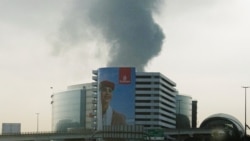
Drone Incident Ignites Fire At Massive Dubai Airport
A drone-related incident sparked a fire near Dubai's international airport, the second-busiest airport in the world prior to the outbreak of the Middle East war.
"Authorities are currently responding to a fire resulting from a drone-related incident in the vicinity of Dubai International Airport," the Dubai Media Office posted on X on March 16.
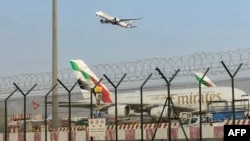
"Civil Defense teams continue their efforts to bring the fire under control. No injuries have been reported so far," it added
"All necessary measures are being taken to ensure everyone's safety," it said, adding that "the drone crash "resulted in damage to one of the fuel tanks."
Iran has fired some 1,800 missiles and drones at the United Arab Emirates, more than any other country targeted by Tehran in retaliation for the US-Israeli air strikes that began on February 28.
The crisis has devastated the emirates' tourist industry and disrupted its crucial oil-sector operations.
Iran claimed that the recent US air strike on Kharg Island originated at an American base in the UAE, which denied the accusation.
Iran Women’s Soccer Captain Becomes Latest Player To Drop Asylum Bid In Australia, Say State Media
The Iranian women’s soccer captain, Zahra Ghanbari, has withdrawn her asylum request in Australia and will return to Iran, state media said, becoming the fifth member of the national team delegation to reverse a bid for sanctuary.
Seven players and staff initially sought refuge after being branded “traitors” at home for not singing the Islamic republic's national anthem before a game during the Women’s Asian Cup.
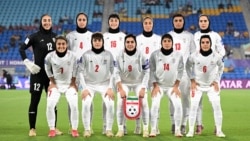


Iranian authorities hailed Ghanbari’s decision, announced on March 15, as patriotic, but opposition media and others say players were pressured to change course through threats against their families.
Australian officials said the team members were given opportunities to pursue asylum but faced "incredibly difficult decisions."
With several already leaving for Malaysia en route to Iran, only two members of the delegation are now expected to remain in Australia.
With reporting by AFP
Interview: Iran's Use Of Chinese Doctrine And Tech Under The Spotlight
- By Ray Furlong

TEL AVIV -- The Iran war offers huge lessons for the effectiveness of Chinese military doctrine and hardware, both used by the Iranian military, according to Eran Ortal, a reserve Brigadier General in the Israel Defense Forces (IDF).
Speaking to RFE/RL from a location near Tel Aviv late on March 14, Ortal said Iranian tactics around the Strait of Hormuz were very similar to those that China would be expected to employ in a future conflict around Taiwan.
The US and Chinese military would be “taking notes” as the current conflict played out, he added.
Ortal was previously commander of the IDF’s Dado center, a military studies unit at the General Staff. He is now head of the military program at the Begin-Sadat center (BESA) at Bar-Ilan University and a visiting scholar at the American Foreign Policy Council (AFPC).
RFE/RL: Iran has blocked the Strait of Hormuz. Is there a military solution, and if so, what does it look like?
Eran Ortal: Well, that's the nature of asymmetric warfare. You can take out the Iranian fleet and the entire Iranian Navy, and the Fifth Fleet has done that. But the asymmetric capabilities, the speed boats, the unmanned boats, the mines and the coastal missiles will still be there. And this is a threat you cannot just totally remove. It's just like we have the anti-tank missile problem in Lebanon. You can take some of them out, you can have countermeasures, but they will always be able to snipe away.
You can protect the vessels going through the Hormuz Straits and you can win the war. That's basically the tactic and the strategy to maneuver around this problem. And I guess this is the American strategy.
Read more here.
Trump Warns Of 'Very Bad' Future For NATO If Allies Fail To Help US In Strait
US President Donald Trump warned that NATO faces a "very bad" future if member states fail to help open the critical Strait of Hormuz, the oil transport lane that has been effectively closed by Iran amid the war with the United States and Israel.
In an interview published on March 16 by The Financial Times, Trump said that just like the United States has helped Ukraine in the war with Russia, he expects Europe to help on the strait.
The disruptions to shipping in the strait has sent oil prices soaring around the world, raising the cost of living for hundreds of millions of people.
"If there's no response or if it's a negative response, I think it will be very bad for the future of NATO," Trump said in the brief interview.
Asked what specific help he was seeking, Trump told the FT he sought minesweepers as well as "people who are going to knock out some bad actors that are along the shore [of Iran]."
"I think China should help too because China gets 90 percent of its oil from the Straits," Trump told the newspaper.
Trump said he has spoken to seven countries about securing shipping in the strait, without identifying them. The Wall Street Journal reported that the US administration is close to announcing the coalition, although when it would begin escorting traffic is still to be determined.
The US president said that Israel is working with Washington on means to protect shipping in the strait.
Macron Tells Pezeshkian To Cease Attacks On Regional Countries
French President Emmanuel Macron told his Iranian counterpart to put an immediate end to "unacceptable" attacks against countries in the region, including Iraq, where a French soldier was killed last week in a drone strike.
Macron wrote on X on March 15 that he "recently" spoke with Iranian President Masud Pezeshkian and "asked him to immediately put an end to the unacceptable attacks that Iran is carrying out, whether directly or through proxy groups, including in Lebanon and Iraq, against countries in the region."
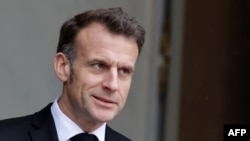
"I reminded him that France intervenes within a strictly defensive framework to protect its interests, its regional partners, and freedom of navigation, and that targeting our country is unacceptable," Macron added.
He said the "unchecked tensions" are "driving the entire region toward chaos."
Tehran has launched missiles and drones toward US Arab allies and Israel in retaliation for a massive US-Israeli air campaign against Iran that began on February 28.
On March 12, a French officer was killed and at least five soldiers were wounded in a drone attack in the Makhmour area of Iraq. It was not clear if the drones were launched by Iran or its proxy groups in Iraq.
German Foreign Minister Makes Clear: Berlin Will Not Participate In Escort Duty
Amid talk of a possible coalition of nations to protect shipping in the all-important Strait of Hormuz, German Foreign Minister Johann Wadephul on March 15 said his country does not plan to take part in such an international military operation. "Will we soon become an active part of this conflict? No," Wadephul told German media. Wadephul said Chancellor Friedrich Merz and Defense Minister Boris Pistorius have made Berlin's position clear. "We will not participate in this conflict," Wadephul said. US President Donald Trump had sought military assistance from other concerned nations to secure shipping through the strait, a vital for global oil transport. Shipping there has virtually ceased since the start of the US-Israeli air strikes on Iran beginning February, driving up oil prices.
Iran Says More Than 500 People Detained In Connection With War
Iranian security officials say they have detained more than 500 people in connection with the war, including people who have provided photos and videos to outside news organizations.
Ahmad-Reza Radan, commander of the Iranian security forces, said about one-half of those detained were "significant cases," the state-run Fars news agency reported on March 15.
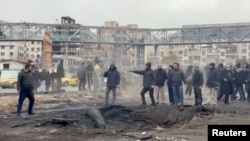
Radan said the detained include individuals who passed information to broadcaster Iran International -- which is run by Iranian exiles based outside the country -- and people who took photographs of locations hit during US-Israeli air strikes since February 28.
The Iranian judiciary has declared that photographs of sensitive facilities and damages may constitute a breach of security and that severe penalties may be imposed.
There is no way to confirm the number of those detained, whether they are still being held, or the condition of those taken into custody.
During mass antigovernment protests earlier this year, tens of thousands of people were arrested and thousands were killed a brutal crackdown.
US President Donald Trump warned the government not to kill or execute protesters prior to the February 28 US and Israeli air strikes on Iran and rights groups assailed the regime in Tehran for the brutality.
Kyiv Vows To Continue Attacking Russian Energy Infrastructure Amid Rising Oil Prices Impacted By Iran War
Ukraine would continue attacking Russian energy infrastructure, President Volodymyr Zelenskyy said, days after the United States moved to temporarily lift sanctions on Russian oil to stabilize global markets amid its military campaign against Iran.
Zelenskyy told CNN in an interview published on March 15 that the Russians "certainly have no intention of stopping the war," as he reiterated Kyiv's stance on sanctions against Russia.
"I believe that lifting sanctions on Russia will not help the world; it will only help Russia," Zelenskyy said. "In just these 14–15 days, they earned roughly $10 billion," he added.
Zelenskyy also said he spoke with French President Emmanuel Macron and others "about halting and confiscating Russian oil."
The interview was released a day after Ukrainian military hit the Afipsky oil refinery and the Kavkaz port in Russia's southern Krasnodar region in response to deadly strikes that killed six people across Ukraine.
With reporting by CNN.
Starmer Discusses Strait Of Hormuz With Trump, Carney
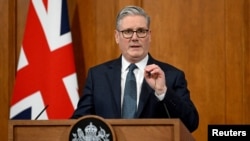
British Prime Minister Keir Starmer spoke with US President Donald Trump about the importance of reopening the Strait of Hormuz in order to stop disruptions to global shipping, a Downing Street spokesperson said on March 15.
Starmer also held a conversation with Canadian Prime Minister Mark Carney, during which they discussed how the ongoing closure of the strait is affecting international shipping. Leaders agreed to continue their discussions on the Middle East conflict during a meeting scheduled for tomorrow.
Pezeshkian, Macron Discuss Middle East In Phone Call, Iranian Media Says
Iranian President Masoud Pezeshkian discussed regional developments with French President Emmanuel Macron in a phone call, Tasnim, Iran's semiofficial news agency associated with the IranIslamic Revolutionary Guard Corps (IRGC), said on March 15.
There was no immediate comment from the French presidency.
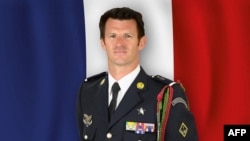
While France is not participating directly in the US-Israeli war effort, the country recently mourned the death of a soldier indirectly connected to the conflict in Iran.
On March 12, Macron confirmed that a drone strike killed the French soldier in Iraq's autonomous Kurdistan region while he was assisting Iraqi forces on antiterrorism missions. "The war in Iran cannot justify such attacks," he said.