




Kyiv has warned that a move by the United States to temporarily lift sanctions on Russian oil to stabilize the global energy markets amid its military campaign against Iran could add around $10 billion to the Kremlin's war chest to use against Ukraine.
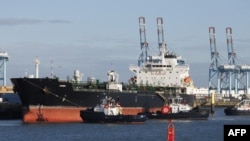
On March 13, US Treasury Secretary Scott Bessent announced a 30-day waiver for countries to buy sanctioned Russian oil and petroleum products that are currently stranded at sea.
The move allows Russian products loaded onto vessels by March 12 to be shipped within the next month and is aimed at boosting supply to keep market prices low amid what Bessent described as "threat and instability posed by the terrorist Iranian regime."
"This single easing by the US could provide Russia with around $10 billion for the war. It certainly does not help peace," Ukrainian President Volodymyr Zelenskyy said during a joint press conference on March 13 with French President Emmanuel Macron in Paris.

As oil prices climbed above $100 per barrel amid reports of attacks on ships in the Persian Gulf -- which handles around one-fifth of global oil transport -- and the closure of key oil terminals, the Kremlin welcomed the US decision.
Previously critical of US military activities in Iran, including the killing of longtime Supreme Leader Ayatollah Ali Khamenei, the Kremlin now says its own interests are "situationally aligned" with Washington's.
"The situation is fraught with the risk of a growing crisis in the global energy sector.... Without significant volumes of Russian oil, market stabilization is impossible," Kremlin spokesperson Dmitry Peskov told reporters on March 13.
Washington's European partners have also criticized the move: Chancellor Friedrich Merz said that Germany was not notified of the decision prior to its announcement; Macron said it was "in no way" justified.
"There is currently a problem with prices but not with supply. And in that respect, I would like to know what other factors led the US government to take this decision," Merz said at a press conference in Norway.

European Council President Antonio Costa also said the decision was "very concerning," warning it could affect European security and give Russia more resources to continue its war against Ukraine.
Will It Work?
A Ukrainian diplomatic source told RFE/RL that Kyiv believes the US decision will not help stabilize the market and will instead allow Russia to wage war for longer, noting that Moscow itself is helping Iran further destabilize the Middle East.
US officials confirmed to RFE/RL on March 6 that Russia was providing Iran with targeting information to attack US troops and military assets in the region, after US media suggested Moscow was playing a substantial part in the widening regional conflict.

The Ukrainian president's sanctions policy commissioner, Vladyslav Vlasiuk, also said that the temporary license issued by the United States may help Russia to deal with "significant pressure" on its budget but added it won't largely impact the situation.
"It is important to look at the bigger picture.... The first months of the year were difficult, energy revenues are declining and the budget deficit is rapidly increasing. Therefore, the temporary relaxation is unpleasant but not critical," Vlasiuk told RFE/RL.
"The key point is that the situation should not be prolonged," he added.

Energy-cargo tracking company Vortexa says around 7.3 million barrels of oil coming from Russia are in floating storage, while 148.6 million barrels are in vessels in transit.
"Since the start of March, Russian crude on the water has fallen by more than 20 [million barrels], equivalent to a drawdown rate of nearly 2 [million barrels per day]. That reflects stronger and faster placement of Russian barrels rather than weaker exports," Vortexa's chief economist David Wech wrote online on March 13.
"With Indian buyers hit hardest by the loss of nearby Gulf supply, Russian crude from western export ports has become significantly more attractive," he added.

